

2 Concepts in Magnetism
53
(a)
(b)
(c)
(d)
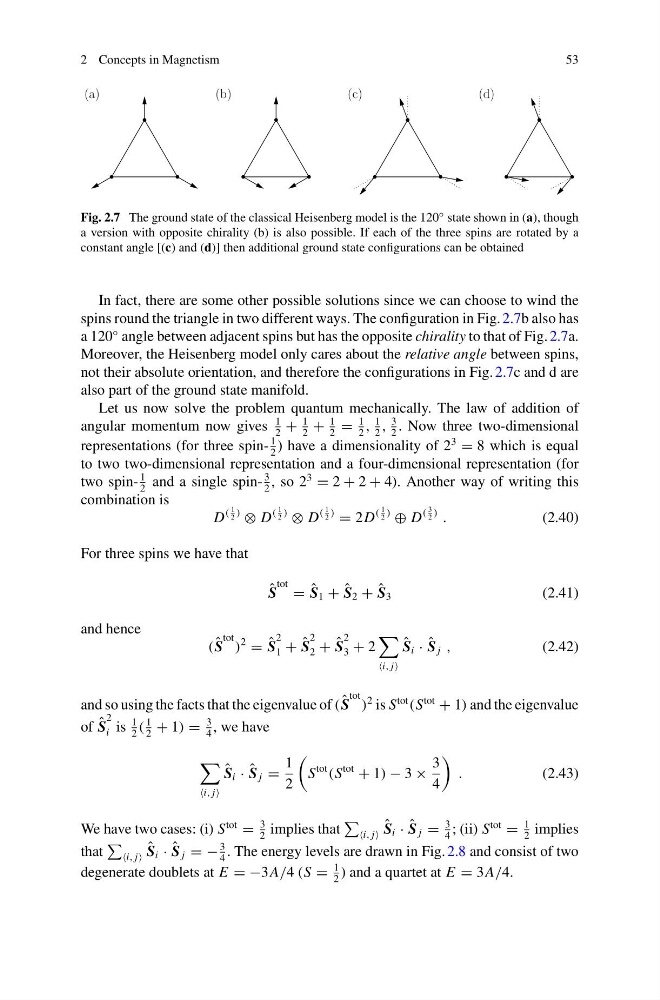
Fig. 2.7 The ground state of the classical Heisenberg model is the 120 ◦ state shown in (a), though
a version with opposite chirality (b) is also possible. If each of the three spins are rotated by a
constant angle [(c) and (d)] then additional ground state configurations can be obtained
In fact, there are some other possible solutions since we can choose to wind the
spins round the triangle in two different ways. The configuration in Fig. 2.7b also has
a 120
◦ angle between adjacent spins but has the opposite chirality to that of Fig. 2.7a.
Moreover, the Heisenberg model only cares about the relative angle between spins,
not their absolute orientation, and therefore the configurations in Fig. 2.7c and d are
also part of the ground state manifold.
Let us now solve the problem quantum mechanically. The law of addition of
angular momentum now gives
1
2
+
1
2
+
1
2
=
1
2
,
1
2
,
3
2
. Now three two-dimensional
representations (for three spin1
2
) have a dimensionality of 2
3
= 8 which is equal
to two two-dimensional representation and a four-dimensional representation (for
two spin1
2
and a single spin3
2
, so 2
3
= 2 + 2 + 4). Another way of writing this
combination is
D
(
1
2 )
⊗ D
(
1
2 )
⊗ D
(
1
2 )
= 2D
(
1
2 )
⊕ D
(
3
2 )
.
(2.40)
For three spins we have that
ˆ
S
tot = ˆ
S 1 + ˆ
S 2 + ˆ
S 3
(2.41)
and hence
( ˆ
S
tot )
2
= ˆ
S
2
1 + ˆ
S
2
2 + ˆ
S
2
3 + 2
j
ˆ
S i · ˆ
S j ,
(2.42)
and so using the facts that the eigenvalue of ( ˆ
S
tot )
2 is S
tot
(S
tot
+ 1) and the eigenvalue
of ˆ
S
2
i is
1
2
(
1
2
+ 1) =
3
4
, we have
j
ˆ
S i · ˆ
S j =
1
2
S
tot
(S
tot
+ 1) − 3 ×
3
4
.
(2.43)
We have two cases: (i) S
tot
=
3
2
implies that
j
ˆ
S i · ˆ
S j =
3
4
; (ii) S
tot
=
1
2
implies
that
j
ˆ
S i · ˆ
S j = −
3
4
. The energy levels are drawn in Fig. 2.8 and consist of two
degenerate doublets at E = −3A/4 (S =
1
2
) and a quartet at E = 3A/4.
53
(a)
(b)
(c)
(d)
Fig. 2.7 The ground state of the classical Heisenberg model is the 120 ◦ state shown in (a), though
a version with opposite chirality (b) is also possible. If each of the three spins are rotated by a
constant angle [(c) and (d)] then additional ground state configurations can be obtained
In fact, there are some other possible solutions since we can choose to wind the
spins round the triangle in two different ways. The configuration in Fig. 2.7b also has
a 120
◦ angle between adjacent spins but has the opposite chirality to that of Fig. 2.7a.
Moreover, the Heisenberg model only cares about the relative angle between spins,
not their absolute orientation, and therefore the configurations in Fig. 2.7c and d are
also part of the ground state manifold.
Let us now solve the problem quantum mechanically. The law of addition of
angular momentum now gives
1
2
+
1
2
+
1
2
=
1
2
,
1
2
,
3
2
. Now three two-dimensional
representations (for three spin1
2
) have a dimensionality of 2
3
= 8 which is equal
to two two-dimensional representation and a four-dimensional representation (for
two spin1
2
and a single spin3
2
, so 2
3
= 2 + 2 + 4). Another way of writing this
combination is
D
(
1
2 )
⊗ D
(
1
2 )
⊗ D
(
1
2 )
= 2D
(
1
2 )
⊕ D
(
3
2 )
.
(2.40)
For three spins we have that
ˆ
S
tot = ˆ
S 1 + ˆ
S 2 + ˆ
S 3
(2.41)
and hence
( ˆ
S
tot )
2
= ˆ
S
2
1 + ˆ
S
2
2 + ˆ
S
2
3 + 2
j
ˆ
S i · ˆ
S j ,
(2.42)
and so using the facts that the eigenvalue of ( ˆ
S
tot )
2 is S
tot
(S
tot
+ 1) and the eigenvalue
of ˆ
S
2
i is
1
2
(
1
2
+ 1) =
3
4
, we have
j
ˆ
S i · ˆ
S j =
1
2
S
tot
(S
tot
+ 1) − 3 ×
3
4
.
(2.43)
We have two cases: (i) S
tot
=
3
2
implies that
j
ˆ
S i · ˆ
S j =
3
4
; (ii) S
tot
=
1
2
implies
that
j
ˆ
S i · ˆ
S j = −
3
4
. The energy levels are drawn in Fig. 2.8 and consist of two
degenerate doublets at E = −3A/4 (S =
1
2
) and a quartet at E = 3A/4.