

2 Concepts in Magnetism
51
|Φ = |
|j =
|q =
1
√
N j
e iqR j |j
j
(a)
(b)
q
ω
8SJ/
0
π/a
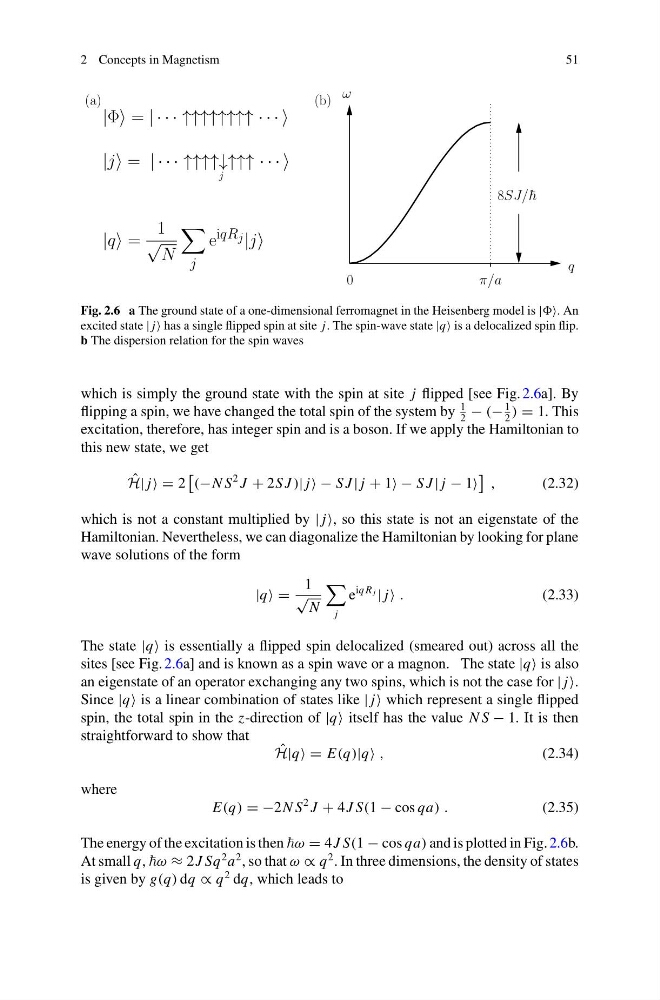
Fig. 2.6 a The ground state of a one-dimensional ferromagnet in the Heisenberg model is | An
excited state | j has a single flipped spin at site j. The spin-wave state |q is a delocalized spin flip.
b The dispersion relation for the spin waves
which is simply the ground state with the spin at site j flipped [see Fig. 2.6a]. By
flipping a spin, we have changed the total spin of the system by
1
2
− (−
1
2
) = 1. This
excitation, therefore, has integer spin and is a boson. If we apply the Hamiltonian to
this new state, we get
ˆ
H| j = 2
(−N S
2 J + 2S J )| j − S J | j + 1 − S J | j − 1
,
(2.32)
which is not a constant multiplied by | j, so this state is not an eigenstate of the
Hamiltonian. Nevertheless, we can diagonalize the Hamiltonian by looking for plane
wave solutions of the form
|q =
1
√
N
j
e
iq R j | j .
(2.33)
The state |q is essentially a flipped spin delocalized (smeared out) across all the
sites [see Fig. 2.6a] and is known as a spin wave or a magnon. The state |q is also
an eigenstate of an operator exchanging any two spins, which is not the case for | j
Since |q is a linear combination of states like | j which represent a single flipped
spin, the total spin in the z-direction of |q itself has the value N S − 1. It is then
straightforward to show that
ˆ
H|q = E(q)|q ,
(2.34)
where
E(q) = −2N S
2 J + 4J S(1 − cos qa) .
(2.35)
The energy of the excitation is then = 4J S(1 − cos qa) and is plotted in Fig. 2.6b.
At small q, ≈ 2J Sq
2 a
2 , so that ω ∝ q
2 . In three dimensions, the density of states
is given by g(q) dq ∝ q
2 dq, which leads to
51
|Φ = |
|j =
|q =
1
√
N j
e iqR j |j
j
(a)
(b)
q
ω
8SJ/
0
π/a
Fig. 2.6 a The ground state of a one-dimensional ferromagnet in the Heisenberg model is | An
excited state | j has a single flipped spin at site j. The spin-wave state |q is a delocalized spin flip.
b The dispersion relation for the spin waves
which is simply the ground state with the spin at site j flipped [see Fig. 2.6a]. By
flipping a spin, we have changed the total spin of the system by
1
2
− (−
1
2
) = 1. This
excitation, therefore, has integer spin and is a boson. If we apply the Hamiltonian to
this new state, we get
ˆ
H| j = 2
(−N S
2 J + 2S J )| j − S J | j + 1 − S J | j − 1
,
(2.32)
which is not a constant multiplied by | j, so this state is not an eigenstate of the
Hamiltonian. Nevertheless, we can diagonalize the Hamiltonian by looking for plane
wave solutions of the form
|q =
1
√
N
j
e
iq R j | j .
(2.33)
The state |q is essentially a flipped spin delocalized (smeared out) across all the
sites [see Fig. 2.6a] and is known as a spin wave or a magnon. The state |q is also
an eigenstate of an operator exchanging any two spins, which is not the case for | j
Since |q is a linear combination of states like | j which represent a single flipped
spin, the total spin in the z-direction of |q itself has the value N S − 1. It is then
straightforward to show that
ˆ
H|q = E(q)|q ,
(2.34)
where
E(q) = −2N S
2 J + 4J S(1 − cos qa) .
(2.35)
The energy of the excitation is then = 4J S(1 − cos qa) and is plotted in Fig. 2.6b.
At small q, ≈ 2J Sq
2 a
2 , so that ω ∝ q
2 . In three dimensions, the density of states
is given by g(q) dq ∝ q
2 dq, which leads to