

50
S. J. Blundell
A
4
−
A
4
E
|
,
,
A
4
−
3A
4
E
|
,
,
+
√
2
|
√
2
ˆ
H = A ˆ
S
z
a
ˆ
S
z
b
ˆ
H = A ˆ
S a · ˆ
S b
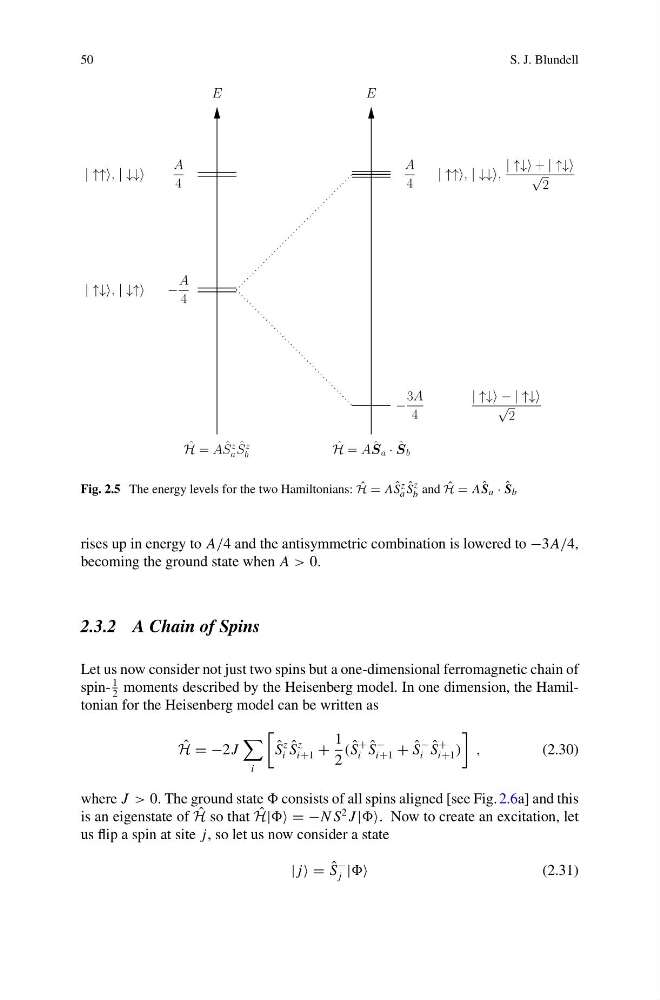
Fig. 2.5 The energy levels for the two Hamiltonians: ˆ
H = A ˆ
S z
a
ˆ
S
z
b and ˆ
H = A ˆ
S a · ˆ
S b
rises up in energy to A/4 and the antisymmetric combination is lowered to −3A/4,
becoming the ground state when A > 0.
2.3.2 A Chain of Spins
Let us now consider not just two spins but a one-dimensional ferromagnetic chain of
spin1
2
moments described by the Heisenberg model. In one dimension, the Hamiltonian for the Heisenberg model can be written as
ˆ
H = −2J
i
ˆ
S
z
i
ˆ
S
z
i+1 +
1
2
( ˆ
S
+
i
ˆ
S
−
i+1 + ˆ
S
−
i
ˆ
S
+
i+1 )
,
(2.30)
where J > 0. The ground state consists of all spins aligned [see Fig. 2.6a] and this
is an eigenstate of ˆ
H so that ˆ
H| = −N S
2 J | Now to create an excitation, let
us flip a spin at site j, so let us now consider a state
| j = ˆ
S
−
j |
(2.31)
S. J. Blundell
A
4
−
A
4
E
|
,
,
A
4
−
3A
4
E
|
,
,
+
√
2
|
√
2
ˆ
H = A ˆ
S
z
a
ˆ
S
z
b
ˆ
H = A ˆ
S a · ˆ
S b
Fig. 2.5 The energy levels for the two Hamiltonians: ˆ
H = A ˆ
S z
a
ˆ
S
z
b and ˆ
H = A ˆ
S a · ˆ
S b
rises up in energy to A/4 and the antisymmetric combination is lowered to −3A/4,
becoming the ground state when A > 0.
2.3.2 A Chain of Spins
Let us now consider not just two spins but a one-dimensional ferromagnetic chain of
spin1
2
moments described by the Heisenberg model. In one dimension, the Hamiltonian for the Heisenberg model can be written as
ˆ
H = −2J
i
ˆ
S
z
i
ˆ
S
z
i+1 +
1
2
( ˆ
S
+
i
ˆ
S
−
i+1 + ˆ
S
−
i
ˆ
S
+
i+1 )
,
(2.30)
where J > 0. The ground state consists of all spins aligned [see Fig. 2.6a] and this
is an eigenstate of ˆ
H so that ˆ
H| = −N S
2 J | Now to create an excitation, let
us flip a spin at site j, so let us now consider a state
| j = ˆ
S
−
j |
(2.31)