

34
P. R. Willmott
which means that at photon energies of the order of 10 keV, the instantaneous BW
(that is, the BW of any one FEL pulse) is of the order of 5 eV. This is over an order of
magnitude larger than the transmitted BW after monochromatization with a diamond
(004) single crystal. In addition, the stochastic nature of the initial spontaneous
generation of SASE radiation is responsible for the central position of the SASE
spectrum jittering from pulse to pulse by a few tens of eV. This is acceptable for
many types of experiment, such as in serial femtosecond crystallography, but can
be problematic in others, especially in spectroscopy. The bandwidth can be reduced
in several ways including self-seeding, or the use of chicanes in so-called highbrightness SASE. It lies outside the remit of this overview to detail these here [3].
In contrast to the transverse coherence length, the longitudinal coherence length
of SASE pulses [which depends inversely on the BW, see (1.14)] is small, of the
order of 200 nm in the hard X-ray regime.
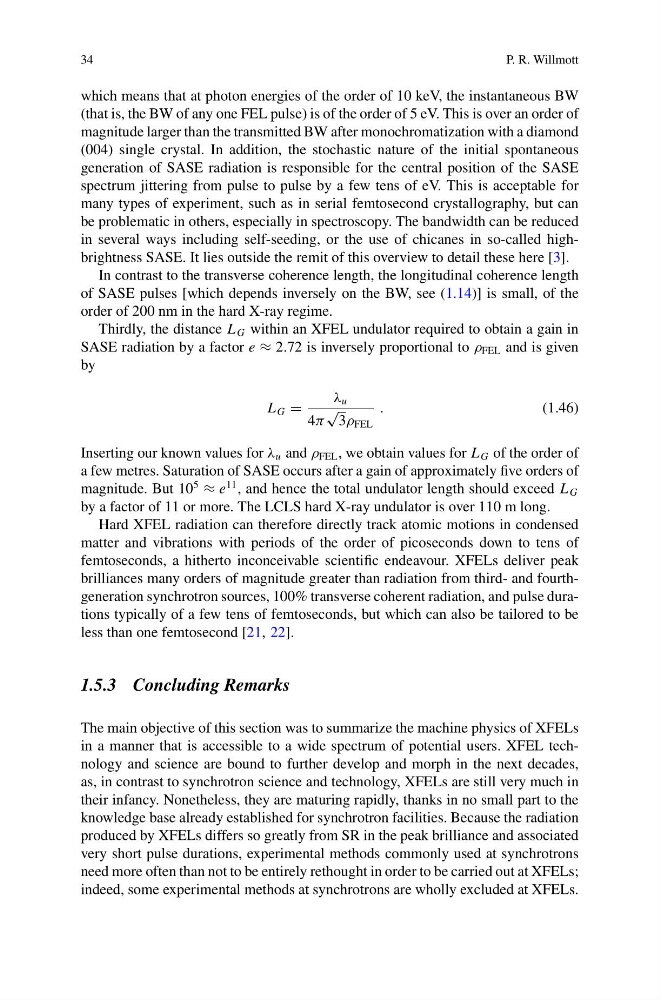
Thirdly, the distance L G within an XFEL undulator required to obtain a gain in
SASE radiation by a factor e ≈ 2.72 is inversely proportional to ρ FEL and is given
by
L G =
λ u
4π
√
3ρ FEL
.
(1.46)
Inserting our known values for λ u and ρ FEL , we obtain values for L G of the order of
a few metres. Saturation of SASE occurs after a gain of approximately five orders of
magnitude. But 10
5
≈ e
11 , and hence the total undulator length should exceed L G
by a factor of 11 or more. The LCLS hard X-ray undulator is over 110 m long.
Hard XFEL radiation can therefore directly track atomic motions in condensed
matter and vibrations with periods of the order of picoseconds down to tens of
femtoseconds, a hitherto inconceivable scientific endeavour. XFELs deliver peak
brilliances many orders of magnitude greater than radiation from third- and fourthgeneration synchrotron sources, 100% transverse coherent radiation, and pulse durations typically of a few tens of femtoseconds, but which can also be tailored to be
less than one femtosecond [21, 22].
1.5.3 Concluding Remarks
The main objective of this section was to summarize the machine physics of XFELs
in a manner that is accessible to a wide spectrum of potential users. XFEL technology and science are bound to further develop and morph in the next decades,
as, in contrast to synchrotron science and technology, XFELs are still very much in
their infancy. Nonetheless, they are maturing rapidly, thanks in no small part to the
knowledge base already established for synchrotron facilities. Because the radiation
produced by XFELs differs so greatly from SR in the peak brilliance and associated
very short pulse durations, experimental methods commonly used at synchrotrons
need more often than not to be entirely rethought in order to be carried out at XFELs;
indeed, some experimental methods at synchrotrons are wholly excluded at XFELs.
P. R. Willmott
which means that at photon energies of the order of 10 keV, the instantaneous BW
(that is, the BW of any one FEL pulse) is of the order of 5 eV. This is over an order of
magnitude larger than the transmitted BW after monochromatization with a diamond
(004) single crystal. In addition, the stochastic nature of the initial spontaneous
generation of SASE radiation is responsible for the central position of the SASE
spectrum jittering from pulse to pulse by a few tens of eV. This is acceptable for
many types of experiment, such as in serial femtosecond crystallography, but can
be problematic in others, especially in spectroscopy. The bandwidth can be reduced
in several ways including self-seeding, or the use of chicanes in so-called highbrightness SASE. It lies outside the remit of this overview to detail these here [3].
In contrast to the transverse coherence length, the longitudinal coherence length
of SASE pulses [which depends inversely on the BW, see (1.14)] is small, of the
order of 200 nm in the hard X-ray regime.
Thirdly, the distance L G within an XFEL undulator required to obtain a gain in
SASE radiation by a factor e ≈ 2.72 is inversely proportional to ρ FEL and is given
by
L G =
λ u
4π
√
3ρ FEL
.
(1.46)
Inserting our known values for λ u and ρ FEL , we obtain values for L G of the order of
a few metres. Saturation of SASE occurs after a gain of approximately five orders of
magnitude. But 10
5
≈ e
11 , and hence the total undulator length should exceed L G
by a factor of 11 or more. The LCLS hard X-ray undulator is over 110 m long.
Hard XFEL radiation can therefore directly track atomic motions in condensed
matter and vibrations with periods of the order of picoseconds down to tens of
femtoseconds, a hitherto inconceivable scientific endeavour. XFELs deliver peak
brilliances many orders of magnitude greater than radiation from third- and fourthgeneration synchrotron sources, 100% transverse coherent radiation, and pulse durations typically of a few tens of femtoseconds, but which can also be tailored to be
less than one femtosecond [21, 22].
1.5.3 Concluding Remarks
The main objective of this section was to summarize the machine physics of XFELs
in a manner that is accessible to a wide spectrum of potential users. XFEL technology and science are bound to further develop and morph in the next decades,
as, in contrast to synchrotron science and technology, XFELs are still very much in
their infancy. Nonetheless, they are maturing rapidly, thanks in no small part to the
knowledge base already established for synchrotron facilities. Because the radiation
produced by XFELs differs so greatly from SR in the peak brilliance and associated
very short pulse durations, experimental methods commonly used at synchrotrons
need more often than not to be entirely rethought in order to be carried out at XFELs;
indeed, some experimental methods at synchrotrons are wholly excluded at XFELs.