

1 X-Ray Sources at Large-Scale Facilities
23
Such an MBA, subtending an arc of angle M/2 times larger than that of the DBA,
will have a superior emittance up to a factor of three for large M. So, for example, a
10
◦ DBA will have a natural emittance 2.25 times that of a 35
◦ 7BA (M = 7) for a
fixed swept angle per dipole.
This is clearly not the way to proceed, as an increase from two bends to M will
reduce the number of straights around the ring by a factor of M/2. A far more effective
way to improve the natural emittance of an MBA can be achieved by reducing the
swept angle θ per dipole. This is due to the cubic dependence of the former on the
latter [see (1.23)]. So, if in the example above, the 7BA is designed to sweep the same
total angle as the DBA, the reduction in emittance will now be (4/9) × (2/7)
3
=
32/3087 ≈ 1/100, thus producing emittances which assume values of the order of
100 pm rad. This is only an order of magnitude larger than the diffraction-limited
photon emittance for hard X-rays of approximately 10 pm rad. Indeed, soft X-ray
beamlines, for which λ/4π ∼ x,MBA , are already diffraction-limited when using
MBAs.
Note also that the natural emittance scales with the square of the storage ring
energy E. The two highest-energy third-generation storage rings, namely the APS
(7 GeV) and SPring8 (8 GeV) are both planning to decrease E to 6 GeV in their
upgrades, despite the associated decrease in the highest accessible photon energies.
In most instances, because an achromat (be it a DBA or MBA) requires about
the same length of ‘real estate’ within the storage ring, the ring’s circumference C
is approximately inversely proportional to θ —large rings have bend achromats that
subtend smaller angles than those at small rings. This is why the large APS facility
has 36 sectors, while the smaller ALS in Berkeley only has 12. Thus, for a fixed cell
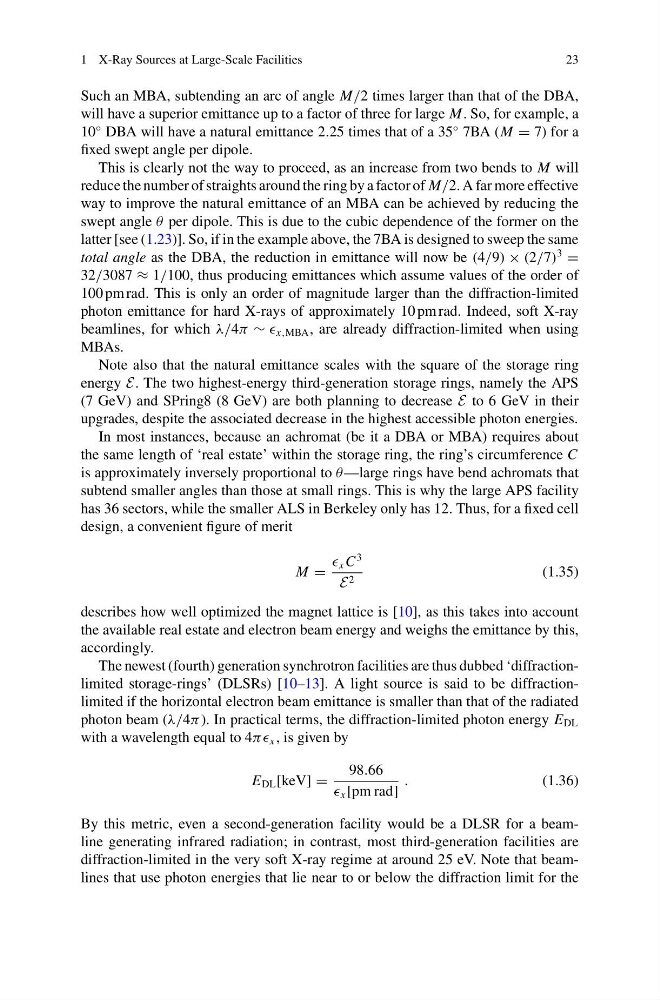
design, a convenient figure of merit
M =
x C
3
E 2
(1.35)
describes how well optimized the magnet lattice is [10], as this takes into account
the available real estate and electron beam energy and weighs the emittance by this,
accordingly.
The newest (fourth) generation synchrotron facilities are thus dubbed ‘diffractionlimited storage-rings’ (DLSRs) [10–13]. A light source is said to be diffractionlimited if the horizontal electron beam emittance is smaller than that of the radiated
photon beam (λ/4π ). In practical terms, the diffraction-limited photon energy E DL
with a wavelength equal to 4ππ x , is given by
E DL [keV] =
98.66
x [pm rad]
.
(1.36)
By this metric, even a second-generation facility would be a DLSR for a beamline generating infrared radiation; in contrast, most third-generation facilities are
diffraction-limited in the very soft X-ray regime at around 25 eV. Note that beamlines that use photon energies that lie near to or below the diffraction limit for the
23
Such an MBA, subtending an arc of angle M/2 times larger than that of the DBA,
will have a superior emittance up to a factor of three for large M. So, for example, a
10
◦ DBA will have a natural emittance 2.25 times that of a 35
◦ 7BA (M = 7) for a
fixed swept angle per dipole.
This is clearly not the way to proceed, as an increase from two bends to M will
reduce the number of straights around the ring by a factor of M/2. A far more effective
way to improve the natural emittance of an MBA can be achieved by reducing the
swept angle θ per dipole. This is due to the cubic dependence of the former on the
latter [see (1.23)]. So, if in the example above, the 7BA is designed to sweep the same
total angle as the DBA, the reduction in emittance will now be (4/9) × (2/7)
3
=
32/3087 ≈ 1/100, thus producing emittances which assume values of the order of
100 pm rad. This is only an order of magnitude larger than the diffraction-limited
photon emittance for hard X-rays of approximately 10 pm rad. Indeed, soft X-ray
beamlines, for which λ/4π ∼ x,MBA , are already diffraction-limited when using
MBAs.
Note also that the natural emittance scales with the square of the storage ring
energy E. The two highest-energy third-generation storage rings, namely the APS
(7 GeV) and SPring8 (8 GeV) are both planning to decrease E to 6 GeV in their
upgrades, despite the associated decrease in the highest accessible photon energies.
In most instances, because an achromat (be it a DBA or MBA) requires about
the same length of ‘real estate’ within the storage ring, the ring’s circumference C
is approximately inversely proportional to θ —large rings have bend achromats that
subtend smaller angles than those at small rings. This is why the large APS facility
has 36 sectors, while the smaller ALS in Berkeley only has 12. Thus, for a fixed cell
design, a convenient figure of merit
M =
x C
3
E 2
(1.35)
describes how well optimized the magnet lattice is [10], as this takes into account
the available real estate and electron beam energy and weighs the emittance by this,
accordingly.
The newest (fourth) generation synchrotron facilities are thus dubbed ‘diffractionlimited storage-rings’ (DLSRs) [10–13]. A light source is said to be diffractionlimited if the horizontal electron beam emittance is smaller than that of the radiated
photon beam (λ/4π ). In practical terms, the diffraction-limited photon energy E DL
with a wavelength equal to 4ππ x , is given by
E DL [keV] =
98.66
x [pm rad]
.
(1.36)
By this metric, even a second-generation facility would be a DLSR for a beamline generating infrared radiation; in contrast, most third-generation facilities are
diffraction-limited in the very soft X-ray regime at around 25 eV. Note that beamlines that use photon energies that lie near to or below the diffraction limit for the