

22
P. R. Willmott
A1
A3
A4
A2
A3
A4
A2
A3
A4
A1
A1
A2
A3
A4
A1
A2
A2
A4
A3
A4
A3
A2
A1
A1
(b)
LV
λ u
LCP
LH
(a)
LT
(c)
RCP
(d)
(e)
(f)
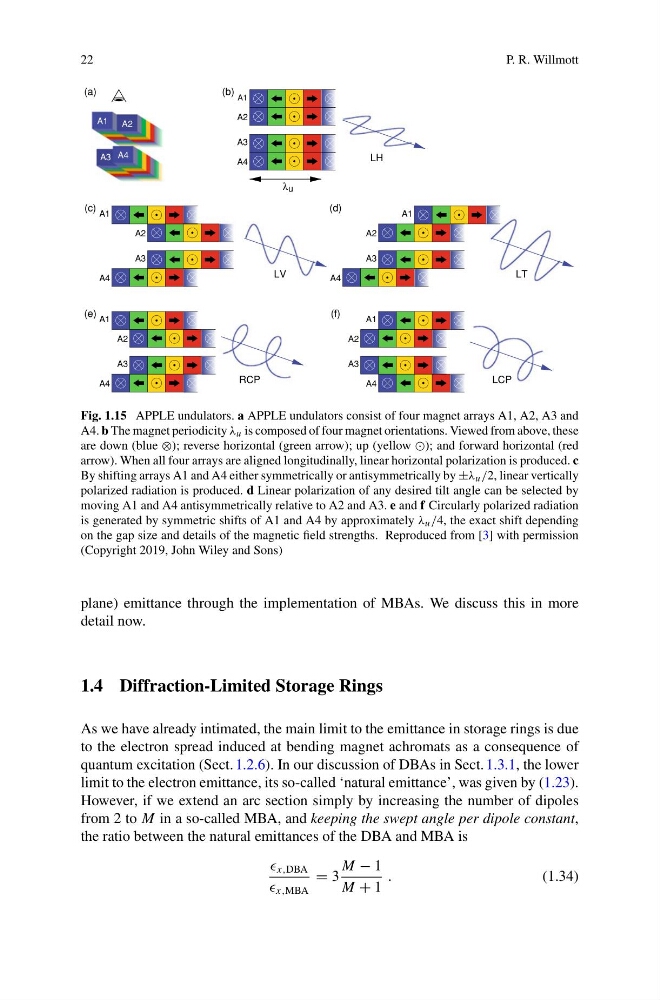
Fig. 1.15 APPLE undulators. a APPLE undulators consist of four magnet arrays A1, A2, A3 and
A4. b The magnet periodicity λ u is composed of four magnet orientations. Viewed from above, these
are down (blue ⊗); reverse horizontal (green arrow); up (yellow ); and forward horizontal (red
arrow). When all four arrays are aligned longitudinally, linear horizontal polarization is produced. c
By shifting arrays A1 and A4 either symmetrically or antisymmetrically by ±λ u /2, linear vertically
polarized radiation is produced. d Linear polarization of any desired tilt angle can be selected by
moving A1 and A4 antisymmetrically relative to A2 and A3. e and f Circularly polarized radiation
is generated by symmetric shifts of A1 and A4 by approximately λ u /4, the exact shift depending
on the gap size and details of the magnetic field strengths. Reproduced from [3] with permission
(Copyright 2019, John Wiley and Sons)
plane) emittance through the implementation of MBAs. We discuss this in more
detail now.
1.4 Diffraction-Limited Storage Rings
As we have already intimated, the main limit to the emittance in storage rings is due
to the electron spread induced at bending magnet achromats as a consequence of
quantum excitation (Sect. 1.2.6). In our discussion of DBAs in Sect. 1.3.1, the lower
limit to the electron emittance, its so-called ‘natural emittance’, was given by (1.23).
However, if we extend an arc section simply by increasing the number of dipoles
from 2 to M in a so-called MBA, and keeping the swept angle per dipole constant,
the ratio between the natural emittances of the DBA and MBA is
x,DBA
x,MBA
= 3
M − 1
M + 1
.
(1.34)
P. R. Willmott
A1
A3
A4
A2
A3
A4
A2
A3
A4
A1
A1
A2
A3
A4
A1
A2
A2
A4
A3
A4
A3
A2
A1
A1
(b)
LV
λ u
LCP
LH
(a)
LT
(c)
RCP
(d)
(e)
(f)
Fig. 1.15 APPLE undulators. a APPLE undulators consist of four magnet arrays A1, A2, A3 and
A4. b The magnet periodicity λ u is composed of four magnet orientations. Viewed from above, these
are down (blue ⊗); reverse horizontal (green arrow); up (yellow ); and forward horizontal (red
arrow). When all four arrays are aligned longitudinally, linear horizontal polarization is produced. c
By shifting arrays A1 and A4 either symmetrically or antisymmetrically by ±λ u /2, linear vertically
polarized radiation is produced. d Linear polarization of any desired tilt angle can be selected by
moving A1 and A4 antisymmetrically relative to A2 and A3. e and f Circularly polarized radiation
is generated by symmetric shifts of A1 and A4 by approximately λ u /4, the exact shift depending
on the gap size and details of the magnetic field strengths. Reproduced from [3] with permission
(Copyright 2019, John Wiley and Sons)
plane) emittance through the implementation of MBAs. We discuss this in more
detail now.
1.4 Diffraction-Limited Storage Rings
As we have already intimated, the main limit to the emittance in storage rings is due
to the electron spread induced at bending magnet achromats as a consequence of
quantum excitation (Sect. 1.2.6). In our discussion of DBAs in Sect. 1.3.1, the lower
limit to the electron emittance, its so-called ‘natural emittance’, was given by (1.23).
However, if we extend an arc section simply by increasing the number of dipoles
from 2 to M in a so-called MBA, and keeping the swept angle per dipole constant,
the ratio between the natural emittances of the DBA and MBA is
x,DBA
x,MBA
= 3
M − 1
M + 1
.
(1.34)