

20
P. R. Willmott
0
1 0
2 0
3 0
4 0
Photon energy [keV]
4
5
6
7
8
Gap size [mm]
3
5
7
9
11
13
15 17 19
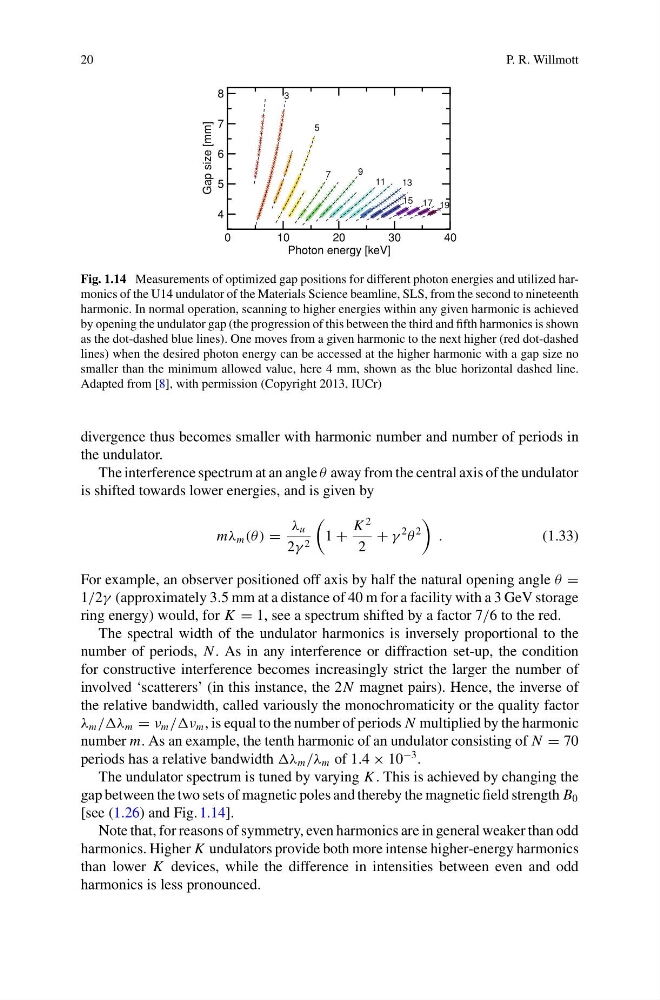
Fig. 1.14 Measurements of optimized gap positions for different photon energies and utilized harmonics of the U14 undulator of the Materials Science beamline, SLS, from the second to nineteenth
harmonic. In normal operation, scanning to higher energies within any given harmonic is achieved
by opening the undulator gap (the progression of this between the third and fifth harmonics is shown
as the dot-dashed blue lines). One moves from a given harmonic to the next higher (red dot-dashed
lines) when the desired photon energy can be accessed at the higher harmonic with a gap size no
smaller than the minimum allowed value, here 4 mm, shown as the blue horizontal dashed line.
Adapted from [8], with permission (Copyright 2013, IUCr)
divergence thus becomes smaller with harmonic number and number of periods in
the undulator.
The interference spectrum at an angle θ away from the central axis of the undulator
is shifted towards lower energies, and is given by
mλ m (θ ) =
λ u
2γ 2
1 +
K
2
2
+ γ
2
θ
2
.
(1.33)
For example, an observer positioned off axis by half the natural opening angle θ =
1/2γ (approximately 3.5 mm at a distance of 40 m for a facility with a 3 GeV storage
ring energy) would, for K = 1, see a spectrum shifted by a factor 7/6 to the red.
The spectral width of the undulator harmonics is inversely proportional to the
number of periods, N . As in any interference or diffraction set-up, the condition
for constructive interference becomes increasingly strict the larger the number of
involved ‘scatterers’ (in this instance, the 2N magnet pairs). Hence, the inverse of
the relative bandwidth, called variously the monochromaticity or the quality factor
λ m //λ m = ν m //ν m , is equal to the number of periods N multiplied by the harmonic
number m. As an example, the tenth harmonic of an undulator consisting of N = 70
periods has a relative bandwidth m /λ m of 1.4 × 10
−3 .
The undulator spectrum is tuned by varying K . This is achieved by changing the
gap between the two sets of magnetic poles and thereby the magnetic field strength B 0
[see (1.26) and Fig. 1.14].
Note that, for reasons of symmetry, even harmonics are in general weaker than odd
harmonics. Higher K undulators provide both more intense higher-energy harmonics
than lower K devices, while the difference in intensities between even and odd
harmonics is less pronounced.
P. R. Willmott
0
1 0
2 0
3 0
4 0
Photon energy [keV]
4
5
6
7
8
Gap size [mm]
3
5
7
9
11
13
15 17 19
Fig. 1.14 Measurements of optimized gap positions for different photon energies and utilized harmonics of the U14 undulator of the Materials Science beamline, SLS, from the second to nineteenth
harmonic. In normal operation, scanning to higher energies within any given harmonic is achieved
by opening the undulator gap (the progression of this between the third and fifth harmonics is shown
as the dot-dashed blue lines). One moves from a given harmonic to the next higher (red dot-dashed
lines) when the desired photon energy can be accessed at the higher harmonic with a gap size no
smaller than the minimum allowed value, here 4 mm, shown as the blue horizontal dashed line.
Adapted from [8], with permission (Copyright 2013, IUCr)
divergence thus becomes smaller with harmonic number and number of periods in
the undulator.
The interference spectrum at an angle θ away from the central axis of the undulator
is shifted towards lower energies, and is given by
mλ m (θ ) =
λ u
2γ 2
1 +
K
2
2
+ γ
2
θ
2
.
(1.33)
For example, an observer positioned off axis by half the natural opening angle θ =
1/2γ (approximately 3.5 mm at a distance of 40 m for a facility with a 3 GeV storage
ring energy) would, for K = 1, see a spectrum shifted by a factor 7/6 to the red.
The spectral width of the undulator harmonics is inversely proportional to the
number of periods, N . As in any interference or diffraction set-up, the condition
for constructive interference becomes increasingly strict the larger the number of
involved ‘scatterers’ (in this instance, the 2N magnet pairs). Hence, the inverse of
the relative bandwidth, called variously the monochromaticity or the quality factor
λ m //λ m = ν m //ν m , is equal to the number of periods N multiplied by the harmonic
number m. As an example, the tenth harmonic of an undulator consisting of N = 70
periods has a relative bandwidth m /λ m of 1.4 × 10
−3 .
The undulator spectrum is tuned by varying K . This is achieved by changing the
gap between the two sets of magnetic poles and thereby the magnetic field strength B 0
[see (1.26) and Fig. 1.14].
Note that, for reasons of symmetry, even harmonics are in general weaker than odd
harmonics. Higher K undulators provide both more intense higher-energy harmonics
than lower K devices, while the difference in intensities between even and odd
harmonics is less pronounced.