

1 X-Ray Sources at Large-Scale Facilities
19
construction of magnet arrays with the required small periodicities and high magnetic field strengths [7]; and on the other, to a clever arrangement of pole orientations
(referred to as the ‘Halbach array’) which effectively suppresses the field strength
on one side of the array and doubles it on the other, thus maximizing the magnetic
flux where it is needed.
The four basic parameters for undulator radiation from a device of length L are the
relativistic Lorentz factor γ , the undulator spatial period λ u , the number of periods in
the magnet array N = L/λ u , and K . As already stated, for an undulator, K is about
unity. K can be varied by changing the gap size between the upper and lower arrays of
magnets; this tunes the spectrum so that a suitable near-lying spectral maximum sits
at the desired photon energy. The transformation from wiggler to undulator radiation
is achieved in practice not by reducing the lateral excursions through reduction of
the magnetic field strength between the magnetic pole pairs—this would result in
an unacceptable drop in flux—but instead by reducing the magnetic pole spatial
periodicity λ u [see (1.26)].
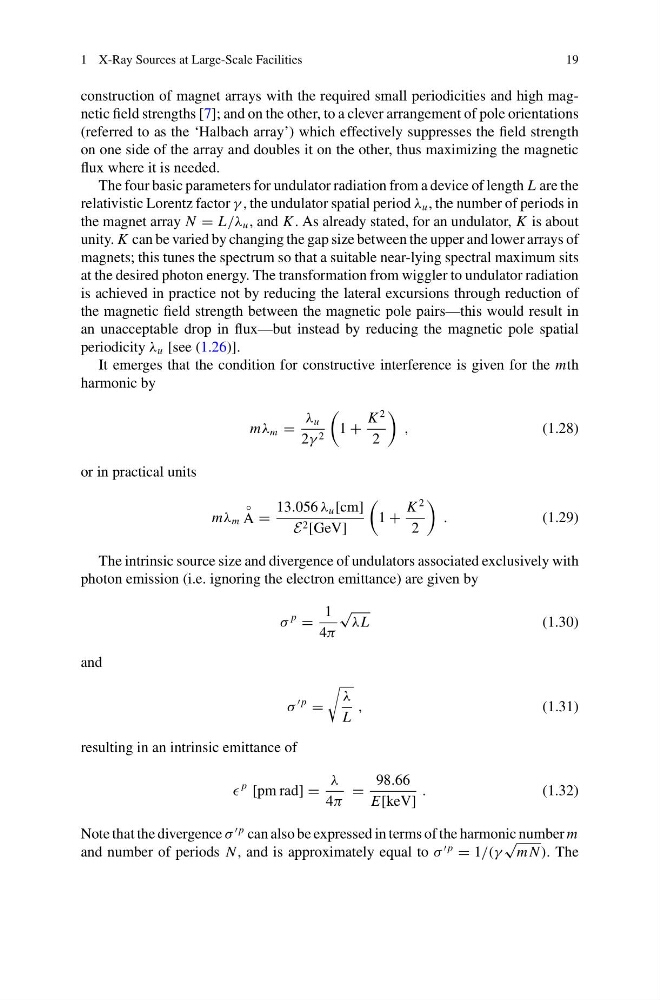
It emerges that the condition for constructive interference is given for the mth
harmonic by
mλ m =
λ u
2γ 2
1 +
K
2
2
,
(1.28)
or in practical units
mλ m
◦
A =
13.056 λ u [cm]
E 2 [GeV]
1 +
K
2
2
.
(1.29)
The intrinsic source size and divergence of undulators associated exclusively with
photon emission (i.e. ignoring the electron emittance) are given by
σ
p
=
1
4π
√
λL
(1.30)
and
σ
p
=
λ
L
,
(1.31)
resulting in an intrinsic emittance of
p
[pm rad] =
λ
4π
=
98.66
E[keV]
.
(1.32)
Note that the divergence σ
p can also be expressed in terms of the harmonic number m
and number of periods N , and is approximately equal to σ
p
= 1/(γ
√
m N ). The
19
construction of magnet arrays with the required small periodicities and high magnetic field strengths [7]; and on the other, to a clever arrangement of pole orientations
(referred to as the ‘Halbach array’) which effectively suppresses the field strength
on one side of the array and doubles it on the other, thus maximizing the magnetic
flux where it is needed.
The four basic parameters for undulator radiation from a device of length L are the
relativistic Lorentz factor γ , the undulator spatial period λ u , the number of periods in
the magnet array N = L/λ u , and K . As already stated, for an undulator, K is about
unity. K can be varied by changing the gap size between the upper and lower arrays of
magnets; this tunes the spectrum so that a suitable near-lying spectral maximum sits
at the desired photon energy. The transformation from wiggler to undulator radiation
is achieved in practice not by reducing the lateral excursions through reduction of
the magnetic field strength between the magnetic pole pairs—this would result in
an unacceptable drop in flux—but instead by reducing the magnetic pole spatial
periodicity λ u [see (1.26)].
It emerges that the condition for constructive interference is given for the mth
harmonic by
mλ m =
λ u
2γ 2
1 +
K
2
2
,
(1.28)
or in practical units
mλ m
◦
A =
13.056 λ u [cm]
E 2 [GeV]
1 +
K
2
2
.
(1.29)
The intrinsic source size and divergence of undulators associated exclusively with
photon emission (i.e. ignoring the electron emittance) are given by
σ
p
=
1
4π
√
λL
(1.30)
and
σ
p
=
λ
L
,
(1.31)
resulting in an intrinsic emittance of
p
[pm rad] =
λ
4π
=
98.66
E[keV]
.
(1.32)
Note that the divergence σ
p can also be expressed in terms of the harmonic number m
and number of periods N , and is approximately equal to σ
p
= 1/(γ
√
m N ). The