

6 p-Wave Superconductivity and d-Vector Representation
201
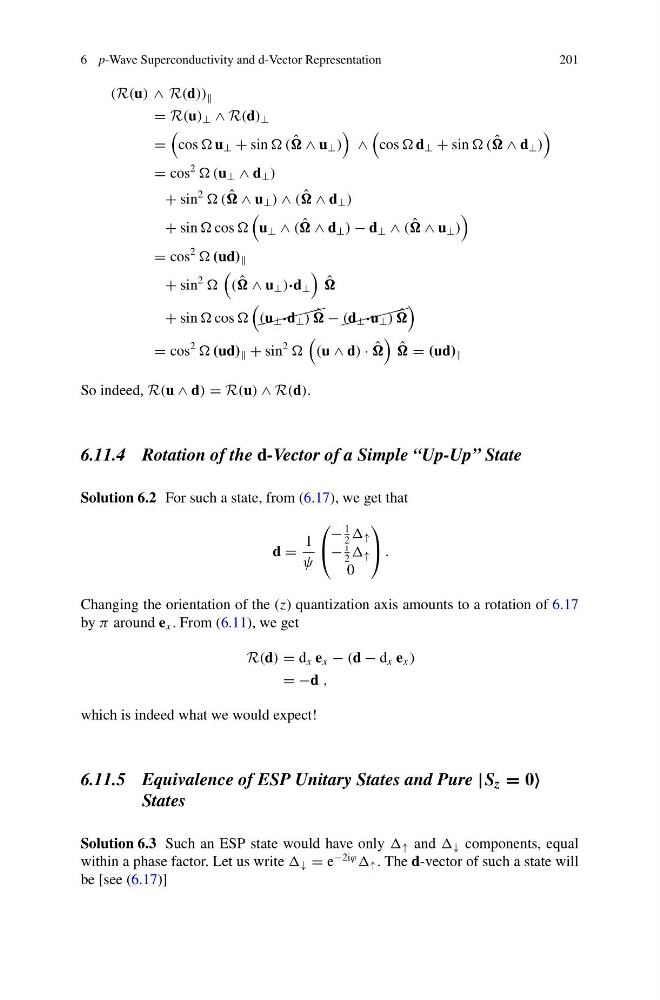
(R(u) ∧ R(d))
= R(u) ⊥ ∧ R(d) ⊥
=
cos u ⊥ + sin ( ˆ
∧ u ⊥ )
∧
cos d ⊥ + sin ( ˆ
∧ d ⊥ )
= cos
2
(u ⊥ ∧ d ⊥ )
+ sin
2
( ˆ
∧ u ⊥ ) ∧ ( ˆ
∧ d ⊥ )
+ sin cos
u ⊥ ∧ ( ˆ
∧ d ⊥ ) − d ⊥ ∧ ( ˆ
∧ u ⊥ )
= cos
2
(ud)
+ sin
2
( ˆ
∧ u ⊥ )·d ⊥
ˆ
+ sin cos
(u ⊥ ·d ⊥ ) ˆ
−
(d ⊥ ·u ⊥ ) ˆ
= cos
2
(ud) + sin
2
(u ∧ d) · ˆ
ˆ
= (ud)
So indeed, R(u ∧ d) = R(u) ∧ R(d).
6.11.4 Rotation of the d-Vector of a Simple “Up-Up” State
Solution 6.2 For such a state, from (6.17), we get that
d =
1
ψ
⎛
⎝
−
1
2
↑
−
i
2
↑
0
⎞
⎠ .
Changing the orientation of the (z) quantization axis amounts to a rotation of 6.17
by π around e x . From (6.11), we get
R(d) = d x e x − (d − d x e x )
= −d ,
which is indeed what we would expect!
6.11.5 Equivalence of ESP Unitary States and Pure |S z = 0
States
Solution 6.3 Such an ESP state would have only ↑ and ↓ components, equal
within a phase factor. Let us write ↓ = e
−2iϕ
↑ . The d-vector of such a state will
be [see (6.17)]
201
(R(u) ∧ R(d))
= R(u) ⊥ ∧ R(d) ⊥
=
cos u ⊥ + sin ( ˆ
∧ u ⊥ )
∧
cos d ⊥ + sin ( ˆ
∧ d ⊥ )
= cos
2
(u ⊥ ∧ d ⊥ )
+ sin
2
( ˆ
∧ u ⊥ ) ∧ ( ˆ
∧ d ⊥ )
+ sin cos
u ⊥ ∧ ( ˆ
∧ d ⊥ ) − d ⊥ ∧ ( ˆ
∧ u ⊥ )
= cos
2
(ud)
+ sin
2
( ˆ
∧ u ⊥ )·d ⊥
ˆ
+ sin cos
(u ⊥ ·d ⊥ ) ˆ
−
(d ⊥ ·u ⊥ ) ˆ
= cos
2
(ud) + sin
2
(u ∧ d) · ˆ
ˆ
= (ud)
So indeed, R(u ∧ d) = R(u) ∧ R(d).
6.11.4 Rotation of the d-Vector of a Simple “Up-Up” State
Solution 6.2 For such a state, from (6.17), we get that
d =
1
ψ
⎛
⎝
−
1
2
↑
−
i
2
↑
0
⎞
⎠ .
Changing the orientation of the (z) quantization axis amounts to a rotation of 6.17
by π around e x . From (6.11), we get
R(d) = d x e x − (d − d x e x )
= −d ,
which is indeed what we would expect!
6.11.5 Equivalence of ESP Unitary States and Pure |S z = 0
States
Solution 6.3 Such an ESP state would have only ↑ and ↓ components, equal
within a phase factor. Let us write ↓ = e
−2iϕ
↑ . The d-vector of such a state will
be [see (6.17)]