

1 X-Ray Sources at Large-Scale Facilities
7
0.8
0.9
0.4
0.95
β
v
a
= 0
0.1
0.2
0.6
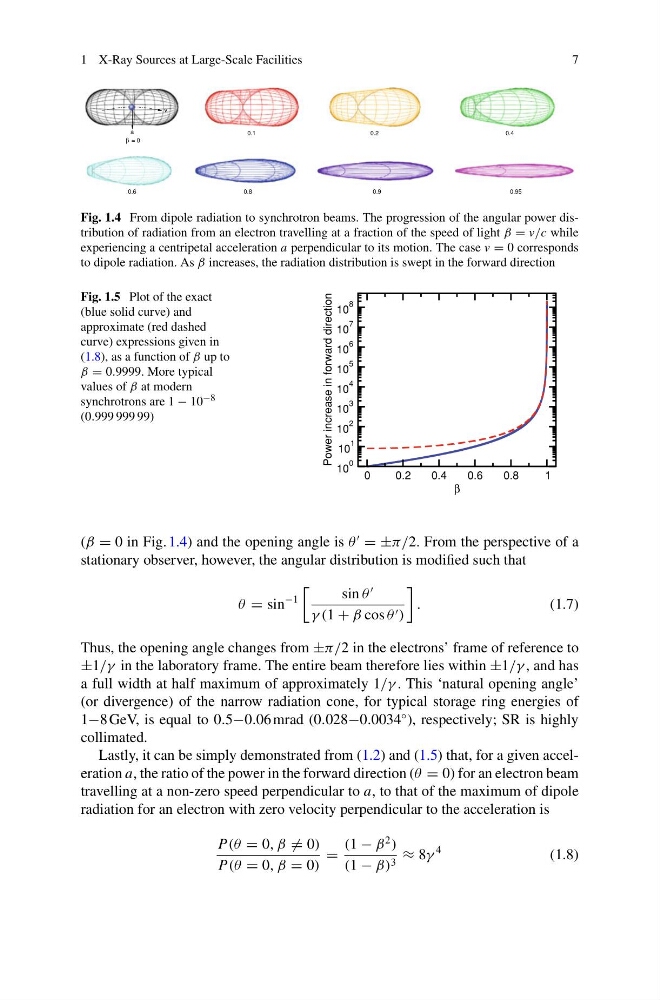
Fig. 1.4 From dipole radiation to synchrotron beams. The progression of the angular power distribution of radiation from an electron travelling at a fraction of the speed of light β = v/c while
experiencing a centripetal acceleration a perpendicular to its motion. The case v = 0 corresponds
to dipole radiation. As β increases, the radiation distribution is swept in the forward direction
Fig. 1.5 Plot of the exact
(blue solid curve) and
approximate (red dashed
curve) expressions given in
(1.8), as a function of β up to
β = 0.9999. More typical
values of β at modern
synchrotrons are 1 − 10 −8
(0.999 999 99)
0
0.2
0.4
0.6
0.8
1
β
10
0
10
1
10
2
10
3
10
4
10
5
10
6
10
7
10
8
Power increase in forward direction
(β = 0 in Fig. 1.4) and the opening angle is θ
= ±π/2. From the perspective of a
stationary observer, however, the angular distribution is modified such that
θ = sin
−1
sin θ
γ (1 + β cos θ )
.
(1.7)
Thus, the opening angle changes from ±π/2 in the electrons’ frame of reference to
±1/γ in the laboratory frame. The entire beam therefore lies within ±1/γ , and has
a full width at half maximum of approximately 1/γ . This ‘natural opening angle’
(or divergence) of the narrow radiation cone, for typical storage ring energies of
1−8 GeV, is equal to 0.5−0.06 mrad (0.028−0.0034
◦ ), respectively; SR is highly
collimated.
Lastly, it can be simply demonstrated from (1.2) and (1.5) that, for a given acceleration a, the ratio of the power in the forward direction (θ = 0) for an electron beam
travelling at a non-zero speed perpendicular to a, to that of the maximum of dipole
radiation for an electron with zero velocity perpendicular to the acceleration is
P(θ = 0, β = 0)
P(θ = 0, β = 0)
=
(1 − β
2
)
(1 − β) 3 ≈ 8γ
4
(1.8)
7
0.8
0.9
0.4
0.95
β
v
a
= 0
0.1
0.2
0.6
Fig. 1.4 From dipole radiation to synchrotron beams. The progression of the angular power distribution of radiation from an electron travelling at a fraction of the speed of light β = v/c while
experiencing a centripetal acceleration a perpendicular to its motion. The case v = 0 corresponds
to dipole radiation. As β increases, the radiation distribution is swept in the forward direction
Fig. 1.5 Plot of the exact
(blue solid curve) and
approximate (red dashed
curve) expressions given in
(1.8), as a function of β up to
β = 0.9999. More typical
values of β at modern
synchrotrons are 1 − 10 −8
(0.999 999 99)
0
0.2
0.4
0.6
0.8
1
β
10
0
10
1
10
2
10
3
10
4
10
5
10
6
10
7
10
8
Power increase in forward direction
(β = 0 in Fig. 1.4) and the opening angle is θ
= ±π/2. From the perspective of a
stationary observer, however, the angular distribution is modified such that
θ = sin
−1
sin θ
γ (1 + β cos θ )
.
(1.7)
Thus, the opening angle changes from ±π/2 in the electrons’ frame of reference to
±1/γ in the laboratory frame. The entire beam therefore lies within ±1/γ , and has
a full width at half maximum of approximately 1/γ . This ‘natural opening angle’
(or divergence) of the narrow radiation cone, for typical storage ring energies of
1−8 GeV, is equal to 0.5−0.06 mrad (0.028−0.0034
◦ ), respectively; SR is highly
collimated.
Lastly, it can be simply demonstrated from (1.2) and (1.5) that, for a given acceleration a, the ratio of the power in the forward direction (θ = 0) for an electron beam
travelling at a non-zero speed perpendicular to a, to that of the maximum of dipole
radiation for an electron with zero velocity perpendicular to the acceleration is
P(θ = 0, β = 0)
P(θ = 0, β = 0)
=
(1 − β
2
)
(1 − β) 3 ≈ 8γ
4
(1.8)