

6
P. R. Willmott
A
B
(b)
(a)
cos t
ω
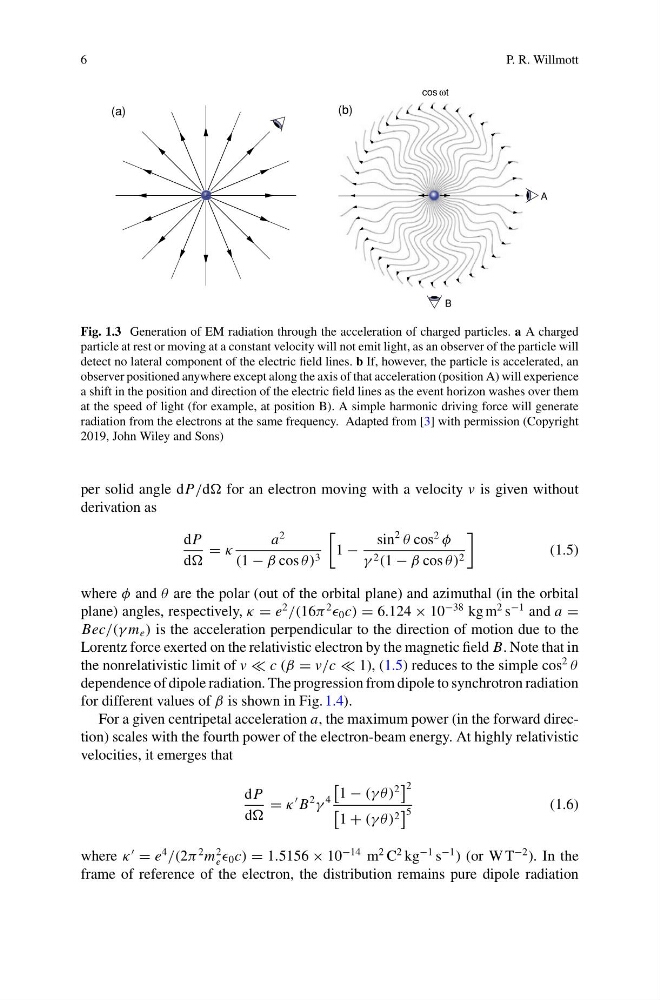
Fig. 1.3 Generation of EM radiation through the acceleration of charged particles. a A charged
particle at rest or moving at a constant velocity will not emit light, as an observer of the particle will
detect no lateral component of the electric field lines. b If, however, the particle is accelerated, an
observer positioned anywhere except along the axis of that acceleration (position A) will experience
a shift in the position and direction of the electric field lines as the event horizon washes over them
at the speed of light (for example, at position B). A simple harmonic driving force will generate
radiation from the electrons at the same frequency. Adapted from [3] with permission (Copyright
2019, John Wiley and Sons)
per solid angle dP/d for an electron moving with a velocity v is given without
derivation as
dP
d
= κ
a
2
(1 − β cos θ) 3
1 −
sin
2
θ cos
2
φ
γ 2 (1 − β cos θ) 2
(1.5)
where φ and θ are the polar (out of the orbital plane) and azimuthal (in the orbital
plane) angles, respectively, κ = e
2
/(16π
2
0 c) = 6.124 × 10
−38 kg m
2 s
−1 and a =
Bec/(γ m e ) is the acceleration perpendicular to the direction of motion due to the
Lorentz force exerted on the relativistic electron by the magnetic field B. Note that in
the nonrelativistic limit of v c (β = v/c 1), (1.5) reduces to the simple cos
2
θ
dependence of dipole radiation. The progression from dipole to synchrotron radiation
for different values of β is shown in Fig. 1.4).
For a given centripetal acceleration a, the maximum power (in the forward direction) scales with the fourth power of the electron-beam energy. At highly relativistic
velocities, it emerges that
dP
d
= κ
B
2
γ
4
1 − (γ θ )
2
2
1 + (γ θ ) 2
5
(1.6)
where κ
= e
4
/(2π
2 m
2
e 0 c) = 1.5156 × 10
−14 m
2 C
2 kg
−1 s
−1 ) (or WT
−2 ). In the
frame of reference of the electron, the distribution remains pure dipole radiation
P. R. Willmott
A
B
(b)
(a)
cos t
ω
Fig. 1.3 Generation of EM radiation through the acceleration of charged particles. a A charged
particle at rest or moving at a constant velocity will not emit light, as an observer of the particle will
detect no lateral component of the electric field lines. b If, however, the particle is accelerated, an
observer positioned anywhere except along the axis of that acceleration (position A) will experience
a shift in the position and direction of the electric field lines as the event horizon washes over them
at the speed of light (for example, at position B). A simple harmonic driving force will generate
radiation from the electrons at the same frequency. Adapted from [3] with permission (Copyright
2019, John Wiley and Sons)
per solid angle dP/d for an electron moving with a velocity v is given without
derivation as
dP
d
= κ
a
2
(1 − β cos θ) 3
1 −
sin
2
θ cos
2
φ
γ 2 (1 − β cos θ) 2
(1.5)
where φ and θ are the polar (out of the orbital plane) and azimuthal (in the orbital
plane) angles, respectively, κ = e
2
/(16π
2
0 c) = 6.124 × 10
−38 kg m
2 s
−1 and a =
Bec/(γ m e ) is the acceleration perpendicular to the direction of motion due to the
Lorentz force exerted on the relativistic electron by the magnetic field B. Note that in
the nonrelativistic limit of v c (β = v/c 1), (1.5) reduces to the simple cos
2
θ
dependence of dipole radiation. The progression from dipole to synchrotron radiation
for different values of β is shown in Fig. 1.4).
For a given centripetal acceleration a, the maximum power (in the forward direction) scales with the fourth power of the electron-beam energy. At highly relativistic
velocities, it emerges that
dP
d
= κ
B
2
γ
4
1 − (γ θ )
2
2
1 + (γ θ ) 2
5
(1.6)
where κ
= e
4
/(2π
2 m
2
e 0 c) = 1.5156 × 10
−14 m
2 C
2 kg
−1 s
−1 ) (or WT
−2 ). In the
frame of reference of the electron, the distribution remains pure dipole radiation