

5 Spintronics and Synchrotron Radiation
157
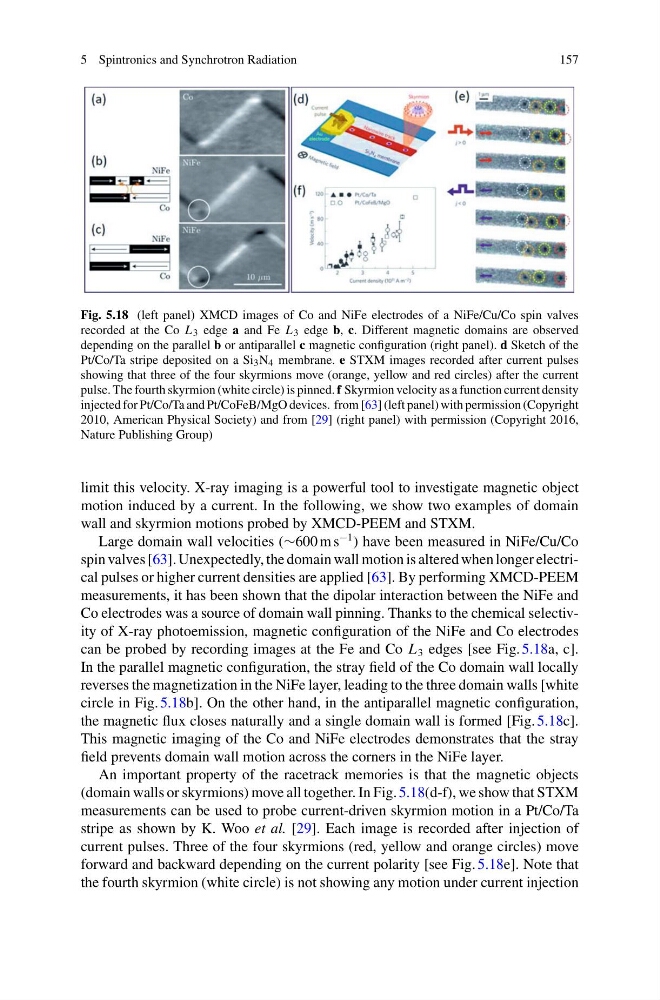
Fig. 5.18 (left panel) XMCD images of Co and NiFe electrodes of a NiFe/Cu/Co spin valves
recorded at the Co L 3 edge a and Fe L 3 edge b, c. Different magnetic domains are observed
depending on the parallel b or antiparallel c magnetic configuration (right panel). d Sketch of the
Pt/Co/Ta stripe deposited on a Si 3 N 4 membrane. e STXM images recorded after current pulses
showing that three of the four skyrmions move (orange, yellow and red circles) after the current
pulse. The fourth skyrmion (white circle) is pinned. f Skyrmion velocity as a function current density
injected for Pt/Co/Ta and Pt/CoFeB/MgO devices. from [63] (left panel) with permission (Copyright
2010, American Physical Society) and from [29] (right panel) with permission (Copyright 2016,
Nature Publishing Group)
limit this velocity. X-ray imaging is a powerful tool to investigate magnetic object
motion induced by a current. In the following, we show two examples of domain
wall and skyrmion motions probed by XMCD-PEEM and STXM.
Large domain wall velocities (∼600 m s
−1 ) have been measured in NiFe/Cu/Co
spin valves [63]. Unexpectedly, the domain wall motion is altered when longer electrical pulses or higher current densities are applied [63]. By performing XMCD-PEEM
measurements, it has been shown that the dipolar interaction between the NiFe and
Co electrodes was a source of domain wall pinning. Thanks to the chemical selectivity of X-ray photoemission, magnetic configuration of the NiFe and Co electrodes
can be probed by recording images at the Fe and Co L 3 edges [see Fig. 5.18a, c].
In the parallel magnetic configuration, the stray field of the Co domain wall locally
reverses the magnetization in the NiFe layer, leading to the three domain walls [white
circle in Fig. 5.18b]. On the other hand, in the antiparallel magnetic configuration,
the magnetic flux closes naturally and a single domain wall is formed [Fig. 5.18c].
This magnetic imaging of the Co and NiFe electrodes demonstrates that the stray
field prevents domain wall motion across the corners in the NiFe layer.
An important property of the racetrack memories is that the magnetic objects
(domain walls or skyrmions) move all together. In Fig. 5.18(d-f), we show that STXM
measurements can be used to probe current-driven skyrmion motion in a Pt/Co/Ta
stripe as shown by K. Woo et al. [29]. Each image is recorded after injection of
current pulses. Three of the four skyrmions (red, yellow and orange circles) move
forward and backward depending on the current polarity [see Fig. 5.18e]. Note that
the fourth skyrmion (white circle) is not showing any motion under current injection
157
Fig. 5.18 (left panel) XMCD images of Co and NiFe electrodes of a NiFe/Cu/Co spin valves
recorded at the Co L 3 edge a and Fe L 3 edge b, c. Different magnetic domains are observed
depending on the parallel b or antiparallel c magnetic configuration (right panel). d Sketch of the
Pt/Co/Ta stripe deposited on a Si 3 N 4 membrane. e STXM images recorded after current pulses
showing that three of the four skyrmions move (orange, yellow and red circles) after the current
pulse. The fourth skyrmion (white circle) is pinned. f Skyrmion velocity as a function current density
injected for Pt/Co/Ta and Pt/CoFeB/MgO devices. from [63] (left panel) with permission (Copyright
2010, American Physical Society) and from [29] (right panel) with permission (Copyright 2016,
Nature Publishing Group)
limit this velocity. X-ray imaging is a powerful tool to investigate magnetic object
motion induced by a current. In the following, we show two examples of domain
wall and skyrmion motions probed by XMCD-PEEM and STXM.
Large domain wall velocities (∼600 m s
−1 ) have been measured in NiFe/Cu/Co
spin valves [63]. Unexpectedly, the domain wall motion is altered when longer electrical pulses or higher current densities are applied [63]. By performing XMCD-PEEM
measurements, it has been shown that the dipolar interaction between the NiFe and
Co electrodes was a source of domain wall pinning. Thanks to the chemical selectivity of X-ray photoemission, magnetic configuration of the NiFe and Co electrodes
can be probed by recording images at the Fe and Co L 3 edges [see Fig. 5.18a, c].
In the parallel magnetic configuration, the stray field of the Co domain wall locally
reverses the magnetization in the NiFe layer, leading to the three domain walls [white
circle in Fig. 5.18b]. On the other hand, in the antiparallel magnetic configuration,
the magnetic flux closes naturally and a single domain wall is formed [Fig. 5.18c].
This magnetic imaging of the Co and NiFe electrodes demonstrates that the stray
field prevents domain wall motion across the corners in the NiFe layer.
An important property of the racetrack memories is that the magnetic objects
(domain walls or skyrmions) move all together. In Fig. 5.18(d-f), we show that STXM
measurements can be used to probe current-driven skyrmion motion in a Pt/Co/Ta
stripe as shown by K. Woo et al. [29]. Each image is recorded after injection of
current pulses. Three of the four skyrmions (red, yellow and orange circles) move
forward and backward depending on the current polarity [see Fig. 5.18e]. Note that
the fourth skyrmion (white circle) is not showing any motion under current injection