

5 Spintronics and Synchrotron Radiation
133
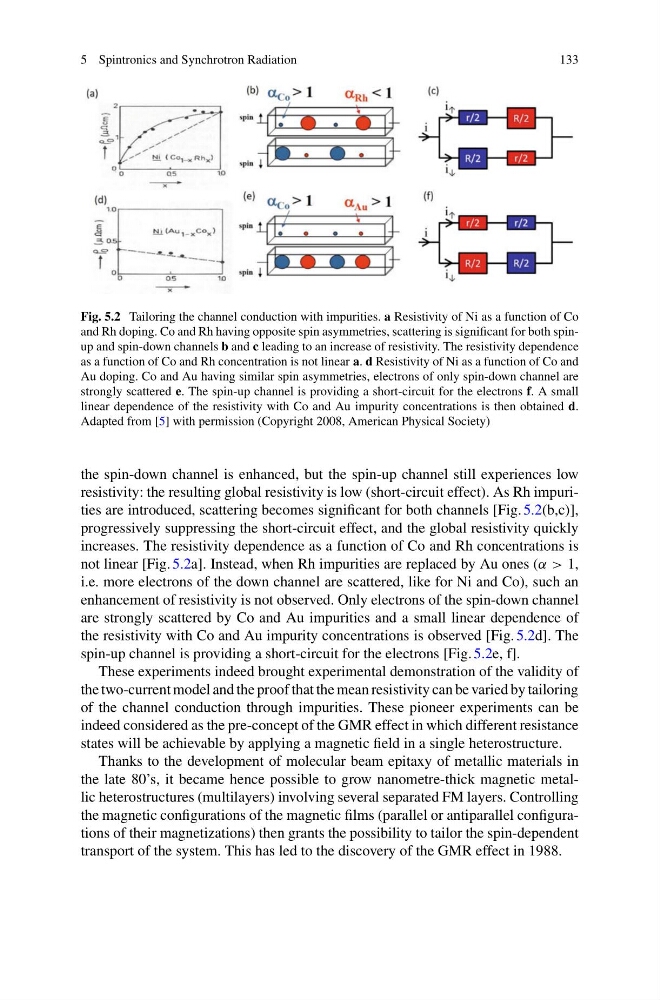
Fig. 5.2 Tailoring the channel conduction with impurities. a Resistivity of Ni as a function of Co
and Rh doping. Co and Rh having opposite spin asymmetries, scattering is significant for both spinup and spin-down channels b and c leading to an increase of resistivity. The resistivity dependence
as a function of Co and Rh concentration is not linear a. d Resistivity of Ni as a function of Co and
Au doping. Co and Au having similar spin asymmetries, electrons of only spin-down channel are
strongly scattered e. The spin-up channel is providing a short-circuit for the electrons f. A small
linear dependence of the resistivity with Co and Au impurity concentrations is then obtained d.
Adapted from [5] with permission (Copyright 2008, American Physical Society)
the spin-down channel is enhanced, but the spin-up channel still experiences low
resistivity: the resulting global resistivity is low (short-circuit effect). As Rh impurities are introduced, scattering becomes significant for both channels [Fig. 5.2(b,c)],
progressively suppressing the short-circuit effect, and the global resistivity quickly
increases. The resistivity dependence as a function of Co and Rh concentrations is
not linear [Fig. 5.2a]. Instead, when Rh impurities are replaced by Au ones (α > 1,
i.e. more electrons of the down channel are scattered, like for Ni and Co), such an
enhancement of resistivity is not observed. Only electrons of the spin-down channel
are strongly scattered by Co and Au impurities and a small linear dependence of
the resistivity with Co and Au impurity concentrations is observed [Fig. 5.2d]. The
spin-up channel is providing a short-circuit for the electrons [Fig. 5.2e, f].
These experiments indeed brought experimental demonstration of the validity of
the two-current model and the proof that the mean resistivity can be varied by tailoring
of the channel conduction through impurities. These pioneer experiments can be
indeed considered as the pre-concept of the GMR effect in which different resistance
states will be achievable by applying a magnetic field in a single heterostructure.
Thanks to the development of molecular beam epitaxy of metallic materials in
the late 80’s, it became hence possible to grow nanometre-thick magnetic metallic heterostructures (multilayers) involving several separated FM layers. Controlling
the magnetic configurations of the magnetic films (parallel or antiparallel configurations of their magnetizations) then grants the possibility to tailor the spin-dependent
transport of the system. This has led to the discovery of the GMR effect in 1988.
133
Fig. 5.2 Tailoring the channel conduction with impurities. a Resistivity of Ni as a function of Co
and Rh doping. Co and Rh having opposite spin asymmetries, scattering is significant for both spinup and spin-down channels b and c leading to an increase of resistivity. The resistivity dependence
as a function of Co and Rh concentration is not linear a. d Resistivity of Ni as a function of Co and
Au doping. Co and Au having similar spin asymmetries, electrons of only spin-down channel are
strongly scattered e. The spin-up channel is providing a short-circuit for the electrons f. A small
linear dependence of the resistivity with Co and Au impurity concentrations is then obtained d.
Adapted from [5] with permission (Copyright 2008, American Physical Society)
the spin-down channel is enhanced, but the spin-up channel still experiences low
resistivity: the resulting global resistivity is low (short-circuit effect). As Rh impurities are introduced, scattering becomes significant for both channels [Fig. 5.2(b,c)],
progressively suppressing the short-circuit effect, and the global resistivity quickly
increases. The resistivity dependence as a function of Co and Rh concentrations is
not linear [Fig. 5.2a]. Instead, when Rh impurities are replaced by Au ones (α > 1,
i.e. more electrons of the down channel are scattered, like for Ni and Co), such an
enhancement of resistivity is not observed. Only electrons of the spin-down channel
are strongly scattered by Co and Au impurities and a small linear dependence of
the resistivity with Co and Au impurity concentrations is observed [Fig. 5.2d]. The
spin-up channel is providing a short-circuit for the electrons [Fig. 5.2e, f].
These experiments indeed brought experimental demonstration of the validity of
the two-current model and the proof that the mean resistivity can be varied by tailoring
of the channel conduction through impurities. These pioneer experiments can be
indeed considered as the pre-concept of the GMR effect in which different resistance
states will be achievable by applying a magnetic field in a single heterostructure.
Thanks to the development of molecular beam epitaxy of metallic materials in
the late 80’s, it became hence possible to grow nanometre-thick magnetic metallic heterostructures (multilayers) involving several separated FM layers. Controlling
the magnetic configurations of the magnetic films (parallel or antiparallel configurations of their magnetizations) then grants the possibility to tailor the spin-dependent
transport of the system. This has led to the discovery of the GMR effect in 1988.