

132
R. Mattana et al.
5.1.1 Giant Magnetoresistance: An Historical Point of View
5.1.1.1 Electric Conduction in Ferromagnets
In 3d ferromagnetic (FM) metals, electric conduction comes mainly from 4s band
electrons, whereas magnetism originates from electrons in 3d bands. Resistivity
in such materials arises from scattering events of carriers on impurities, phonons
and local potentials. In particular, localized d orbitals act as diffusive centres for
the s electrons which carry most of the charge current. Moreover, the non-zero net
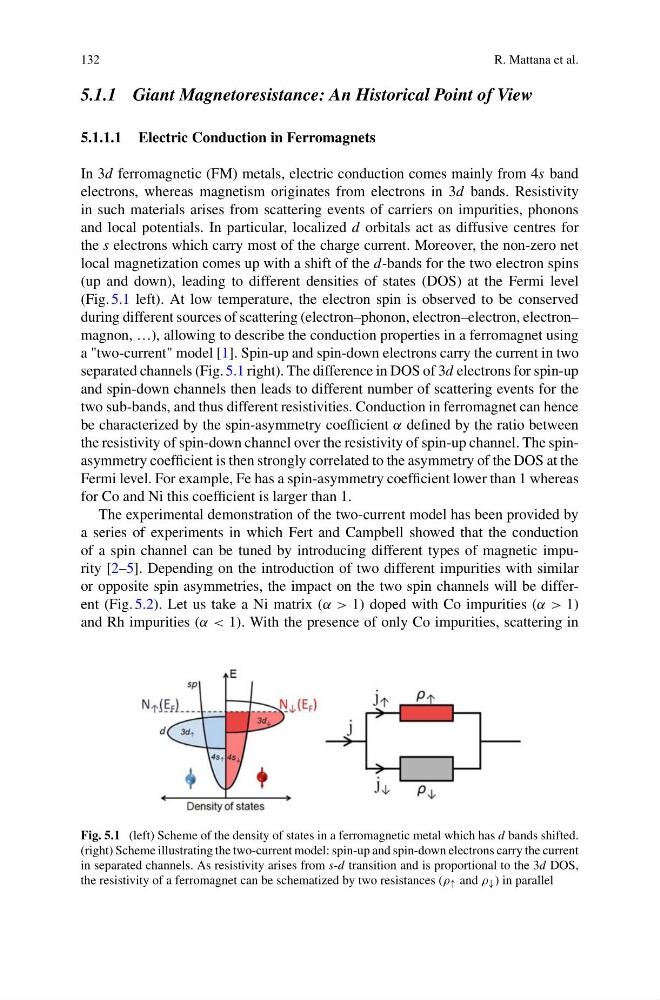
local magnetization comes up with a shift of the d-bands for the two electron spins
(up and down), leading to different densities of states (DOS) at the Fermi level
(Fig. 5.1 left). At low temperature, the electron spin is observed to be conserved
during different sources of scattering (electron–phonon, electron–electron, electron–
magnon, …), allowing to describe the conduction properties in a ferromagnet using
a "two-current" model [1]. Spin-up and spin-down electrons carry the current in two
separated channels (Fig. 5.1 right). The difference in DOS of 3d electrons for spin-up
and spin-down channels then leads to different number of scattering events for the
two sub-bands, and thus different resistivities. Conduction in ferromagnet can hence
be characterized by the spin-asymmetry coefficient α defined by the ratio between
the resistivity of spin-down channel over the resistivity of spin-up channel. The spinasymmetry coefficient is then strongly correlated to the asymmetry of the DOS at the
Fermi level. For example, Fe has a spin-asymmetry coefficient lower than 1 whereas
for Co and Ni this coefficient is larger than 1.
The experimental demonstration of the two-current model has been provided by
a series of experiments in which Fert and Campbell showed that the conduction
of a spin channel can be tuned by introducing different types of magnetic impurity [2–5]. Depending on the introduction of two different impurities with similar
or opposite spin asymmetries, the impact on the two spin channels will be different (Fig. 5.2). Let us take a Ni matrix (α > 1) doped with Co impurities (α > 1)
and Rh impurities (α < 1). With the presence of only Co impurities, scattering in
Fig. 5.1 (left) Scheme of the density of states in a ferromagnetic metal which has d bands shifted.
(right) Scheme illustrating the two-current model: spin-up and spin-down electrons carry the current
in separated channels. As resistivity arises from s-d transition and is proportional to the 3d DOS,
the resistivity of a ferromagnet can be schematized by two resistances (ρ ↑ and ρ ↓ ) in parallel
R. Mattana et al.
5.1.1 Giant Magnetoresistance: An Historical Point of View
5.1.1.1 Electric Conduction in Ferromagnets
In 3d ferromagnetic (FM) metals, electric conduction comes mainly from 4s band
electrons, whereas magnetism originates from electrons in 3d bands. Resistivity
in such materials arises from scattering events of carriers on impurities, phonons
and local potentials. In particular, localized d orbitals act as diffusive centres for
the s electrons which carry most of the charge current. Moreover, the non-zero net
local magnetization comes up with a shift of the d-bands for the two electron spins
(up and down), leading to different densities of states (DOS) at the Fermi level
(Fig. 5.1 left). At low temperature, the electron spin is observed to be conserved
during different sources of scattering (electron–phonon, electron–electron, electron–
magnon, …), allowing to describe the conduction properties in a ferromagnet using
a "two-current" model [1]. Spin-up and spin-down electrons carry the current in two
separated channels (Fig. 5.1 right). The difference in DOS of 3d electrons for spin-up
and spin-down channels then leads to different number of scattering events for the
two sub-bands, and thus different resistivities. Conduction in ferromagnet can hence
be characterized by the spin-asymmetry coefficient α defined by the ratio between
the resistivity of spin-down channel over the resistivity of spin-up channel. The spinasymmetry coefficient is then strongly correlated to the asymmetry of the DOS at the
Fermi level. For example, Fe has a spin-asymmetry coefficient lower than 1 whereas
for Co and Ni this coefficient is larger than 1.
The experimental demonstration of the two-current model has been provided by
a series of experiments in which Fert and Campbell showed that the conduction
of a spin channel can be tuned by introducing different types of magnetic impurity [2–5]. Depending on the introduction of two different impurities with similar
or opposite spin asymmetries, the impact on the two spin channels will be different (Fig. 5.2). Let us take a Ni matrix (α > 1) doped with Co impurities (α > 1)
and Rh impurities (α < 1). With the presence of only Co impurities, scattering in
Fig. 5.1 (left) Scheme of the density of states in a ferromagnetic metal which has d bands shifted.
(right) Scheme illustrating the two-current model: spin-up and spin-down electrons carry the current
in separated channels. As resistivity arises from s-d transition and is proportional to the 3d DOS,
the resistivity of a ferromagnet can be schematized by two resistances (ρ ↑ and ρ ↓ ) in parallel