

102
H. Elnaggar et al.
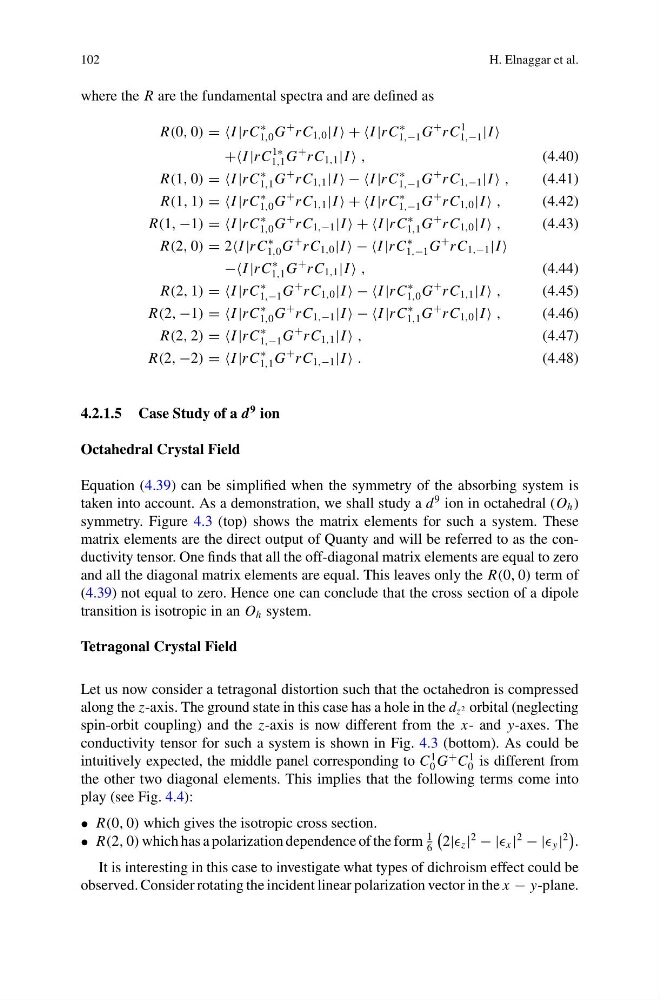
where the R are the fundamental spectra and are defined as
R(0, 0) = =I |rC
∗
1,0 G
+ rC 1,0 |I + +I |rC
∗
1,−1 G
+ rC
1
1,−1 |I
++I |rC
1∗
1,1 G
+ rC 1,1 |I ,
(4.40)
R(1, 0) = =I |rC
∗
1,1 G
+ rC 1,1 |I − −I |rC
∗
1,−1 G
+ rC 1,−1 |I ,
(4.41)
R(1, 1) = =I |rC
∗
1,0 G
+ rC 1,1 |I + +I |rC
∗
1,−1 G
+ rC 1,0 |I ,
(4.42)
R(1, −1) = =I |rC
∗
1,0 G
+ rC 1,−1 |I + +I |rC
∗
1,1 G
+ rC 1,0 |I ,
(4.43)
R(2, 0) = 2I |rC
∗
1,0 G
+ rC 1,0 |I − −I |rC
∗
1,−1 G
+ rC 1,−1 |I
−−I |rC
∗
1,1 G
+ rC 1,1 |I ,
(4.44)
R(2, 1) = =I |rC
∗
1,−1 G
+ rC 1,0 |I − −I |rC
∗
1,0 G
+ rC 1,1 |I ,
(4.45)
R(2, −1) = =I |rC
∗
1,0 G
+ rC 1,−1 |I − −I |rC
∗
1,1 G
+ rC 1,0 |I ,
(4.46)
R(2, 2) = =I |rC
∗
1,−1 G
+ rC 1,1 |I ,
(4.47)
R(2, −2) = =I |rC
∗
1,1 G
+ rC 1,−1 |I .
(4.48)
4.2.1.5 Case Study of a d
9 ion
Octahedral Crystal Field
Equation (4.39) can be simplified when the symmetry of the absorbing system is
taken into account. As a demonstration, we shall study a d
9 ion in octahedral (O h )
symmetry. Figure 4.3 (top) shows the matrix elements for such a system. These
matrix elements are the direct output of Quanty and will be referred to as the conductivity tensor. One finds that all the off-diagonal matrix elements are equal to zero
and all the diagonal matrix elements are equal. This leaves only the R(0, 0) term of
(4.39) not equal to zero. Hence one can conclude that the cross section of a dipole
transition is isotropic in an O h system.
Tetragonal Crystal Field
Let us now consider a tetragonal distortion such that the octahedron is compressed
along the z-axis. The ground state in this case has a hole in the d z 2 orbital (neglecting
spin-orbit coupling) and the z-axis is now different from the x- and y-axes. The
conductivity tensor for such a system is shown in Fig. 4.3 (bottom). As could be
intuitively expected, the middle panel corresponding to C
1
0 G
+ C
1
0 is different from
the other two diagonal elements. This implies that the following terms come into
play (see Fig. 4.4):
• R(0, 0) which gives the isotropic cross section.
• R(2, 0) which has a polarization dependence of the form
1
6
2| z |
2
− | x |
2
− | y |
2
.
It is interesting in this case to investigate what types of dichroism effect could be
observed. Consider rotating the incident linear polarization vector in the x − y-plane.
H. Elnaggar et al.
where the R are the fundamental spectra and are defined as
R(0, 0) = =I |rC
∗
1,0 G
+ rC 1,0 |I + +I |rC
∗
1,−1 G
+ rC
1
1,−1 |I
++I |rC
1∗
1,1 G
+ rC 1,1 |I ,
(4.40)
R(1, 0) = =I |rC
∗
1,1 G
+ rC 1,1 |I − −I |rC
∗
1,−1 G
+ rC 1,−1 |I ,
(4.41)
R(1, 1) = =I |rC
∗
1,0 G
+ rC 1,1 |I + +I |rC
∗
1,−1 G
+ rC 1,0 |I ,
(4.42)
R(1, −1) = =I |rC
∗
1,0 G
+ rC 1,−1 |I + +I |rC
∗
1,1 G
+ rC 1,0 |I ,
(4.43)
R(2, 0) = 2I |rC
∗
1,0 G
+ rC 1,0 |I − −I |rC
∗
1,−1 G
+ rC 1,−1 |I
−−I |rC
∗
1,1 G
+ rC 1,1 |I ,
(4.44)
R(2, 1) = =I |rC
∗
1,−1 G
+ rC 1,0 |I − −I |rC
∗
1,0 G
+ rC 1,1 |I ,
(4.45)
R(2, −1) = =I |rC
∗
1,0 G
+ rC 1,−1 |I − −I |rC
∗
1,1 G
+ rC 1,0 |I ,
(4.46)
R(2, 2) = =I |rC
∗
1,−1 G
+ rC 1,1 |I ,
(4.47)
R(2, −2) = =I |rC
∗
1,1 G
+ rC 1,−1 |I .
(4.48)
4.2.1.5 Case Study of a d
9 ion
Octahedral Crystal Field
Equation (4.39) can be simplified when the symmetry of the absorbing system is
taken into account. As a demonstration, we shall study a d
9 ion in octahedral (O h )
symmetry. Figure 4.3 (top) shows the matrix elements for such a system. These
matrix elements are the direct output of Quanty and will be referred to as the conductivity tensor. One finds that all the off-diagonal matrix elements are equal to zero
and all the diagonal matrix elements are equal. This leaves only the R(0, 0) term of
(4.39) not equal to zero. Hence one can conclude that the cross section of a dipole
transition is isotropic in an O h system.
Tetragonal Crystal Field
Let us now consider a tetragonal distortion such that the octahedron is compressed
along the z-axis. The ground state in this case has a hole in the d z 2 orbital (neglecting
spin-orbit coupling) and the z-axis is now different from the x- and y-axes. The
conductivity tensor for such a system is shown in Fig. 4.3 (bottom). As could be
intuitively expected, the middle panel corresponding to C
1
0 G
+ C
1
0 is different from
the other two diagonal elements. This implies that the following terms come into
play (see Fig. 4.4):
• R(0, 0) which gives the isotropic cross section.
• R(2, 0) which has a polarization dependence of the form
1
6
2| z |
2
− | x |
2
− | y |
2
.
It is interesting in this case to investigate what types of dichroism effect could be
observed. Consider rotating the incident linear polarization vector in the x − y-plane.