

4 X-ray Dichroisms in Spherical Tensor and Green’s Function Formalism
101
σ (2, 2) = −4παω × Im
−1
2
(( x − i y )((
∗
x − i
∗
y )
×
I |rC
∗
1,−1 G
+ rC 1,1 |I
,
(4.37)
σ (2, −2) = −4παω × Im
−1
2
(( x + i y )((
∗
x + i
∗
y )
×
I |rC
∗
1,1 G
+ rC 1,−1 |I
.
(4.38)
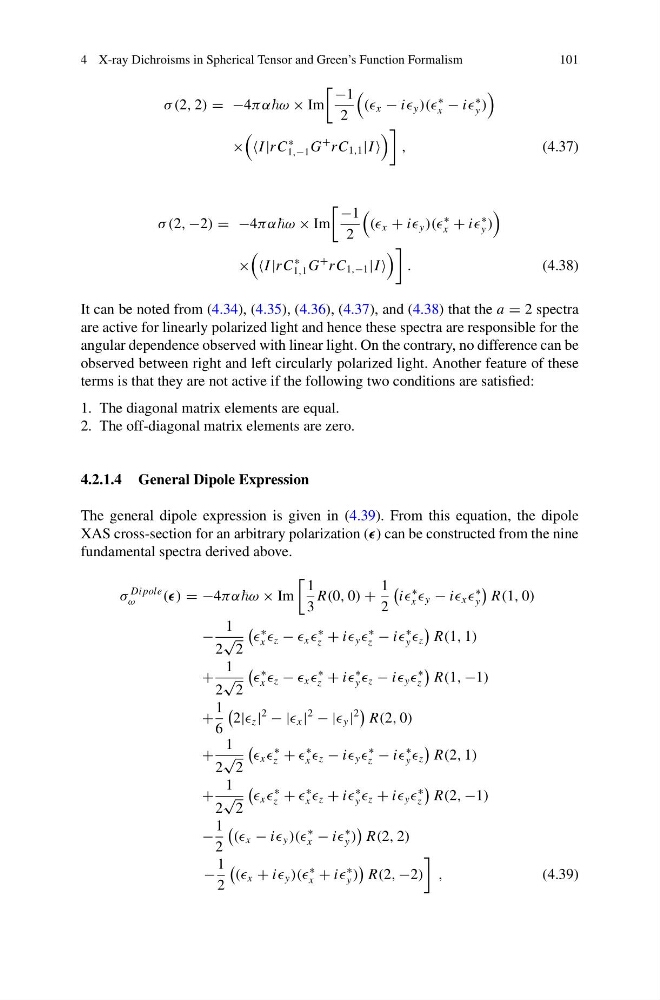
It can be noted from (4.34), (4.35), (4.36), (4.37), and (4.38) that the a = 2 spectra
are active for linearly polarized light and hence these spectra are responsible for the
angular dependence observed with linear light. On the contrary, no difference can be
observed between right and left circularly polarized light. Another feature of these
terms is that they are not active if the following two conditions are satisfied:
1. The diagonal matrix elements are equal.
2. The off-diagonal matrix elements are zero.
4.2.1.4 General Dipole Expression
The general dipole expression is given in (4.39). From this equation, the dipole
XAS cross-section for an arbitrary polarization () can be constructed from the nine
fundamental spectra derived above.
σ
Di pole
ω
() = −4παω × Im
1
3
R(0, 0) +
1
2
i
∗
x y − i x
∗
y
R(1, 0)
−
1
2
√
2
∗
x z − x
∗
z + i y
∗
z − i
∗
y z
R(1, 1)
+
1
2
√
2
∗
x z − x
∗
z + i
∗
y z − i y
∗
z
R(1, −1)
+
1
6
2| z |
2
− | x |
2
− | y |
2
R(2, 0)
+
1
2
√
2
x
∗
z +
∗
x z − i y
∗
z − i
∗
y z
R(2, 1)
+
1
2
√
2
x
∗
z +
∗
x z + i
∗
y z + i y
∗
z
R(2, −1)
−
1
2
(( x − i y )((
∗
x − i
∗
y )
R(2, 2)
−
1
2
(( x + i y )((
∗
x + i
∗
y )
R(2, −2)
,
(4.39)
101
σ (2, 2) = −4παω × Im
−1
2
(( x − i y )((
∗
x − i
∗
y )
×
I |rC
∗
1,−1 G
+ rC 1,1 |I
,
(4.37)
σ (2, −2) = −4παω × Im
−1
2
(( x + i y )((
∗
x + i
∗
y )
×
I |rC
∗
1,1 G
+ rC 1,−1 |I
.
(4.38)
It can be noted from (4.34), (4.35), (4.36), (4.37), and (4.38) that the a = 2 spectra
are active for linearly polarized light and hence these spectra are responsible for the
angular dependence observed with linear light. On the contrary, no difference can be
observed between right and left circularly polarized light. Another feature of these
terms is that they are not active if the following two conditions are satisfied:
1. The diagonal matrix elements are equal.
2. The off-diagonal matrix elements are zero.
4.2.1.4 General Dipole Expression
The general dipole expression is given in (4.39). From this equation, the dipole
XAS cross-section for an arbitrary polarization () can be constructed from the nine
fundamental spectra derived above.
σ
Di pole
ω
() = −4παω × Im
1
3
R(0, 0) +
1
2
i
∗
x y − i x
∗
y
R(1, 0)
−
1
2
√
2
∗
x z − x
∗
z + i y
∗
z − i
∗
y z
R(1, 1)
+
1
2
√
2
∗
x z − x
∗
z + i
∗
y z − i y
∗
z
R(1, −1)
+
1
6
2| z |
2
− | x |
2
− | y |
2
R(2, 0)
+
1
2
√
2
x
∗
z +
∗
x z − i y
∗
z − i
∗
y z
R(2, 1)
+
1
2
√
2
x
∗
z +
∗
x z + i
∗
y z + i y
∗
z
R(2, −1)
−
1
2
(( x − i y )((
∗
x − i
∗
y )
R(2, 2)
−
1
2
(( x + i y )((
∗
x + i
∗
y )
R(2, −2)
,
(4.39)