

4 X-ray Dichroisms in Spherical Tensor and Green’s Function Formalism
99
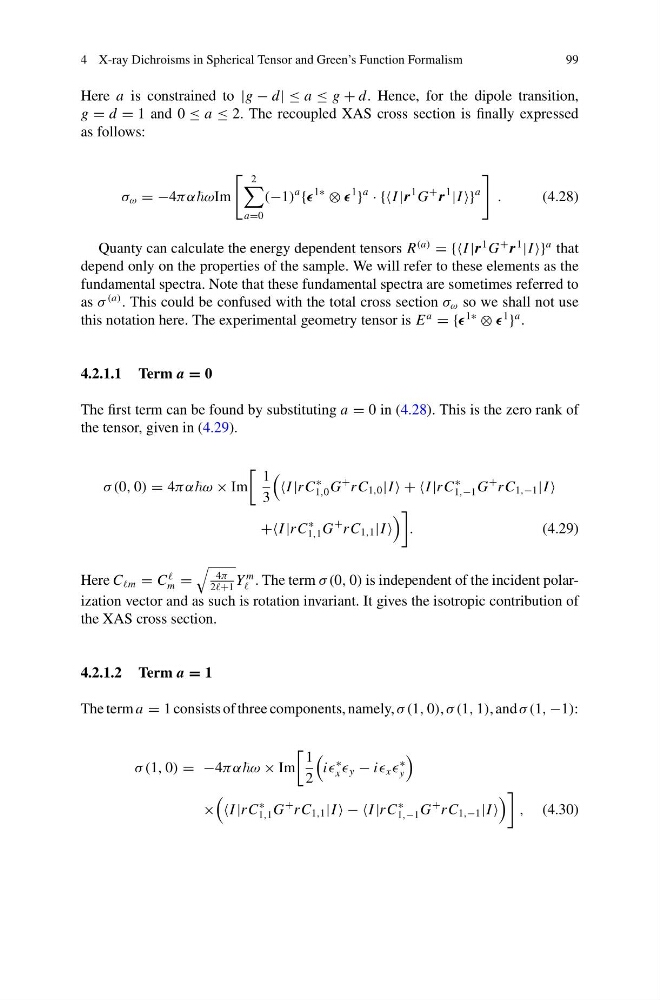
Here a is constrained to |g − d| ≤ a ≤ g + d. Hence, for the dipole transition,
g = d = 1 and 0 ≤ a ≤ 2. The recoupled XAS cross section is finally expressed
as follows:
σ ω = −4παωIm
2
a=0
(−1)
a
{
1∗
⊗
1
}
a
· {{I |r
1 G
+ r
1
|I }
a
.
(4.28)
Quanty can calculate the energy dependent tensors R
(a)
= {{I |r
1 G
+ r
1
|I }
a that
depend only on the properties of the sample. We will refer to these elements as the
fundamental spectra. Note that these fundamental spectra are sometimes referred to
as σ
(a) . This could be confused with the total cross section σ ω so we shall not use
this notation here. The experimental geometry tensor is E
a
= {
1∗
⊗
1
}
a .
4.2.1.1 Term a = 0
The first term can be found by substituting a = 0 in (4.28). This is the zero rank of
the tensor, given in (4.29).
σ (0, 0) = 4παω × Im
1
3
I |rC
∗
1,0 G
+ rC 1,0 |I + +I |rC
∗
1,−1 G
+ rC 1,−1 |I
++I |rC
∗
1,1 G
+ rC 1,1 |I
.
(4.29)
Here C m = C
m =
4π
2+1
Y
m
. The term σ (0, 0) is independent of the incident polarization vector and as such is rotation invariant. It gives the isotropic contribution of
the XAS cross section.
4.2.1.2 Term a = 1
The term a = 1 consists of three components, namely, σ (1, 0), σ (1, 1), and σ (1, −1):
σ (1, 0) = −4παω × Im
1
2
i
∗
x y − i x
∗
y
×
I |rC
∗
1,1 G
+ rC 1,1 |I − −I |rC
∗
1,−1 G
+ rC 1,−1 |I
, (4.30)
99
Here a is constrained to |g − d| ≤ a ≤ g + d. Hence, for the dipole transition,
g = d = 1 and 0 ≤ a ≤ 2. The recoupled XAS cross section is finally expressed
as follows:
σ ω = −4παωIm
2
a=0
(−1)
a
{
1∗
⊗
1
}
a
· {{I |r
1 G
+ r
1
|I }
a
.
(4.28)
Quanty can calculate the energy dependent tensors R
(a)
= {{I |r
1 G
+ r
1
|I }
a that
depend only on the properties of the sample. We will refer to these elements as the
fundamental spectra. Note that these fundamental spectra are sometimes referred to
as σ
(a) . This could be confused with the total cross section σ ω so we shall not use
this notation here. The experimental geometry tensor is E
a
= {
1∗
⊗
1
}
a .
4.2.1.1 Term a = 0
The first term can be found by substituting a = 0 in (4.28). This is the zero rank of
the tensor, given in (4.29).
σ (0, 0) = 4παω × Im
1
3
I |rC
∗
1,0 G
+ rC 1,0 |I + +I |rC
∗
1,−1 G
+ rC 1,−1 |I
++I |rC
∗
1,1 G
+ rC 1,1 |I
.
(4.29)
Here C m = C
m =
4π
2+1
Y
m
. The term σ (0, 0) is independent of the incident polarization vector and as such is rotation invariant. It gives the isotropic contribution of
the XAS cross section.
4.2.1.2 Term a = 1
The term a = 1 consists of three components, namely, σ (1, 0), σ (1, 1), and σ (1, −1):
σ (1, 0) = −4παω × Im
1
2
i
∗
x y − i x
∗
y
×
I |rC
∗
1,1 G
+ rC 1,1 |I − −I |rC
∗
1,−1 G
+ rC 1,−1 |I
, (4.30)