

4 X-ray Dichroisms in Spherical Tensor and Green’s Function Formalism
97
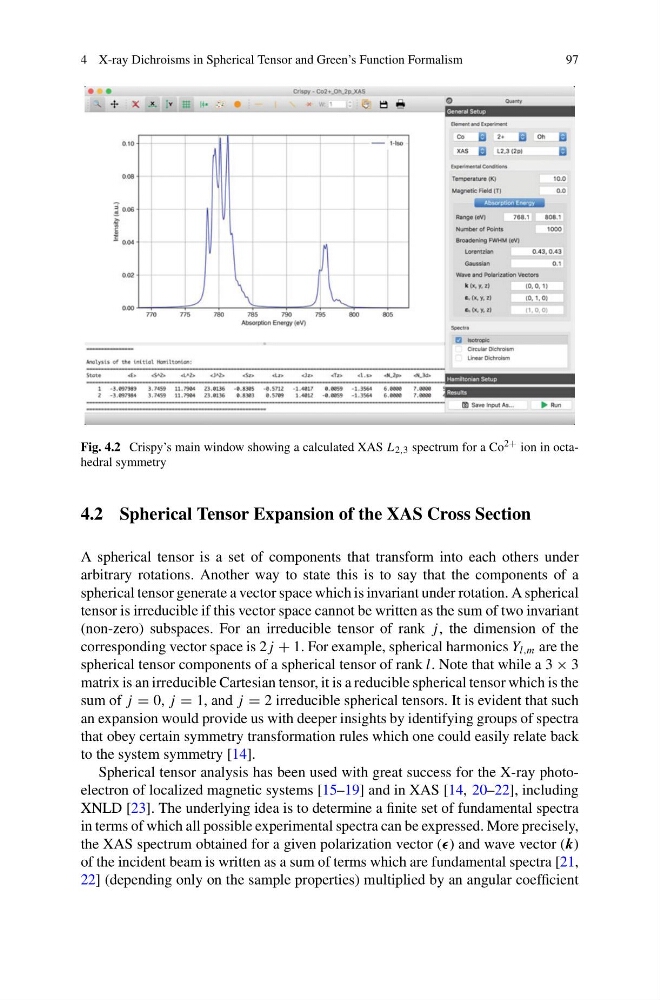
Fig. 4.2 Crispy’s main window showing a calculated XAS L 2,3 spectrum for a Co 2+ ion in octahedral symmetry
4.2 Spherical Tensor Expansion of the XAS Cross Section
A spherical tensor is a set of components that transform into each others under
arbitrary rotations. Another way to state this is to say that the components of a
spherical tensor generate a vector space which is invariant under rotation. A spherical
tensor is irreducible if this vector space cannot be written as the sum of two invariant
(non-zero) subspaces. For an irreducible tensor of rank j, the dimension of the
corresponding vector space is 2 j + 1. For example, spherical harmonics Y l,m are the
spherical tensor components of a spherical tensor of rank l. Note that while a 3 × 3
matrix is an irreducible Cartesian tensor, it is a reducible spherical tensor which is the
sum of j = 0, j = 1, and j = 2 irreducible spherical tensors. It is evident that such
an expansion would provide us with deeper insights by identifying groups of spectra
that obey certain symmetry transformation rules which one could easily relate back
to the system symmetry [14].
Spherical tensor analysis has been used with great success for the X-ray photoelectron of localized magnetic systems [15–19] and in XAS [14, 20–22], including
XNLD [23]. The underlying idea is to determine a finite set of fundamental spectra
in terms of which all possible experimental spectra can be expressed. More precisely,
the XAS spectrum obtained for a given polarization vector () and wave vector (k)
of the incident beam is written as a sum of terms which are fundamental spectra [21,
22] (depending only on the sample properties) multiplied by an angular coefficient
97
Fig. 4.2 Crispy’s main window showing a calculated XAS L 2,3 spectrum for a Co 2+ ion in octahedral symmetry
4.2 Spherical Tensor Expansion of the XAS Cross Section
A spherical tensor is a set of components that transform into each others under
arbitrary rotations. Another way to state this is to say that the components of a
spherical tensor generate a vector space which is invariant under rotation. A spherical
tensor is irreducible if this vector space cannot be written as the sum of two invariant
(non-zero) subspaces. For an irreducible tensor of rank j, the dimension of the
corresponding vector space is 2 j + 1. For example, spherical harmonics Y l,m are the
spherical tensor components of a spherical tensor of rank l. Note that while a 3 × 3
matrix is an irreducible Cartesian tensor, it is a reducible spherical tensor which is the
sum of j = 0, j = 1, and j = 2 irreducible spherical tensors. It is evident that such
an expansion would provide us with deeper insights by identifying groups of spectra
that obey certain symmetry transformation rules which one could easily relate back
to the system symmetry [14].
Spherical tensor analysis has been used with great success for the X-ray photoelectron of localized magnetic systems [15–19] and in XAS [14, 20–22], including
XNLD [23]. The underlying idea is to determine a finite set of fundamental spectra
in terms of which all possible experimental spectra can be expressed. More precisely,
the XAS spectrum obtained for a given polarization vector () and wave vector (k)
of the incident beam is written as a sum of terms which are fundamental spectra [21,
22] (depending only on the sample properties) multiplied by an angular coefficient