

401
results showed no significant difference between control and intervention sites with
regard to river water quality, periphyton and macroinvertebrate metrics. However, it
did show a small significant decrease in runoff volume in intervention areas.
Kondo et al. (2015) investigated the effects of a range of green storm water infrastructures across 52 sites in Philadelphia on health and social outcomes using a
difference-in-difference design. Installed infrastructure included 152 tree trenches,
46 infiltration/storage trenches, 43 rain gardens, 29 pervious pavements, five storm
water basins, and one wetland. The comparator groups were matched control sites
where no construction took place. Results showed significant reductions in narcotics possession (18–27% less; p < 0.01), narcotics manufacture and burglaries. There
were non-significant reductions in homicides, assaults, thefts and public drunkenness. In addition, there were negative, non-significant effects on stress levels and
increased reporting of high blood pressure and cholesterol.
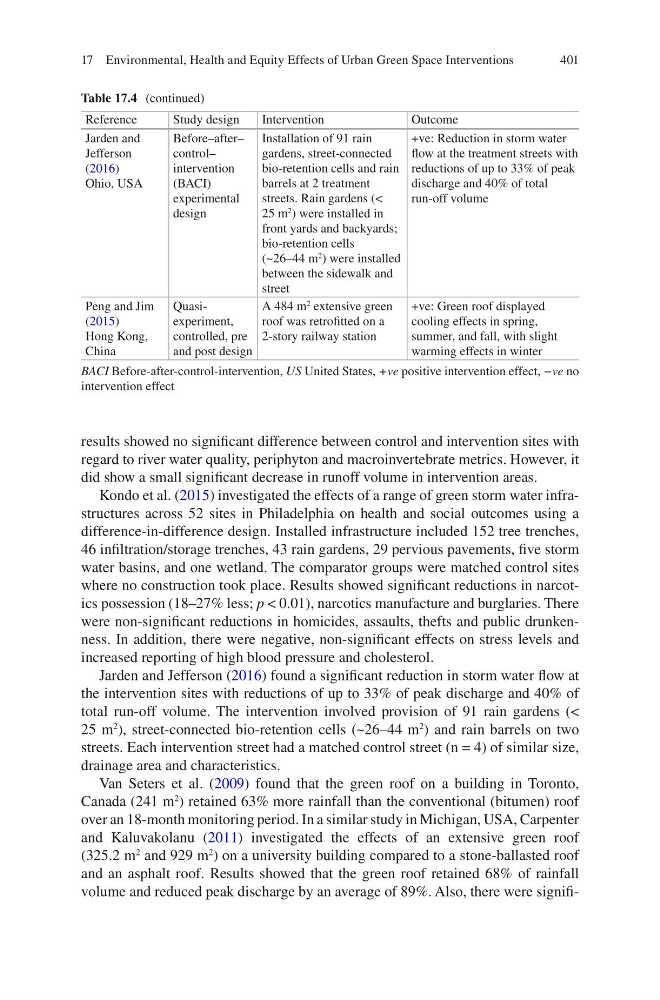
Jarden and Jefferson (2016) found a significant reduction in storm water flow at
the intervention sites with reductions of up to 33% of peak discharge and 40% of
total run-off volume. The intervention involved provision of 91 rain gardens (<
25 m
2
), street-connected bio-retention cells (~26–44 m
2
) and rain barrels on two
streets. Each intervention street had a matched control street (n = 4) of similar size,
drainage area and characteristics.
Van Seters et al. (2009) found that the green roof on a building in Toronto,
Canada (241 m
2
) retained 63% more rainfall than the conventional (bitumen) roof
over an 18-month monitoring period. In a similar study in Michigan, USA, Carpenter
and Kaluvakolanu (2011) investigated the effects of an extensive green roof
(325.2 m
2
and 929 m
2
) on a university building compared to a stone-ballasted roof
and an asphalt roof. Results showed that the green roof retained 68% of rainfall
volume and reduced peak discharge by an average of 89%. Also, there were signifiTable 17.4 (continued)
Reference
Study design
Intervention
Outcome
Jarden and
Jefferson
(2016)
Ohio, USA
Before–after–
control–
intervention
(BACI)
experimental
design
Installation of 91 rain
gardens, street-connected
bio-retention cells and rain
barrels at 2 treatment
streets. Rain gardens (<
25 m
2 ) were installed in
front yards and backyards;
bio-retention cells
(~26–44 m
2 ) were installed
between the sidewalk and
street
+ve: Reduction in storm water
flow at the treatment streets with
reductions of up to 33% of peak
discharge and 40% of total
run-off volume
Peng and Jim
(2015)
Hong Kong,
China
Quasiexperiment,
controlled, pre
and post design
A 484 m
2 extensive green
roof was retrofitted on a
2-story railway station
+ve: Green roof displayed
cooling effects in spring,
summer, and fall, with slight
warming effects in winter
BACI Before-after-control-intervention, US United States, +ve positive intervention effect, −ve no
intervention effect
17 Environmental, Health and Equity Effects of Urban Green Space Interventions
results showed no significant difference between control and intervention sites with
regard to river water quality, periphyton and macroinvertebrate metrics. However, it
did show a small significant decrease in runoff volume in intervention areas.
Kondo et al. (2015) investigated the effects of a range of green storm water infrastructures across 52 sites in Philadelphia on health and social outcomes using a
difference-in-difference design. Installed infrastructure included 152 tree trenches,
46 infiltration/storage trenches, 43 rain gardens, 29 pervious pavements, five storm
water basins, and one wetland. The comparator groups were matched control sites
where no construction took place. Results showed significant reductions in narcotics possession (18–27% less; p < 0.01), narcotics manufacture and burglaries. There
were non-significant reductions in homicides, assaults, thefts and public drunkenness. In addition, there were negative, non-significant effects on stress levels and
increased reporting of high blood pressure and cholesterol.
Jarden and Jefferson (2016) found a significant reduction in storm water flow at
the intervention sites with reductions of up to 33% of peak discharge and 40% of
total run-off volume. The intervention involved provision of 91 rain gardens (<
25 m
2
), street-connected bio-retention cells (~26–44 m
2
) and rain barrels on two
streets. Each intervention street had a matched control street (n = 4) of similar size,
drainage area and characteristics.
Van Seters et al. (2009) found that the green roof on a building in Toronto,
Canada (241 m
2
) retained 63% more rainfall than the conventional (bitumen) roof
over an 18-month monitoring period. In a similar study in Michigan, USA, Carpenter
and Kaluvakolanu (2011) investigated the effects of an extensive green roof
(325.2 m
2
and 929 m
2
) on a university building compared to a stone-ballasted roof
and an asphalt roof. Results showed that the green roof retained 68% of rainfall
volume and reduced peak discharge by an average of 89%. Also, there were signifiTable 17.4 (continued)
Reference
Study design
Intervention
Outcome
Jarden and
Jefferson
(2016)
Ohio, USA
Before–after–
control–
intervention
(BACI)
experimental
design
Installation of 91 rain
gardens, street-connected
bio-retention cells and rain
barrels at 2 treatment
streets. Rain gardens (<
25 m
2 ) were installed in
front yards and backyards;
bio-retention cells
(~26–44 m
2 ) were installed
between the sidewalk and
street
+ve: Reduction in storm water
flow at the treatment streets with
reductions of up to 33% of peak
discharge and 40% of total
run-off volume
Peng and Jim
(2015)
Hong Kong,
China
Quasiexperiment,
controlled, pre
and post design
A 484 m
2 extensive green
roof was retrofitted on a
2-story railway station
+ve: Green roof displayed
cooling effects in spring,
summer, and fall, with slight
warming effects in winter
BACI Before-after-control-intervention, US United States, +ve positive intervention effect, −ve no
intervention effect
17 Environmental, Health and Equity Effects of Urban Green Space Interventions