

398
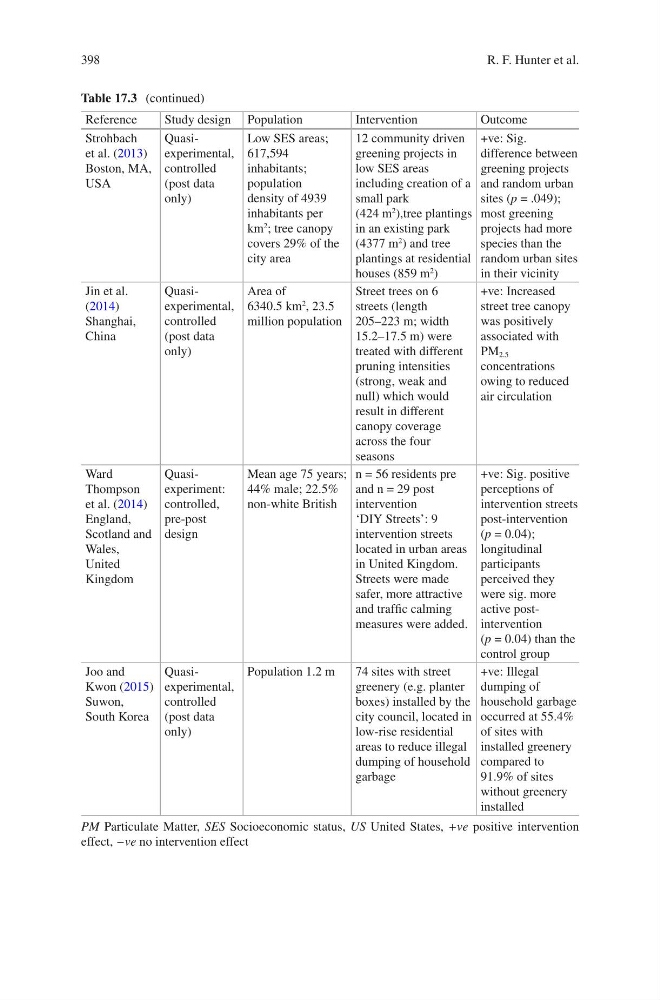
Table 17.3 (continued)
Reference
Study design Population
Intervention
Outcome
Strohbach
et al. (2013)
Boston, MA,
USA
Quasiexperimental,
controlled
(post data
only)
Low SES areas;
617,594
inhabitants;
population
density of 4939
inhabitants per
km
2 ; tree canopy
covers 29% of the
city area
12 community driven
greening projects in
low SES areas
including creation of a
small park
(424 m
2
),tree plantings
in an existing park
(4377 m
2
) and tree
plantings at residential
houses (859 m
2 )
+ve: Sig.
difference between
greening projects
and random urban
sites (p = .049);
most greening
projects had more
species than the
random urban sites
in their vicinity
Jin et al.
(2014)
Shanghai,
China
Quasiexperimental,
controlled
(post data
only)
Area of
6340.5 km
2 , 23.5
million population
Street trees on 6
streets (length
205–223 m; width
15.2–17.5 m) were
treated with different
pruning intensities
(strong, weak and
null) which would
result in different
canopy coverage
across the four
seasons
+ve: Increased
street tree canopy
was positively
associated with
PM 2.5
concentrations
owing to reduced
air circulation
Ward
Thompson
et al. (2014)
England,
Scotland and
Wales,
United
Kingdom
Quasiexperiment:
controlled,
pre-post
design
Mean age 75 years;
44% male; 22.5%
non-white British
n = 56 residents pre
and n = 29 post
intervention
‘DIY Streets’: 9
intervention streets
located in urban areas
in United Kingdom.
Streets were made
safer, more attractive
and traffic calming
measures were added.
+ve: Sig. positive
perceptions of
intervention streets
post-intervention
(p = 0.04);
longitudinal
participants
perceived they
were sig. more
active postintervention
(p = 0.04) than the
control group
Joo and
Kwon (2015)
Suwon,
South Korea
Quasiexperimental,
controlled
(post data
only)
Population 1.2 m
74 sites with street
greenery (e.g. planter
boxes) installed by the
city council, located in
low-rise residential
areas to reduce illegal
dumping of household
garbage
+ve: Illegal
dumping of
household garbage
occurred at 55.4%
of sites with
installed greenery
compared to
91.9% of sites
without greenery
installed
PM Particulate Matter, SES Socioeconomic status, US United States, +ve positive intervention
effect, −ve no intervention effect
R. F. Hunter et al.
Table 17.3 (continued)
Reference
Study design Population
Intervention
Outcome
Strohbach
et al. (2013)
Boston, MA,
USA
Quasiexperimental,
controlled
(post data
only)
Low SES areas;
617,594
inhabitants;
population
density of 4939
inhabitants per
km
2 ; tree canopy
covers 29% of the
city area
12 community driven
greening projects in
low SES areas
including creation of a
small park
(424 m
2
),tree plantings
in an existing park
(4377 m
2
) and tree
plantings at residential
houses (859 m
2 )
+ve: Sig.
difference between
greening projects
and random urban
sites (p = .049);
most greening
projects had more
species than the
random urban sites
in their vicinity
Jin et al.
(2014)
Shanghai,
China
Quasiexperimental,
controlled
(post data
only)
Area of
6340.5 km
2 , 23.5
million population
Street trees on 6
streets (length
205–223 m; width
15.2–17.5 m) were
treated with different
pruning intensities
(strong, weak and
null) which would
result in different
canopy coverage
across the four
seasons
+ve: Increased
street tree canopy
was positively
associated with
PM 2.5
concentrations
owing to reduced
air circulation
Ward
Thompson
et al. (2014)
England,
Scotland and
Wales,
United
Kingdom
Quasiexperiment:
controlled,
pre-post
design
Mean age 75 years;
44% male; 22.5%
non-white British
n = 56 residents pre
and n = 29 post
intervention
‘DIY Streets’: 9
intervention streets
located in urban areas
in United Kingdom.
Streets were made
safer, more attractive
and traffic calming
measures were added.
+ve: Sig. positive
perceptions of
intervention streets
post-intervention
(p = 0.04);
longitudinal
participants
perceived they
were sig. more
active postintervention
(p = 0.04) than the
control group
Joo and
Kwon (2015)
Suwon,
South Korea
Quasiexperimental,
controlled
(post data
only)
Population 1.2 m
74 sites with street
greenery (e.g. planter
boxes) installed by the
city council, located in
low-rise residential
areas to reduce illegal
dumping of household
garbage
+ve: Illegal
dumping of
household garbage
occurred at 55.4%
of sites with
installed greenery
compared to
91.9% of sites
without greenery
installed
PM Particulate Matter, SES Socioeconomic status, US United States, +ve positive intervention
effect, −ve no intervention effect
R. F. Hunter et al.