

397
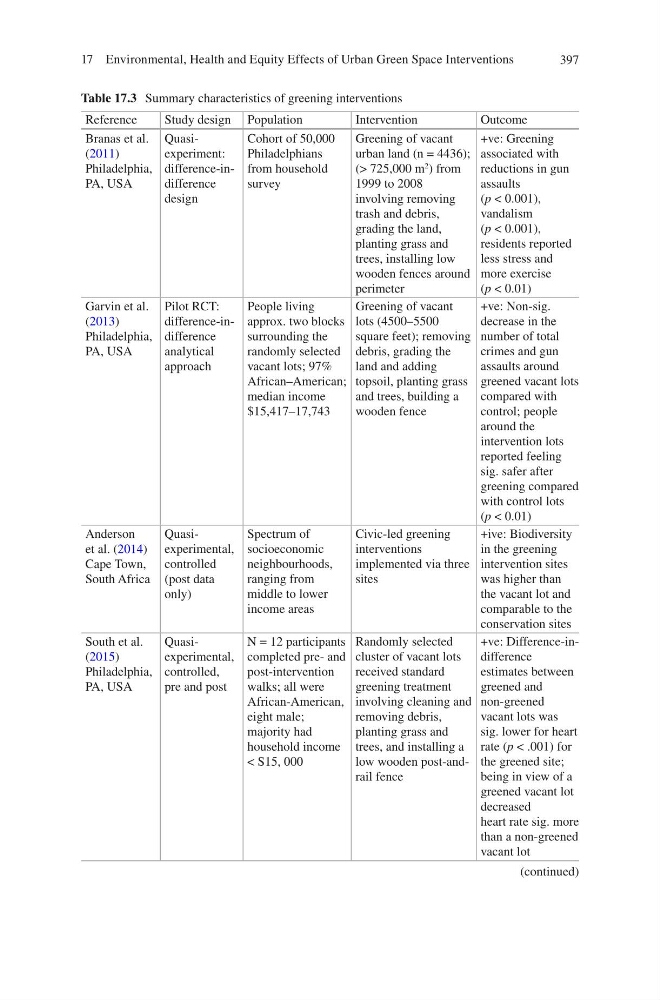
Table 17.3 Summary characteristics of greening interventions
Reference
Study design Population
Intervention
Outcome
Branas et al.
(2011)
Philadelphia,
PA, USA
Quasiexperiment:
difference-indifference
design
Cohort of 50,000
Philadelphians
from household
survey
Greening of vacant
urban land (n = 4436);
(> 725,000 m
2
) from
1999 to 2008
involving removing
trash and debris,
grading the land,
planting grass and
trees, installing low
wooden fences around
perimeter
+ve: Greening
associated with
reductions in gun
assaults
(p < 0.001),
vandalism
(p < 0.001),
residents reported
less stress and
more exercise
(p < 0.01)
Garvin et al.
(2013)
Philadelphia,
PA, USA
Pilot RCT:
difference-indifference
analytical
approach
People living
approx. two blocks
surrounding the
randomly selected
vacant lots; 97%
African–American;
median income
$15,417–17,743
Greening of vacant
lots (4500–5500
square feet); removing
debris, grading the
land and adding
topsoil, planting grass
and trees, building a
wooden fence
+ve: Non-sig.
decrease in the
number of total
crimes and gun
assaults around
greened vacant lots
compared with
control; people
around the
intervention lots
reported feeling
sig. safer after
greening compared
with control lots
(p < 0.01)
Anderson
et al. (2014)
Cape Town,
South Africa
Quasiexperimental,
controlled
(post data
only)
Spectrum of
socioeconomic
neighbourhoods,
ranging from
middle to lower
income areas
Civic-led greening
interventions
implemented via three
sites
+ive: Biodiversity
in the greening
intervention sites
was higher than
the vacant lot and
comparable to the
conservation sites
South et al.
(2015)
Philadelphia,
PA, USA
Quasiexperimental,
controlled,
pre and post
N = 12 participants
completed pre- and
post-intervention
walks; all were
African-American,
eight male;
majority had
household income
< S15, 000
Randomly selected
cluster of vacant lots
received standard
greening treatment
involving cleaning and
removing debris,
planting grass and
trees, and installing a
low wooden post-andrail fence
+ve: Difference-indifference
estimates between
greened and
non-greened
vacant lots was
sig. lower for heart
rate (p < .001) for
the greened site;
being in view of a
greened vacant lot
decreased
heart rate sig. more
than a non-greened
vacant lot
(continued)
17 Environmental, Health and Equity Effects of Urban Green Space Interventions
Table 17.3 Summary characteristics of greening interventions
Reference
Study design Population
Intervention
Outcome
Branas et al.
(2011)
Philadelphia,
PA, USA
Quasiexperiment:
difference-indifference
design
Cohort of 50,000
Philadelphians
from household
survey
Greening of vacant
urban land (n = 4436);
(> 725,000 m
2
) from
1999 to 2008
involving removing
trash and debris,
grading the land,
planting grass and
trees, installing low
wooden fences around
perimeter
+ve: Greening
associated with
reductions in gun
assaults
(p < 0.001),
vandalism
(p < 0.001),
residents reported
less stress and
more exercise
(p < 0.01)
Garvin et al.
(2013)
Philadelphia,
PA, USA
Pilot RCT:
difference-indifference
analytical
approach
People living
approx. two blocks
surrounding the
randomly selected
vacant lots; 97%
African–American;
median income
$15,417–17,743
Greening of vacant
lots (4500–5500
square feet); removing
debris, grading the
land and adding
topsoil, planting grass
and trees, building a
wooden fence
+ve: Non-sig.
decrease in the
number of total
crimes and gun
assaults around
greened vacant lots
compared with
control; people
around the
intervention lots
reported feeling
sig. safer after
greening compared
with control lots
(p < 0.01)
Anderson
et al. (2014)
Cape Town,
South Africa
Quasiexperimental,
controlled
(post data
only)
Spectrum of
socioeconomic
neighbourhoods,
ranging from
middle to lower
income areas
Civic-led greening
interventions
implemented via three
sites
+ive: Biodiversity
in the greening
intervention sites
was higher than
the vacant lot and
comparable to the
conservation sites
South et al.
(2015)
Philadelphia,
PA, USA
Quasiexperimental,
controlled,
pre and post
N = 12 participants
completed pre- and
post-intervention
walks; all were
African-American,
eight male;
majority had
household income
< S15, 000
Randomly selected
cluster of vacant lots
received standard
greening treatment
involving cleaning and
removing debris,
planting grass and
trees, and installing a
low wooden post-andrail fence
+ve: Difference-indifference
estimates between
greened and
non-greened
vacant lots was
sig. lower for heart
rate (p < .001) for
the greened site;
being in view of a
greened vacant lot
decreased
heart rate sig. more
than a non-greened
vacant lot
(continued)
17 Environmental, Health and Equity Effects of Urban Green Space Interventions