

387
Reference
Study design Population
Intervention
Outcome
NSW Health
(2002)
Sydney,
Australia
Quasiexperiment:
controlled,
pre-post
design
Residents aged
25–65 years
3 types of interventions in 3 parks: promoting PA and park use
(via advertisements, walking maps), park modifications
(signage, greening, improved paths, new playground) and the
establishment of walking groups
+ve: Intervention group more likely
to have walked in the 2 weeks prior
to follow-up than control. Sig.
group by gender interaction
indicated,
intervention males were 2.8 times
more likely to walk than were
males in the control ward
Tester and Baker
(2009)
San Francisco,
CA, USA
Quasiexperiment:
controlled,
pre-post
design
Resource poor
neighbourhoods;
primarily Latino
community
Major renovations to two parks: lighting, fencing, artificial turf,
landscaping, picnic benches, goal posts, walkways
+ve: Sig. increases of greater than
fourfold magnitude among children
and adults of both genders at the
intervention park playfields, but not
in the control park; sig. park use in
non-play fields
Cohen et al.
(2013)
Los Angeles,
CA, USA
RCT: parks
randomized
to 3 study
arms (17
parks per
study arm)
Parks users and
residents living
within 1 mile
radius of park
2 intervention groups:
(1) Park Director only; (2) Park Advisory Board-Park Director
Involved in all aspects of research and in using baseline results
to design park- specific interventions to increase park use and
PA; Park Directors received five training sessions from a
marketing consultant
Each park received $4000 to spend on signage; promotional
incentives; outreach and support for group activities
+ve: In both intervention parks, PA
increased, generating an estimated
average of 600 more visits/week/
park, and 1830 more MET-hours of
PA/week/park
Ward Thompson
et al. (2013)
Glasgow,
Scotland, United
Kingdom
Quasiexperiment:
controlled,
pre-post
design
High
socioeconomic
deprivation areas
with woods/green
space within
500 m of the
community
Regeneration of local community: construction of improved
footpaths; clearing rubbish and signs of vandalism; signage and
entrance gateways; silvicultural work to improve appearance
and safety of trees and vegetation (improve views and
visibility); publicity and group activities to encourage
knowledge of woodlands and opportunities for use.
+ve: Quality of life sig. increased in
both neighbourhoods (more in
intervention) over time and a sig.
difference in quality of the physical
environment between sites in 2006
but not 2009. Sig. differences in
perceptions of safety (p < 0.05) in
the intervention site over time,
compared with no sig. change in
the control
(continued)
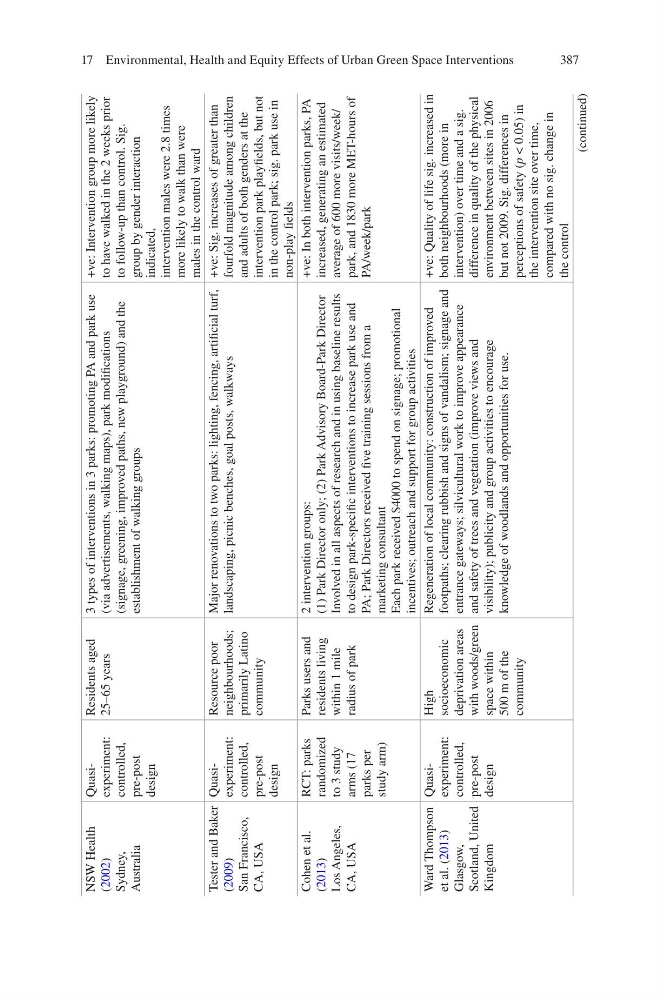
17 Environmental, Health and Equity Effects of Urban Green Space Interventions
Reference
Study design Population
Intervention
Outcome
NSW Health
(2002)
Sydney,
Australia
Quasiexperiment:
controlled,
pre-post
design
Residents aged
25–65 years
3 types of interventions in 3 parks: promoting PA and park use
(via advertisements, walking maps), park modifications
(signage, greening, improved paths, new playground) and the
establishment of walking groups
+ve: Intervention group more likely
to have walked in the 2 weeks prior
to follow-up than control. Sig.
group by gender interaction
indicated,
intervention males were 2.8 times
more likely to walk than were
males in the control ward
Tester and Baker
(2009)
San Francisco,
CA, USA
Quasiexperiment:
controlled,
pre-post
design
Resource poor
neighbourhoods;
primarily Latino
community
Major renovations to two parks: lighting, fencing, artificial turf,
landscaping, picnic benches, goal posts, walkways
+ve: Sig. increases of greater than
fourfold magnitude among children
and adults of both genders at the
intervention park playfields, but not
in the control park; sig. park use in
non-play fields
Cohen et al.
(2013)
Los Angeles,
CA, USA
RCT: parks
randomized
to 3 study
arms (17
parks per
study arm)
Parks users and
residents living
within 1 mile
radius of park
2 intervention groups:
(1) Park Director only; (2) Park Advisory Board-Park Director
Involved in all aspects of research and in using baseline results
to design park- specific interventions to increase park use and
PA; Park Directors received five training sessions from a
marketing consultant
Each park received $4000 to spend on signage; promotional
incentives; outreach and support for group activities
+ve: In both intervention parks, PA
increased, generating an estimated
average of 600 more visits/week/
park, and 1830 more MET-hours of
PA/week/park
Ward Thompson
et al. (2013)
Glasgow,
Scotland, United
Kingdom
Quasiexperiment:
controlled,
pre-post
design
High
socioeconomic
deprivation areas
with woods/green
space within
500 m of the
community
Regeneration of local community: construction of improved
footpaths; clearing rubbish and signs of vandalism; signage and
entrance gateways; silvicultural work to improve appearance
and safety of trees and vegetation (improve views and
visibility); publicity and group activities to encourage
knowledge of woodlands and opportunities for use.
+ve: Quality of life sig. increased in
both neighbourhoods (more in
intervention) over time and a sig.
difference in quality of the physical
environment between sites in 2006
but not 2009. Sig. differences in
perceptions of safety (p < 0.05) in
the intervention site over time,
compared with no sig. change in
the control
(continued)
17 Environmental, Health and Equity Effects of Urban Green Space Interventions