

110
confounders mostly address variables of social status that include education of survey participants or households, followed by income or employment status.
For income, it was shown that a higher household income was found to be less
likely for residents with psychiatric morbidity, and that this was less prevalent in
greener neighbourhoods (Astell-Burt et al. 2014). Significant associations between
greenness and physical activity were identified in all income groups (McMorris
et al. 2015). Mukherjee et al. (2017) showed that park size was significantly negatively associated with depression even when models were adjusted for confounders
such as income, education or employment status, but also for age, gender, marital
status and household composition. Similarly, Calogiuri et al. (2016) and Nichani
et al. (2017) found that socio-economic inequality in mental well-being was significantly lower among respondents reporting good access to a green space compared with those who had less access. Other studies, however, could not find any
relationship between health outcome and socio-economic or socio-demographic
confounders (Calogiuri et al. 2016; Nichani et al. 2017) or showed that significant
associations between green space and health outcome became non-significant after
models were adjusted for confounders (Cusack et al. 2017; Richardson et al.
2017a). For example, Padilla et al. (2016) showed that the significant association
between green space and stress disappeared when models were adjusted for socioeconomic confounders. A case study city in France showed a significant relationship between infant and neonatal mortality risk and level of deprivation, but could
not clearly explain the link to urban green space (Kihal-Talantikite et al. 2013)
(Fig. 5.4).
age
sex/gender
race/ethnicity
marital status
household composition
population density
0
5
10
15
20
No. of articles
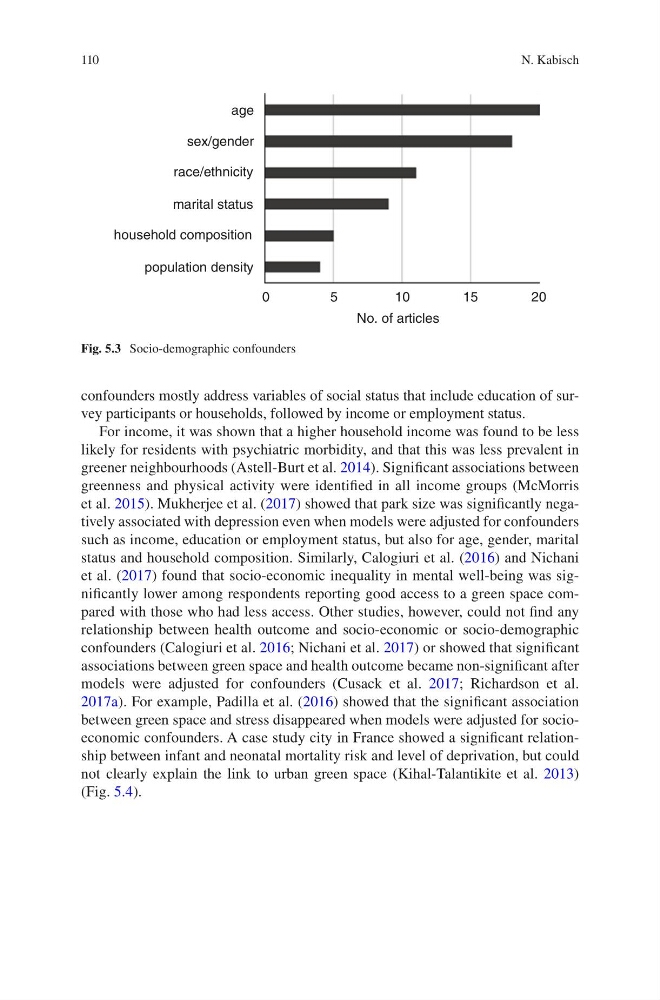
Fig. 5.3 Socio-demographic confounders
N. Kabisch
confounders mostly address variables of social status that include education of survey participants or households, followed by income or employment status.
For income, it was shown that a higher household income was found to be less
likely for residents with psychiatric morbidity, and that this was less prevalent in
greener neighbourhoods (Astell-Burt et al. 2014). Significant associations between
greenness and physical activity were identified in all income groups (McMorris
et al. 2015). Mukherjee et al. (2017) showed that park size was significantly negatively associated with depression even when models were adjusted for confounders
such as income, education or employment status, but also for age, gender, marital
status and household composition. Similarly, Calogiuri et al. (2016) and Nichani
et al. (2017) found that socio-economic inequality in mental well-being was significantly lower among respondents reporting good access to a green space compared with those who had less access. Other studies, however, could not find any
relationship between health outcome and socio-economic or socio-demographic
confounders (Calogiuri et al. 2016; Nichani et al. 2017) or showed that significant
associations between green space and health outcome became non-significant after
models were adjusted for confounders (Cusack et al. 2017; Richardson et al.
2017a). For example, Padilla et al. (2016) showed that the significant association
between green space and stress disappeared when models were adjusted for socioeconomic confounders. A case study city in France showed a significant relationship between infant and neonatal mortality risk and level of deprivation, but could
not clearly explain the link to urban green space (Kihal-Talantikite et al. 2013)
(Fig. 5.4).
age
sex/gender
race/ethnicity
marital status
household composition
population density
0
5
10
15
20
No. of articles
Fig. 5.3 Socio-demographic confounders
N. Kabisch