

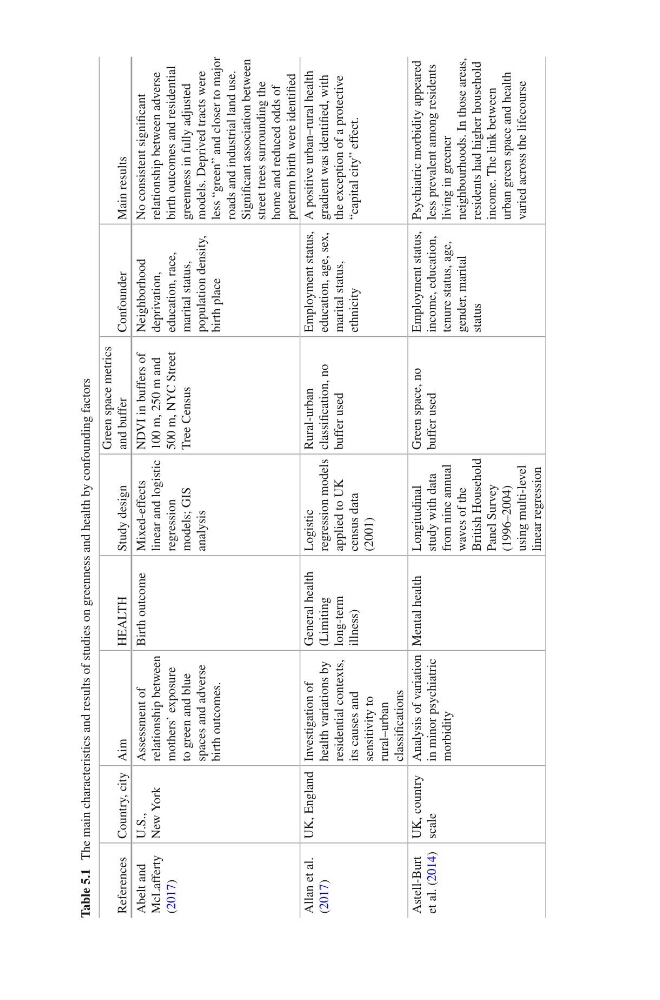
Table 5.1 The main characteristics and results of studies on greenness and health by confounding factors
References Country, city Aim
HEALTH
Study design
Green space metrics
and buffer
Confounder
Main results
Abelt and
McLafferty
(2017)
U.S.,
New York
Assessment of
relationship between
mothers’ exposure
to green and blue
spaces and adverse
birth outcomes.
Birth outcome
Mixed-effects
linear and logistic
regression
models; GIS
analysis
NDVI in buffers of
100 m, 250 m and
500 m, NYC Street
Tree Census
Neighborhood
deprivation,
education, race,
marital status,
population density,
birth place
No consistent significant
relationship between adverse
birth outcomes and residential
greenness in fully adjusted
models. Deprived tracts were
less “green” and closer to major
roads and industrial land use.
Significant association between
street trees surrounding the
home and reduced odds of
preterm birth were identified
Allan et al.
(2017)
UK, England Investigation of
health variations by
residential contexts,
its causes and
sensitivity to
rural–urban
classifications
General health
(Limiting
long-term
illness)
Logistic
regression models
applied to UK
census data
(2001)
Rural-urban
classification, no
buffer used
Employment status,
education, age, sex,
marital status,
ethnicity
A positive urban–rural health
gradient was identified, with
the exception of a protective
“capital city” effect.
Astell-Burt
et al. (2014)
UK, country
scale
Analysis of variation
in minor psychiatric
morbidity
Mental health
Longitudinal
study with data
from nine annual
waves of the
British Household
Panel Survey
(1996–2004)
using multi- level
linear regression
Green space, no
buffer used
Employment status,
income, education,
tenure status, age,
gender, marital
status
Psychiatric morbidity appeared
less prevalent among residents
living in greener
neighbourhoods. In those areas,
residents had higher household
income. The link between
urban green space and health
varied across the lifecourse
References Country, city Aim
HEALTH
Study design
Green space metrics
and buffer
Confounder
Main results
Abelt and
McLafferty
(2017)
U.S.,
New York
Assessment of
relationship between
mothers’ exposure
to green and blue
spaces and adverse
birth outcomes.
Birth outcome
Mixed-effects
linear and logistic
regression
models; GIS
analysis
NDVI in buffers of
100 m, 250 m and
500 m, NYC Street
Tree Census
Neighborhood
deprivation,
education, race,
marital status,
population density,
birth place
No consistent significant
relationship between adverse
birth outcomes and residential
greenness in fully adjusted
models. Deprived tracts were
less “green” and closer to major
roads and industrial land use.
Significant association between
street trees surrounding the
home and reduced odds of
preterm birth were identified
Allan et al.
(2017)
UK, England Investigation of
health variations by
residential contexts,
its causes and
sensitivity to
rural–urban
classifications
General health
(Limiting
long-term
illness)
Logistic
regression models
applied to UK
census data
(2001)
Rural-urban
classification, no
buffer used
Employment status,
education, age, sex,
marital status,
ethnicity
A positive urban–rural health
gradient was identified, with
the exception of a protective
“capital city” effect.
Astell-Burt
et al. (2014)
UK, country
scale
Analysis of variation
in minor psychiatric
morbidity
Mental health
Longitudinal
study with data
from nine annual
waves of the
British Household
Panel Survey
(1996–2004)
using multi- level
linear regression
Green space, no
buffer used
Employment status,
income, education,
tenure status, age,
gender, marital
status
Psychiatric morbidity appeared
less prevalent among residents
living in greener
neighbourhoods. In those areas,
residents had higher household
income. The link between
urban green space and health
varied across the lifecourse