

76
Q. Hu and L. Dong
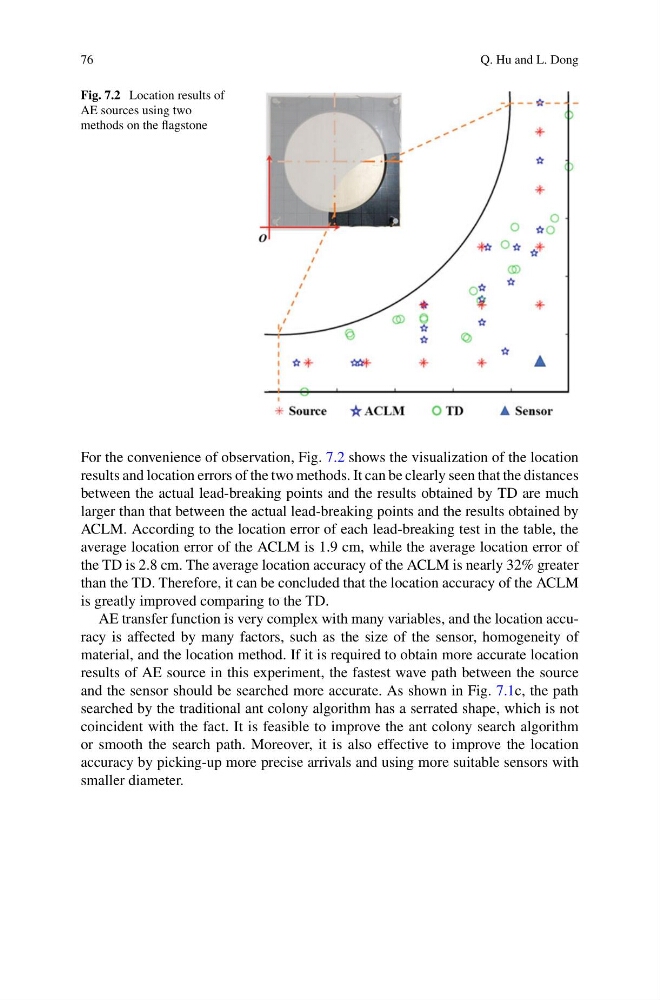
Fig. 7.2 Location results of
AE sources using two
methods on the flagstone
For the convenience of observation, Fig. 7.2 shows the visualization of the location
results and location errors of the two methods. It can be clearly seen that the distances
between the actual lead-breaking points and the results obtained by TD are much
larger than that between the actual lead-breaking points and the results obtained by
ACLM. According to the location error of each lead-breaking test in the table, the
average location error of the ACLM is 1.9 cm, while the average location error of
the TD is 2.8 cm. The average location accuracy of the ACLM is nearly 32% greater
than the TD. Therefore, it can be concluded that the location accuracy of the ACLM
is greatly improved comparing to the TD.
AE transfer function is very complex with many variables, and the location accuracy is affected by many factors, such as the size of the sensor, homogeneity of
material, and the location method. If it is required to obtain more accurate location
results of AE source in this experiment, the fastest wave path between the source
and the sensor should be searched more accurate. As shown in Fig. 7.1c, the path
searched by the traditional ant colony algorithm has a serrated shape, which is not
coincident with the fact. It is feasible to improve the ant colony search algorithm
or smooth the search path. Moreover, it is also effective to improve the location
accuracy by picking-up more precise arrivals and using more suitable sensors with
smaller diameter.
Q. Hu and L. Dong
Fig. 7.2 Location results of
AE sources using two
methods on the flagstone
For the convenience of observation, Fig. 7.2 shows the visualization of the location
results and location errors of the two methods. It can be clearly seen that the distances
between the actual lead-breaking points and the results obtained by TD are much
larger than that between the actual lead-breaking points and the results obtained by
ACLM. According to the location error of each lead-breaking test in the table, the
average location error of the ACLM is 1.9 cm, while the average location error of
the TD is 2.8 cm. The average location accuracy of the ACLM is nearly 32% greater
than the TD. Therefore, it can be concluded that the location accuracy of the ACLM
is greatly improved comparing to the TD.
AE transfer function is very complex with many variables, and the location accuracy is affected by many factors, such as the size of the sensor, homogeneity of
material, and the location method. If it is required to obtain more accurate location
results of AE source in this experiment, the fastest wave path between the source
and the sensor should be searched more accurate. As shown in Fig. 7.1c, the path
searched by the traditional ant colony algorithm has a serrated shape, which is not
coincident with the fact. It is feasible to improve the ant colony search algorithm
or smooth the search path. Moreover, it is also effective to improve the location
accuracy by picking-up more precise arrivals and using more suitable sensors with
smaller diameter.