

50 Acoustic Emissions of Cathode Carbon Block …
569
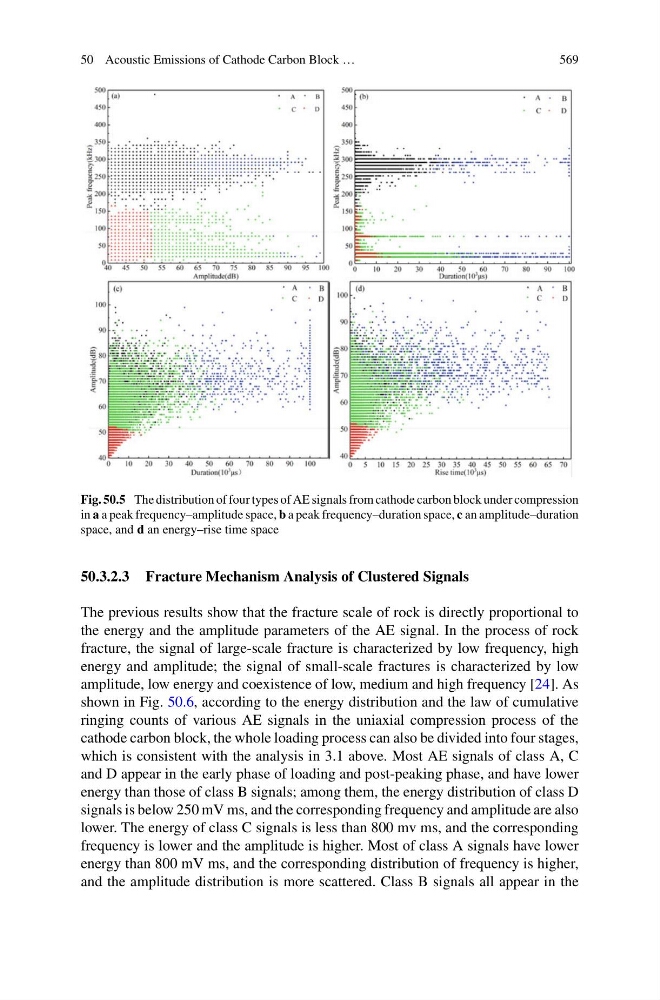
Fig. 50.5 The distribution of four types of AE signals from cathode carbon block under compression
in a a peak frequency–amplitude space, b a peak frequency–duration space, c an amplitude–duration
space, and d an energy–rise time space
50.3.2.3 Fracture Mechanism Analysis of Clustered Signals
The previous results show that the fracture scale of rock is directly proportional to
the energy and the amplitude parameters of the AE signal. In the process of rock
fracture, the signal of large-scale fracture is characterized by low frequency, high
energy and amplitude; the signal of small-scale fractures is characterized by low
amplitude, low energy and coexistence of low, medium and high frequency [24]. As
shown in Fig. 50.6, according to the energy distribution and the law of cumulative
ringing counts of various AE signals in the uniaxial compression process of the
cathode carbon block, the whole loading process can also be divided into four stages,
which is consistent with the analysis in 3.1 above. Most AE signals of class A, C
and D appear in the early phase of loading and post-peaking phase, and have lower
energy than those of class B signals; among them, the energy distribution of class D
signals is below 250 mV ms, and the corresponding frequency and amplitude are also
lower. The energy of class C signals is less than 800 mv ms, and the corresponding
frequency is lower and the amplitude is higher. Most of class A signals have lower
energy than 800 mV ms, and the corresponding distribution of frequency is higher,
and the amplitude distribution is more scattered. Class B signals all appear in the
569
Fig. 50.5 The distribution of four types of AE signals from cathode carbon block under compression
in a a peak frequency–amplitude space, b a peak frequency–duration space, c an amplitude–duration
space, and d an energy–rise time space
50.3.2.3 Fracture Mechanism Analysis of Clustered Signals
The previous results show that the fracture scale of rock is directly proportional to
the energy and the amplitude parameters of the AE signal. In the process of rock
fracture, the signal of large-scale fracture is characterized by low frequency, high
energy and amplitude; the signal of small-scale fractures is characterized by low
amplitude, low energy and coexistence of low, medium and high frequency [24]. As
shown in Fig. 50.6, according to the energy distribution and the law of cumulative
ringing counts of various AE signals in the uniaxial compression process of the
cathode carbon block, the whole loading process can also be divided into four stages,
which is consistent with the analysis in 3.1 above. Most AE signals of class A, C
and D appear in the early phase of loading and post-peaking phase, and have lower
energy than those of class B signals; among them, the energy distribution of class D
signals is below 250 mV ms, and the corresponding frequency and amplitude are also
lower. The energy of class C signals is less than 800 mv ms, and the corresponding
frequency is lower and the amplitude is higher. Most of class A signals have lower
energy than 800 mV ms, and the corresponding distribution of frequency is higher,
and the amplitude distribution is more scattered. Class B signals all appear in the