

540
J. Zhang et al.
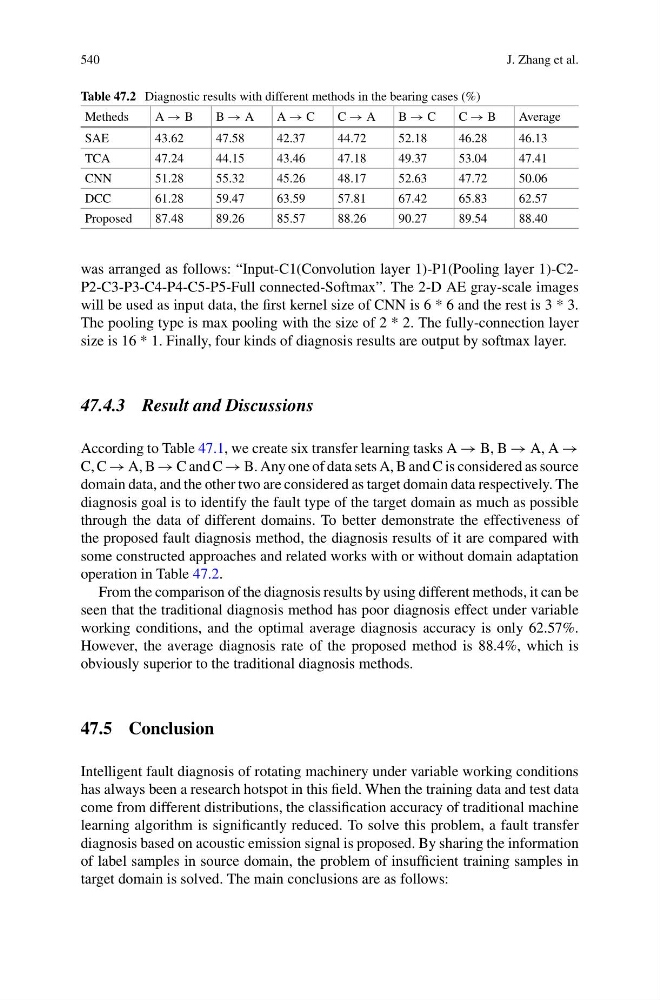
Table 47.2 Diagnostic results with different methods in the bearing cases (%)
Metheds
A → B
B → A
A → C
C → A
B → C
C → B
Average
SAE
43.62
47.58
42.37
44.72
52.18
46.28
46.13
TCA
47.24
44.15
43.46
47.18
49.37
53.04
47.41
CNN
51.28
55.32
45.26
48.17
52.63
47.72
50.06
DCC
61.28
59.47
63.59
57.81
67.42
65.83
62.57
Proposed
87.48
89.26
85.57
88.26
90.27
89.54
88.40
was arranged as follows: “Input-C1(Convolution layer 1)-P1(Pooling layer 1)-C2P2-C3-P3-C4-P4-C5-P5-Full connected-Softmax”. The 2-D AE gray-scale images
will be used as input data, the first kernel size of CNN is 6 * 6 and the rest is 3 * 3.
The pooling type is max pooling with the size of 2 * 2. The fully-connection layer
size is 16 * 1. Finally, four kinds of diagnosis results are output by softmax layer.
47.4.3 Result and Discussions
According to Table 47.1, we create six transfer learning tasks A → B, B → A, A →
C, C → A, B → C and C → B. Any one of data sets A, B and C is considered as source
domain data, and the other two are considered as target domain data respectively. The
diagnosis goal is to identify the fault type of the target domain as much as possible
through the data of different domains. To better demonstrate the effectiveness of
the proposed fault diagnosis method, the diagnosis results of it are compared with
some constructed approaches and related works with or without domain adaptation
operation in Table 47.2.
From the comparison of the diagnosis results by using different methods, it can be
seen that the traditional diagnosis method has poor diagnosis effect under variable
working conditions, and the optimal average diagnosis accuracy is only 62.57%.
However, the average diagnosis rate of the proposed method is 88.4%, which is
obviously superior to the traditional diagnosis methods.
47.5 Conclusion
Intelligent fault diagnosis of rotating machinery under variable working conditions
has always been a research hotspot in this field. When the training data and test data
come from different distributions, the classification accuracy of traditional machine
learning algorithm is significantly reduced. To solve this problem, a fault transfer
diagnosis based on acoustic emission signal is proposed. By sharing the information
of label samples in source domain, the problem of insufficient training samples in
target domain is solved. The main conclusions are as follows:
J. Zhang et al.
Table 47.2 Diagnostic results with different methods in the bearing cases (%)
Metheds
A → B
B → A
A → C
C → A
B → C
C → B
Average
SAE
43.62
47.58
42.37
44.72
52.18
46.28
46.13
TCA
47.24
44.15
43.46
47.18
49.37
53.04
47.41
CNN
51.28
55.32
45.26
48.17
52.63
47.72
50.06
DCC
61.28
59.47
63.59
57.81
67.42
65.83
62.57
Proposed
87.48
89.26
85.57
88.26
90.27
89.54
88.40
was arranged as follows: “Input-C1(Convolution layer 1)-P1(Pooling layer 1)-C2P2-C3-P3-C4-P4-C5-P5-Full connected-Softmax”. The 2-D AE gray-scale images
will be used as input data, the first kernel size of CNN is 6 * 6 and the rest is 3 * 3.
The pooling type is max pooling with the size of 2 * 2. The fully-connection layer
size is 16 * 1. Finally, four kinds of diagnosis results are output by softmax layer.
47.4.3 Result and Discussions
According to Table 47.1, we create six transfer learning tasks A → B, B → A, A →
C, C → A, B → C and C → B. Any one of data sets A, B and C is considered as source
domain data, and the other two are considered as target domain data respectively. The
diagnosis goal is to identify the fault type of the target domain as much as possible
through the data of different domains. To better demonstrate the effectiveness of
the proposed fault diagnosis method, the diagnosis results of it are compared with
some constructed approaches and related works with or without domain adaptation
operation in Table 47.2.
From the comparison of the diagnosis results by using different methods, it can be
seen that the traditional diagnosis method has poor diagnosis effect under variable
working conditions, and the optimal average diagnosis accuracy is only 62.57%.
However, the average diagnosis rate of the proposed method is 88.4%, which is
obviously superior to the traditional diagnosis methods.
47.5 Conclusion
Intelligent fault diagnosis of rotating machinery under variable working conditions
has always been a research hotspot in this field. When the training data and test data
come from different distributions, the classification accuracy of traditional machine
learning algorithm is significantly reduced. To solve this problem, a fault transfer
diagnosis based on acoustic emission signal is proposed. By sharing the information
of label samples in source domain, the problem of insufficient training samples in
target domain is solved. The main conclusions are as follows: