

45 Identification of Acoustic Emission Signals …
523
Table 45.3 Sample setting under training conditions
Training label
Rolling bearing operating
condition
Number of training
samples
Number of test samples
00001
Normal
30
6
00010
Outer ring failure
30
6
00100
Inner ring failure
30
6
01000
Rolling element failure
30
6
10000
Cage failure
30
6
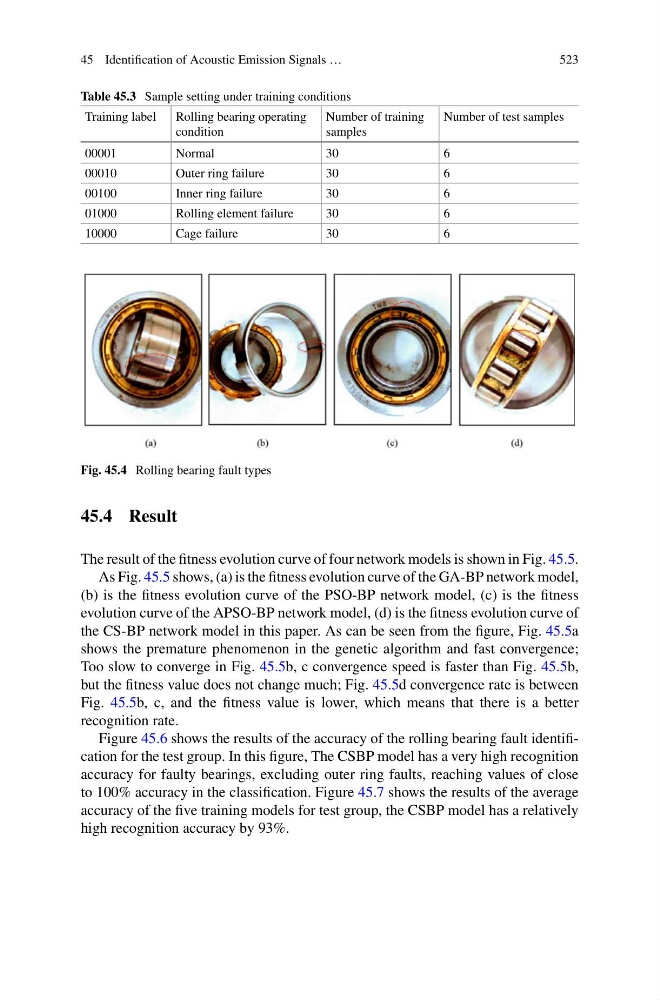
Fig. 45.4 Rolling bearing fault types
45.4 Result
The result of the fitness evolution curve of four network models is shown in Fig. 45.5.
As Fig. 45.5 shows, (a) is the fitness evolution curve of the GA-BP network model,
(b) is the fitness evolution curve of the PSO-BP network model, (c) is the fitness
evolution curve of the APSO-BP network model, (d) is the fitness evolution curve of
the CS-BP network model in this paper. As can be seen from the figure, Fig. 45.5a
shows the premature phenomenon in the genetic algorithm and fast convergence;
Too slow to converge in Fig. 45.5b, c convergence speed is faster than Fig. 45.5b,
but the fitness value does not change much; Fig. 45.5d convergence rate is between
Fig. 45.5b, c, and the fitness value is lower, which means that there is a better
recognition rate.
Figure 45.6 shows the results of the accuracy of the rolling bearing fault identification for the test group. In this figure, The CSBP model has a very high recognition
accuracy for faulty bearings, excluding outer ring faults, reaching values of close
to 100% accuracy in the classification. Figure 45.7 shows the results of the average
accuracy of the five training models for test group, the CSBP model has a relatively
high recognition accuracy by 93%.
523
Table 45.3 Sample setting under training conditions
Training label
Rolling bearing operating
condition
Number of training
samples
Number of test samples
00001
Normal
30
6
00010
Outer ring failure
30
6
00100
Inner ring failure
30
6
01000
Rolling element failure
30
6
10000
Cage failure
30
6
Fig. 45.4 Rolling bearing fault types
45.4 Result
The result of the fitness evolution curve of four network models is shown in Fig. 45.5.
As Fig. 45.5 shows, (a) is the fitness evolution curve of the GA-BP network model,
(b) is the fitness evolution curve of the PSO-BP network model, (c) is the fitness
evolution curve of the APSO-BP network model, (d) is the fitness evolution curve of
the CS-BP network model in this paper. As can be seen from the figure, Fig. 45.5a
shows the premature phenomenon in the genetic algorithm and fast convergence;
Too slow to converge in Fig. 45.5b, c convergence speed is faster than Fig. 45.5b,
but the fitness value does not change much; Fig. 45.5d convergence rate is between
Fig. 45.5b, c, and the fitness value is lower, which means that there is a better
recognition rate.
Figure 45.6 shows the results of the accuracy of the rolling bearing fault identification for the test group. In this figure, The CSBP model has a very high recognition
accuracy for faulty bearings, excluding outer ring faults, reaching values of close
to 100% accuracy in the classification. Figure 45.7 shows the results of the average
accuracy of the five training models for test group, the CSBP model has a relatively
high recognition accuracy by 93%.