

522
P. Yang et al.
Table 45.1 PCI-2 acquisition
card parameters
Parameter
Value
Time driven rate
1000 ms
RMS/AST time constant
500 ms
Channel gain
40 dB
HLT
1000 ms
HDT
800 ms
Analog filter
100–400 kHz
45.3.3 Experimental Design
The characteristics of the original acoustic emission signals collected by the PCI2 system are more than 20 kinds, which can complete the adaptive extraction and
intelligent diagnosis of the rolling bearing fault characteristics. In this experiment,
8 parameters of acoustic emission signals were selected as the input sample feature
vectors of the network model, such as rise time, count, energy, duration, amplitude,
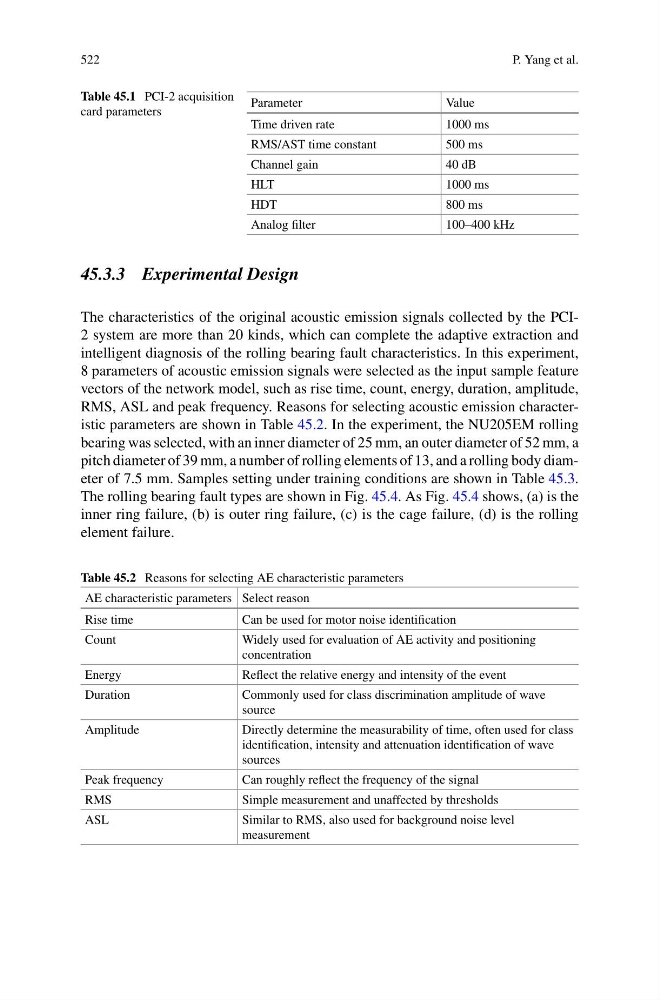
RMS, ASL and peak frequency. Reasons for selecting acoustic emission characteristic parameters are shown in Table 45.2. In the experiment, the NU205EM rolling
bearing was selected, with an inner diameter of 25 mm, an outer diameter of 52 mm, a
pitch diameter of 39 mm, a number of rolling elements of 13, and a rolling body diameter of 7.5 mm. Samples setting under training conditions are shown in Table 45.3.
The rolling bearing fault types are shown in Fig. 45.4. As Fig. 45.4 shows, (a) is the
inner ring failure, (b) is outer ring failure, (c) is the cage failure, (d) is the rolling
element failure.
Table 45.2 Reasons for selecting AE characteristic parameters
AE characteristic parameters Select reason
Rise time
Can be used for motor noise identification
Count
Widely used for evaluation of AE activity and positioning
concentration
Energy
Reflect the relative energy and intensity of the event
Duration
Commonly used for class discrimination amplitude of wave
source
Amplitude
Directly determine the measurability of time, often used for class
identification, intensity and attenuation identification of wave
sources
Peak frequency
Can roughly reflect the frequency of the signal
RMS
Simple measurement and unaffected by thresholds
ASL
Similar to RMS, also used for background noise level
measurement
P. Yang et al.
Table 45.1 PCI-2 acquisition
card parameters
Parameter
Value
Time driven rate
1000 ms
RMS/AST time constant
500 ms
Channel gain
40 dB
HLT
1000 ms
HDT
800 ms
Analog filter
100–400 kHz
45.3.3 Experimental Design
The characteristics of the original acoustic emission signals collected by the PCI2 system are more than 20 kinds, which can complete the adaptive extraction and
intelligent diagnosis of the rolling bearing fault characteristics. In this experiment,
8 parameters of acoustic emission signals were selected as the input sample feature
vectors of the network model, such as rise time, count, energy, duration, amplitude,
RMS, ASL and peak frequency. Reasons for selecting acoustic emission characteristic parameters are shown in Table 45.2. In the experiment, the NU205EM rolling
bearing was selected, with an inner diameter of 25 mm, an outer diameter of 52 mm, a
pitch diameter of 39 mm, a number of rolling elements of 13, and a rolling body diameter of 7.5 mm. Samples setting under training conditions are shown in Table 45.3.
The rolling bearing fault types are shown in Fig. 45.4. As Fig. 45.4 shows, (a) is the
inner ring failure, (b) is outer ring failure, (c) is the cage failure, (d) is the rolling
element failure.
Table 45.2 Reasons for selecting AE characteristic parameters
AE characteristic parameters Select reason
Rise time
Can be used for motor noise identification
Count
Widely used for evaluation of AE activity and positioning
concentration
Energy
Reflect the relative energy and intensity of the event
Duration
Commonly used for class discrimination amplitude of wave
source
Amplitude
Directly determine the measurability of time, often used for class
identification, intensity and attenuation identification of wave
sources
Peak frequency
Can roughly reflect the frequency of the signal
RMS
Simple measurement and unaffected by thresholds
ASL
Similar to RMS, also used for background noise level
measurement