

44 Acoustic Emission Characteristics of Defects …
511
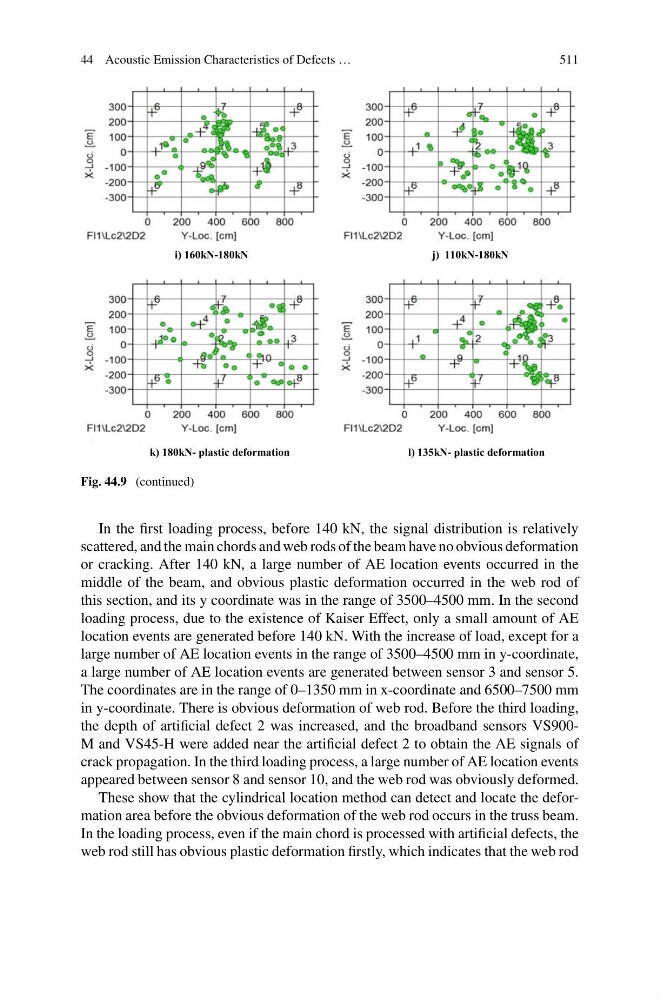
i) 160kN-180kN
j) 110kN-180kN
k) 180kN- plastic deformation
l) 135kN- plastic deformation
Fig. 44.9 (continued)
In the first loading process, before 140 kN, the signal distribution is relatively
scattered, and the main chords and web rods of the beam have no obvious deformation
or cracking. After 140 kN, a large number of AE location events occurred in the
middle of the beam, and obvious plastic deformation occurred in the web rod of
this section, and its y coordinate was in the range of 3500–4500 mm. In the second
loading process, due to the existence of Kaiser Effect, only a small amount of AE
location events are generated before 140 kN. With the increase of load, except for a
large number of AE location events in the range of 3500–4500 mm in y-coordinate,
a large number of AE location events are generated between sensor 3 and sensor 5.
The coordinates are in the range of 0–1350 mm in x-coordinate and 6500–7500 mm
in y-coordinate. There is obvious deformation of web rod. Before the third loading,
the depth of artificial defect 2 was increased, and the broadband sensors VS900M and VS45-H were added near the artificial defect 2 to obtain the AE signals of
crack propagation. In the third loading process, a large number of AE location events
appeared between sensor 8 and sensor 10, and the web rod was obviously deformed.
These show that the cylindrical location method can detect and locate the deformation area before the obvious deformation of the web rod occurs in the truss beam.
In the loading process, even if the main chord is processed with artificial defects, the
web rod still has obvious plastic deformation firstly, which indicates that the web rod
511
i) 160kN-180kN
j) 110kN-180kN
k) 180kN- plastic deformation
l) 135kN- plastic deformation
Fig. 44.9 (continued)
In the first loading process, before 140 kN, the signal distribution is relatively
scattered, and the main chords and web rods of the beam have no obvious deformation
or cracking. After 140 kN, a large number of AE location events occurred in the
middle of the beam, and obvious plastic deformation occurred in the web rod of
this section, and its y coordinate was in the range of 3500–4500 mm. In the second
loading process, due to the existence of Kaiser Effect, only a small amount of AE
location events are generated before 140 kN. With the increase of load, except for a
large number of AE location events in the range of 3500–4500 mm in y-coordinate,
a large number of AE location events are generated between sensor 3 and sensor 5.
The coordinates are in the range of 0–1350 mm in x-coordinate and 6500–7500 mm
in y-coordinate. There is obvious deformation of web rod. Before the third loading,
the depth of artificial defect 2 was increased, and the broadband sensors VS900M and VS45-H were added near the artificial defect 2 to obtain the AE signals of
crack propagation. In the third loading process, a large number of AE location events
appeared between sensor 8 and sensor 10, and the web rod was obviously deformed.
These show that the cylindrical location method can detect and locate the deformation area before the obvious deformation of the web rod occurs in the truss beam.
In the loading process, even if the main chord is processed with artificial defects, the
web rod still has obvious plastic deformation firstly, which indicates that the web rod