

43 The Influence of Rod Waveguide on Acoustic Emission …
499
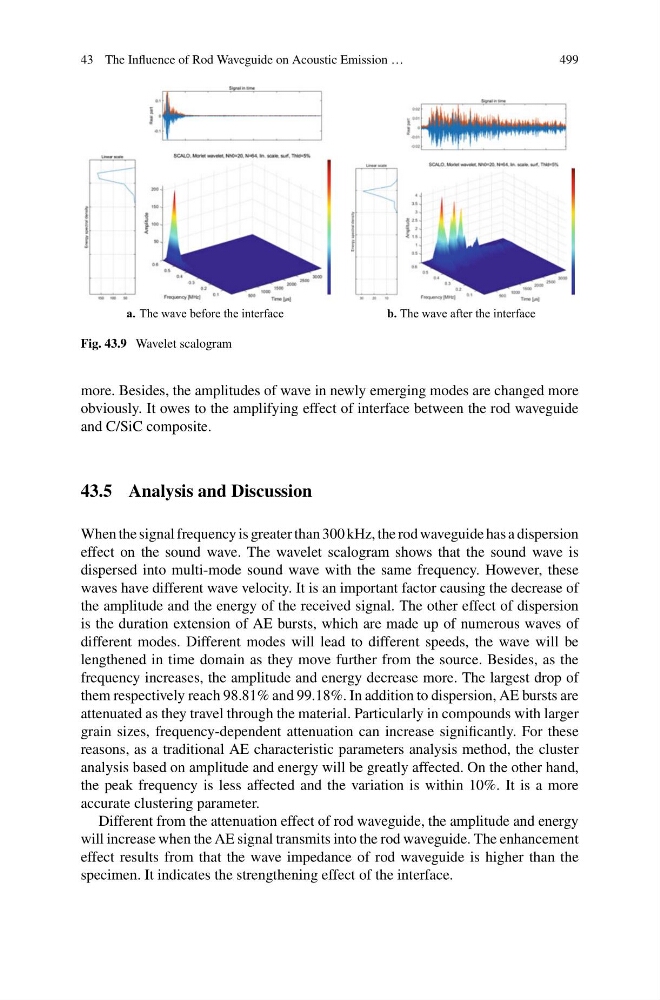
a. The wave before the interface
b. The wave after the interface
Fig. 43.9 Wavelet scalogram
more. Besides, the amplitudes of wave in newly emerging modes are changed more
obviously. It owes to the amplifying effect of interface between the rod waveguide
and C/SiC composite.
43.5 Analysis and Discussion
When the signal frequency is greater than 300 kHz, the rod waveguide has a dispersion
effect on the sound wave. The wavelet scalogram shows that the sound wave is
dispersed into multi-mode sound wave with the same frequency. However, these
waves have different wave velocity. It is an important factor causing the decrease of
the amplitude and the energy of the received signal. The other effect of dispersion
is the duration extension of AE bursts, which are made up of numerous waves of
different modes. Different modes will lead to different speeds, the wave will be
lengthened in time domain as they move further from the source. Besides, as the
frequency increases, the amplitude and energy decrease more. The largest drop of
them respectively reach 98.81% and 99.18%. In addition to dispersion, AE bursts are
attenuated as they travel through the material. Particularly in compounds with larger
grain sizes, frequency-dependent attenuation can increase significantly. For these
reasons, as a traditional AE characteristic parameters analysis method, the cluster
analysis based on amplitude and energy will be greatly affected. On the other hand,
the peak frequency is less affected and the variation is within 10%. It is a more
accurate clustering parameter.
Different from the attenuation effect of rod waveguide, the amplitude and energy
will increase when the AE signal transmits into the rod waveguide. The enhancement
effect results from that the wave impedance of rod waveguide is higher than the
specimen. It indicates the strengthening effect of the interface.
499
a. The wave before the interface
b. The wave after the interface
Fig. 43.9 Wavelet scalogram
more. Besides, the amplitudes of wave in newly emerging modes are changed more
obviously. It owes to the amplifying effect of interface between the rod waveguide
and C/SiC composite.
43.5 Analysis and Discussion
When the signal frequency is greater than 300 kHz, the rod waveguide has a dispersion
effect on the sound wave. The wavelet scalogram shows that the sound wave is
dispersed into multi-mode sound wave with the same frequency. However, these
waves have different wave velocity. It is an important factor causing the decrease of
the amplitude and the energy of the received signal. The other effect of dispersion
is the duration extension of AE bursts, which are made up of numerous waves of
different modes. Different modes will lead to different speeds, the wave will be
lengthened in time domain as they move further from the source. Besides, as the
frequency increases, the amplitude and energy decrease more. The largest drop of
them respectively reach 98.81% and 99.18%. In addition to dispersion, AE bursts are
attenuated as they travel through the material. Particularly in compounds with larger
grain sizes, frequency-dependent attenuation can increase significantly. For these
reasons, as a traditional AE characteristic parameters analysis method, the cluster
analysis based on amplitude and energy will be greatly affected. On the other hand,
the peak frequency is less affected and the variation is within 10%. It is a more
accurate clustering parameter.
Different from the attenuation effect of rod waveguide, the amplitude and energy
will increase when the AE signal transmits into the rod waveguide. The enhancement
effect results from that the wave impedance of rod waveguide is higher than the
specimen. It indicates the strengthening effect of the interface.