

43 The Influence of Rod Waveguide on Acoustic Emission …
491
T(0,1)
T(0,2)
T(0,3)
L(0,1)
L(0,2)
L(0,3)
L(0,4)
F(1,1)
F(1,2)
F(1,3)
F(1,4)
F(1,5)
F(1,6)
F(1,7)
0
100 200 300 400 500 600 700 800 900 1000
Frequency (kHz)
0
1000
2000
3000
4000
5000
6000
Group speed (m/s)
Dispersion curves (group speed)
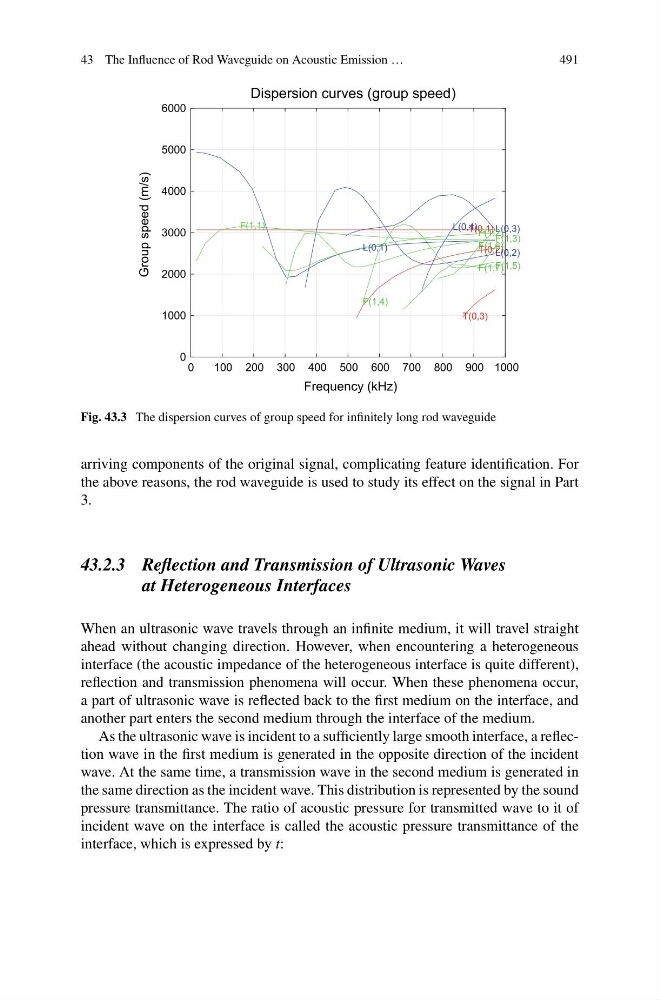
Fig. 43.3 The dispersion curves of group speed for infinitely long rod waveguide
arriving components of the original signal, complicating feature identification. For
the above reasons, the rod waveguide is used to study its effect on the signal in Part
3.
43.2.3 Reflection and Transmission of Ultrasonic Waves
at Heterogeneous Interfaces
When an ultrasonic wave travels through an infinite medium, it will travel straight
ahead without changing direction. However, when encountering a heterogeneous
interface (the acoustic impedance of the heterogeneous interface is quite different),
reflection and transmission phenomena will occur. When these phenomena occur,
a part of ultrasonic wave is reflected back to the first medium on the interface, and
another part enters the second medium through the interface of the medium.
As the ultrasonic wave is incident to a sufficiently large smooth interface, a reflection wave in the first medium is generated in the opposite direction of the incident
wave. At the same time, a transmission wave in the second medium is generated in
the same direction as the incident wave. This distribution is represented by the sound
pressure transmittance. The ratio of acoustic pressure for transmitted wave to it of
incident wave on the interface is called the acoustic pressure transmittance of the
interface, which is expressed by t:
491
T(0,1)
T(0,2)
T(0,3)
L(0,1)
L(0,2)
L(0,3)
L(0,4)
F(1,1)
F(1,2)
F(1,3)
F(1,4)
F(1,5)
F(1,6)
F(1,7)
0
100 200 300 400 500 600 700 800 900 1000
Frequency (kHz)
0
1000
2000
3000
4000
5000
6000
Group speed (m/s)
Dispersion curves (group speed)
Fig. 43.3 The dispersion curves of group speed for infinitely long rod waveguide
arriving components of the original signal, complicating feature identification. For
the above reasons, the rod waveguide is used to study its effect on the signal in Part
3.
43.2.3 Reflection and Transmission of Ultrasonic Waves
at Heterogeneous Interfaces
When an ultrasonic wave travels through an infinite medium, it will travel straight
ahead without changing direction. However, when encountering a heterogeneous
interface (the acoustic impedance of the heterogeneous interface is quite different),
reflection and transmission phenomena will occur. When these phenomena occur,
a part of ultrasonic wave is reflected back to the first medium on the interface, and
another part enters the second medium through the interface of the medium.
As the ultrasonic wave is incident to a sufficiently large smooth interface, a reflection wave in the first medium is generated in the opposite direction of the incident
wave. At the same time, a transmission wave in the second medium is generated in
the same direction as the incident wave. This distribution is represented by the sound
pressure transmittance. The ratio of acoustic pressure for transmitted wave to it of
incident wave on the interface is called the acoustic pressure transmittance of the
interface, which is expressed by t: