

14
L. Dong
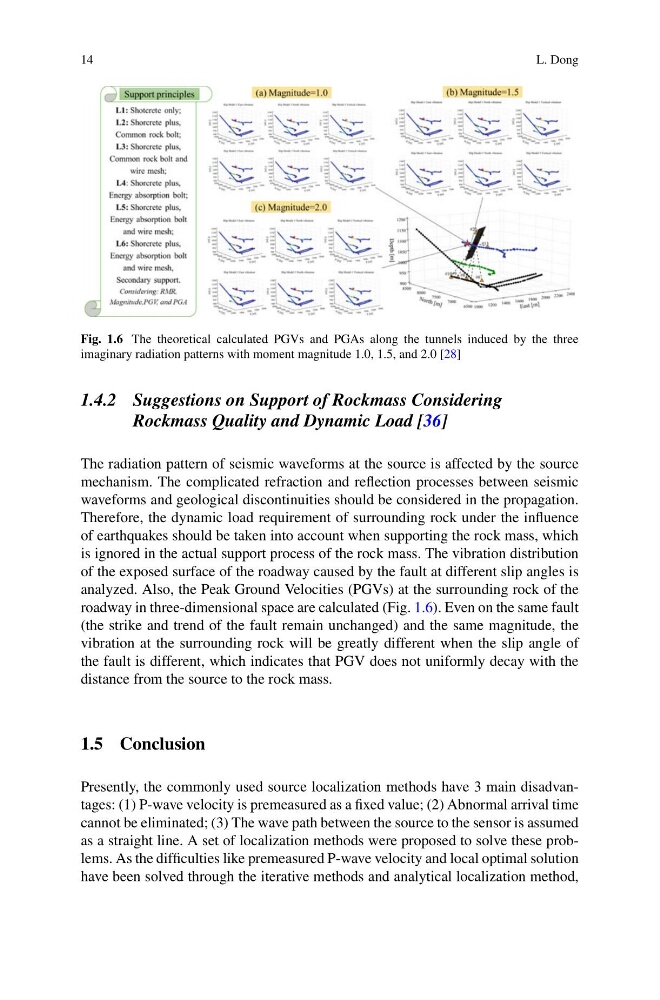
Fig. 1.6 The theoretical calculated PGVs and PGAs along the tunnels induced by the three
imaginary radiation patterns with moment magnitude 1.0, 1.5, and 2.0 [28]
1.4.2 Suggestions on Support of Rockmass Considering
Rockmass Quality and Dynamic Load [36]
The radiation pattern of seismic waveforms at the source is affected by the source
mechanism. The complicated refraction and reflection processes between seismic
waveforms and geological discontinuities should be considered in the propagation.
Therefore, the dynamic load requirement of surrounding rock under the influence
of earthquakes should be taken into account when supporting the rock mass, which
is ignored in the actual support process of the rock mass. The vibration distribution
of the exposed surface of the roadway caused by the fault at different slip angles is
analyzed. Also, the Peak Ground Velocities (PGVs) at the surrounding rock of the
roadway in three-dimensional space are calculated (Fig. 1.6). Even on the same fault
(the strike and trend of the fault remain unchanged) and the same magnitude, the
vibration at the surrounding rock will be greatly different when the slip angle of
the fault is different, which indicates that PGV does not uniformly decay with the
distance from the source to the rock mass.
1.5 Conclusion
Presently, the commonly used source localization methods have 3 main disadvantages: (1) P-wave velocity is premeasured as a fixed value; (2) Abnormal arrival time
cannot be eliminated; (3) The wave path between the source to the sensor is assumed
as a straight line. A set of localization methods were proposed to solve these problems. As the difficulties like premeasured P-wave velocity and local optimal solution
have been solved through the iterative methods and analytical localization method,
L. Dong
Fig. 1.6 The theoretical calculated PGVs and PGAs along the tunnels induced by the three
imaginary radiation patterns with moment magnitude 1.0, 1.5, and 2.0 [28]
1.4.2 Suggestions on Support of Rockmass Considering
Rockmass Quality and Dynamic Load [36]
The radiation pattern of seismic waveforms at the source is affected by the source
mechanism. The complicated refraction and reflection processes between seismic
waveforms and geological discontinuities should be considered in the propagation.
Therefore, the dynamic load requirement of surrounding rock under the influence
of earthquakes should be taken into account when supporting the rock mass, which
is ignored in the actual support process of the rock mass. The vibration distribution
of the exposed surface of the roadway caused by the fault at different slip angles is
analyzed. Also, the Peak Ground Velocities (PGVs) at the surrounding rock of the
roadway in three-dimensional space are calculated (Fig. 1.6). Even on the same fault
(the strike and trend of the fault remain unchanged) and the same magnitude, the
vibration at the surrounding rock will be greatly different when the slip angle of
the fault is different, which indicates that PGV does not uniformly decay with the
distance from the source to the rock mass.
1.5 Conclusion
Presently, the commonly used source localization methods have 3 main disadvantages: (1) P-wave velocity is premeasured as a fixed value; (2) Abnormal arrival time
cannot be eliminated; (3) The wave path between the source to the sensor is assumed
as a straight line. A set of localization methods were proposed to solve these problems. As the difficulties like premeasured P-wave velocity and local optimal solution
have been solved through the iterative methods and analytical localization method,