

1 Localization and Discrimination of Microseismic/AE Sources …
13
R
S
=
R m
S m
, m = 1, 2, . . . , M
(1.12)
R
S
t
= c ∗ t
H
(1.13)
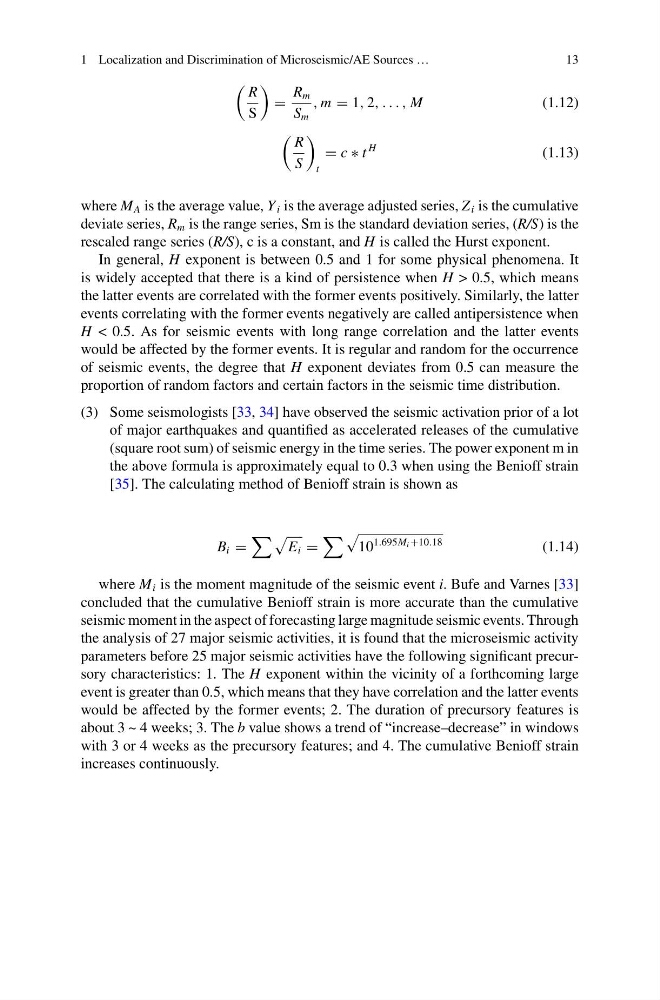
where M A is the average value, Y i is the average adjusted series, Z i is the cumulative
deviate series, R m is the range series, Sm is the standard deviation series, (R/S) is the
rescaled range series (R/S), c is a constant, and H is called the Hurst exponent.
In general, H exponent is between 0.5 and 1 for some physical phenomena. It
is widely accepted that there is a kind of persistence when H > 0.5, which means
the latter events are correlated with the former events positively. Similarly, the latter
events correlating with the former events negatively are called antipersistence when
H < 0.5. As for seismic events with long range correlation and the latter events
would be affected by the former events. It is regular and random for the occurrence
of seismic events, the degree that H exponent deviates from 0.5 can measure the
proportion of random factors and certain factors in the seismic time distribution.
(3) Some seismologists [33, 34] have observed the seismic activation prior of a lot
of major earthquakes and quantified as accelerated releases of the cumulative
(square root sum) of seismic energy in the time series. The power exponent m in
the above formula is approximately equal to 0.3 when using the Benioff strain
[35]. The calculating method of Benioff strain is shown as
B i =
E i =
10
1.695M i +10.18
(1.14)
where M i is the moment magnitude of the seismic event i. Bufe and Varnes [33]
concluded that the cumulative Benioff strain is more accurate than the cumulative
seismic moment in the aspect of forecasting large magnitude seismic events. Through
the analysis of 27 major seismic activities, it is found that the microseismic activity
parameters before 25 major seismic activities have the following significant precursory characteristics: 1. The H exponent within the vicinity of a forthcoming large
event is greater than 0.5, which means that they have correlation and the latter events
would be affected by the former events; 2. The duration of precursory features is
about 3 ~ 4 weeks; 3. The b value shows a trend of “increase–decrease” in windows
with 3 or 4 weeks as the precursory features; and 4. The cumulative Benioff strain
increases continuously.
13
R
S
=
R m
S m
, m = 1, 2, . . . , M
(1.12)
R
S
t
= c ∗ t
H
(1.13)
where M A is the average value, Y i is the average adjusted series, Z i is the cumulative
deviate series, R m is the range series, Sm is the standard deviation series, (R/S) is the
rescaled range series (R/S), c is a constant, and H is called the Hurst exponent.
In general, H exponent is between 0.5 and 1 for some physical phenomena. It
is widely accepted that there is a kind of persistence when H > 0.5, which means
the latter events are correlated with the former events positively. Similarly, the latter
events correlating with the former events negatively are called antipersistence when
H < 0.5. As for seismic events with long range correlation and the latter events
would be affected by the former events. It is regular and random for the occurrence
of seismic events, the degree that H exponent deviates from 0.5 can measure the
proportion of random factors and certain factors in the seismic time distribution.
(3) Some seismologists [33, 34] have observed the seismic activation prior of a lot
of major earthquakes and quantified as accelerated releases of the cumulative
(square root sum) of seismic energy in the time series. The power exponent m in
the above formula is approximately equal to 0.3 when using the Benioff strain
[35]. The calculating method of Benioff strain is shown as
B i =
E i =
10
1.695M i +10.18
(1.14)
where M i is the moment magnitude of the seismic event i. Bufe and Varnes [33]
concluded that the cumulative Benioff strain is more accurate than the cumulative
seismic moment in the aspect of forecasting large magnitude seismic events. Through
the analysis of 27 major seismic activities, it is found that the microseismic activity
parameters before 25 major seismic activities have the following significant precursory characteristics: 1. The H exponent within the vicinity of a forthcoming large
event is greater than 0.5, which means that they have correlation and the latter events
would be affected by the former events; 2. The duration of precursory features is
about 3 ~ 4 weeks; 3. The b value shows a trend of “increase–decrease” in windows
with 3 or 4 weeks as the precursory features; and 4. The cumulative Benioff strain
increases continuously.