

378
Z. Hu et al.
sensitivity [4, 5]. However, acoustic emission signals have uncertainty and randomness, and the detected signal is mixed with various noise interference, which makes it
difficult to locate acoustic emission signal [6–9]. Common acoustic emission signal
positioning methods include one-dimensional linear positioning method [10], plane
triangle positioning method [11, 12] and parallelogram positioning method [13].
Which methods are plane positioning. However, when acoustic emission corrosion
monitoring is used in the field. Acoustic emission sensors are mostly arranged around
the tank wall and not in the same plane as the floor. The sound source signal propagates
along the surface of a metal sphere. Space metal it is broken down into various wave
forms for conduction. Therefore, according to the same plane positioning calculation
has a large error.
Based on the acoustic emission monitoring process of tank floor corrosion, the
general placement characteristics of acoustic emission sensors, and the time difference of signals reception, a new three-dimensional geometric positioning calculation
method was established in this study. This method can provide accurate results for
spot monitoring of corrosion location of tank floor.
32.2 Positioning Principle
Establish a three-dimensional cylindrical coordinate system at the center of the base
plate. The inner surface of the floor is in the xy plane. Place two sensors at the
same height: 1#(R 1 , θ 1 , z 1 ) and 2#(R 2 , θ 2 , z 2 ). 3#(R 3 , θ 3 , 0) is located at the origin
of coordinates (not drawn). And the rectangular coordinates of the three sensors
1#(x 1 , y 1 , z 1 ), 2#(x 2 , y 2 , z 2 ) and 3#(x 3 , y 3 , 0). Suppose there is an acoustic emission
source S(r, θ, 0) at the floor. The distances between the sound source and the sensors
1#, 2# and 3# are r 1 , r 2 and r 3 . Fig. 32.1 is a space diagram.
Meanwhile, t 1 and t 2 are respectively the time taken by AE sources to reach sensor
1 and sensor 2. v is the locating sound velocity, and its size is the propagation velocity
of acoustic emission signal. The distance between the sound source signals and the
sensor r 1 and r 2 can be expressed as:
r 1 = r 3 + δ 1 , r 2 = r 3 + δ 2
(32.1)
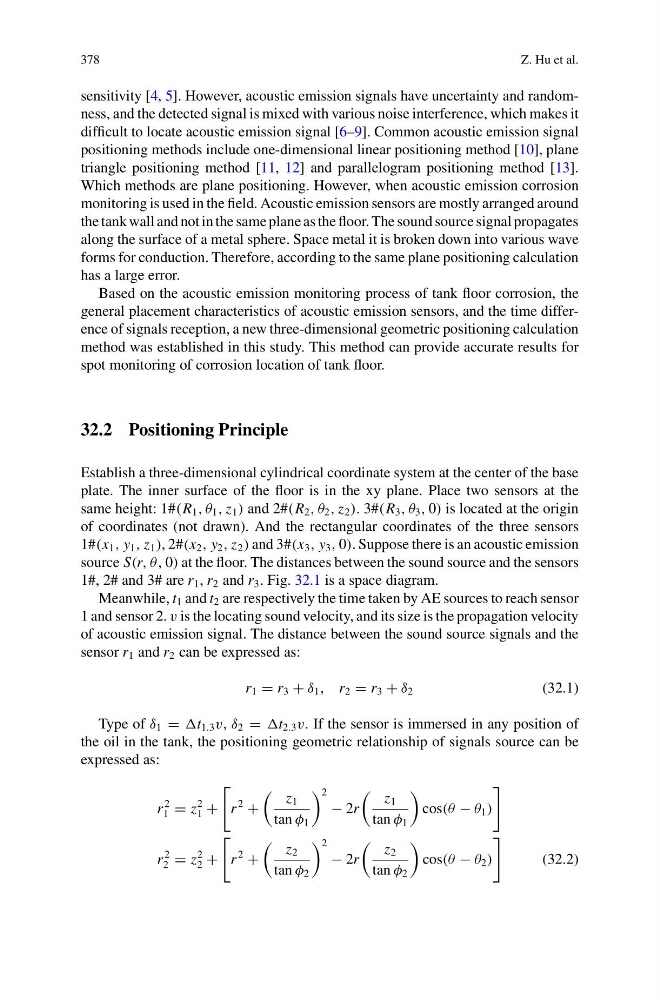
Type of δ 1 = t 1.3 v, δ 2 = t 2.3 v. If the sensor is immersed in any position of
the oil in the tank, the positioning geometric relationship of signals source can be
expressed as:
r
2
1 = z
2
1 +
r
2
+
z 1
tan φ 1
2
− 2r
z 1
tan φ 1
cos(θ − θ 1 )
r
2
2 = z
2
2 +
r
2
+
z 2
tan φ 2
2
− 2r
z 2
tan φ 2
cos(θ − θ 2 )
(32.2)
Z. Hu et al.
sensitivity [4, 5]. However, acoustic emission signals have uncertainty and randomness, and the detected signal is mixed with various noise interference, which makes it
difficult to locate acoustic emission signal [6–9]. Common acoustic emission signal
positioning methods include one-dimensional linear positioning method [10], plane
triangle positioning method [11, 12] and parallelogram positioning method [13].
Which methods are plane positioning. However, when acoustic emission corrosion
monitoring is used in the field. Acoustic emission sensors are mostly arranged around
the tank wall and not in the same plane as the floor. The sound source signal propagates
along the surface of a metal sphere. Space metal it is broken down into various wave
forms for conduction. Therefore, according to the same plane positioning calculation
has a large error.
Based on the acoustic emission monitoring process of tank floor corrosion, the
general placement characteristics of acoustic emission sensors, and the time difference of signals reception, a new three-dimensional geometric positioning calculation
method was established in this study. This method can provide accurate results for
spot monitoring of corrosion location of tank floor.
32.2 Positioning Principle
Establish a three-dimensional cylindrical coordinate system at the center of the base
plate. The inner surface of the floor is in the xy plane. Place two sensors at the
same height: 1#(R 1 , θ 1 , z 1 ) and 2#(R 2 , θ 2 , z 2 ). 3#(R 3 , θ 3 , 0) is located at the origin
of coordinates (not drawn). And the rectangular coordinates of the three sensors
1#(x 1 , y 1 , z 1 ), 2#(x 2 , y 2 , z 2 ) and 3#(x 3 , y 3 , 0). Suppose there is an acoustic emission
source S(r, θ, 0) at the floor. The distances between the sound source and the sensors
1#, 2# and 3# are r 1 , r 2 and r 3 . Fig. 32.1 is a space diagram.
Meanwhile, t 1 and t 2 are respectively the time taken by AE sources to reach sensor
1 and sensor 2. v is the locating sound velocity, and its size is the propagation velocity
of acoustic emission signal. The distance between the sound source signals and the
sensor r 1 and r 2 can be expressed as:
r 1 = r 3 + δ 1 , r 2 = r 3 + δ 2
(32.1)
Type of δ 1 = t 1.3 v, δ 2 = t 2.3 v. If the sensor is immersed in any position of
the oil in the tank, the positioning geometric relationship of signals source can be
expressed as:
r
2
1 = z
2
1 +
r
2
+
z 1
tan φ 1
2
− 2r
z 1
tan φ 1
cos(θ − θ 1 )
r
2
2 = z
2
2 +
r
2
+
z 2
tan φ 2
2
− 2r
z 2
tan φ 2
cos(θ − θ 2 )
(32.2)