

31 Research on Immersion-Type Acoustic Emission …
365
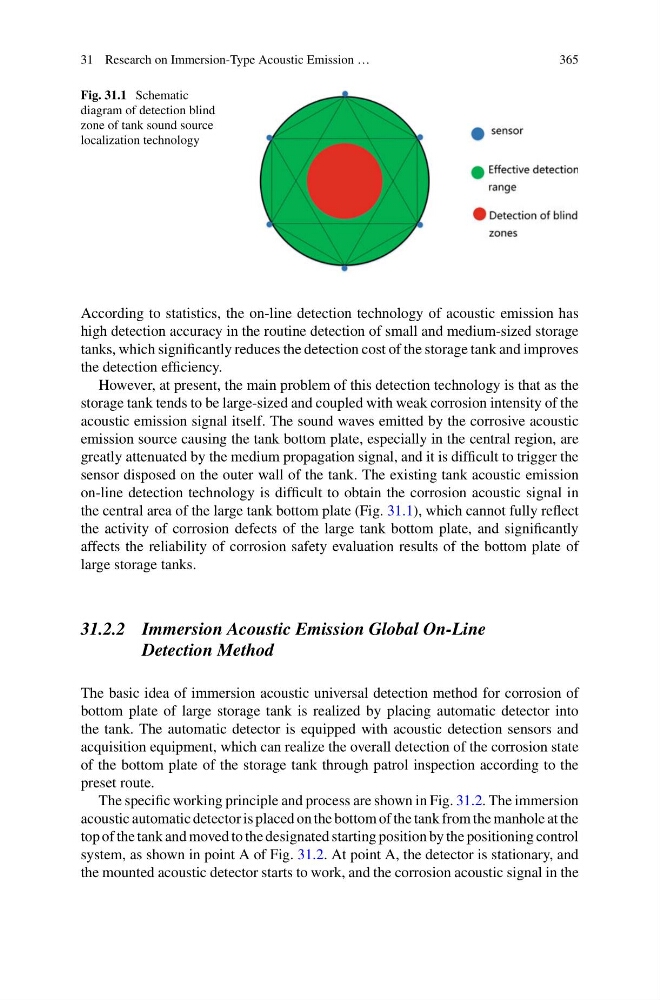
Fig. 31.1 Schematic
diagram of detection blind
zone of tank sound source
localization technology
According to statistics, the on-line detection technology of acoustic emission has
high detection accuracy in the routine detection of small and medium-sized storage
tanks, which significantly reduces the detection cost of the storage tank and improves
the detection efficiency.
However, at present, the main problem of this detection technology is that as the
storage tank tends to be large-sized and coupled with weak corrosion intensity of the
acoustic emission signal itself. The sound waves emitted by the corrosive acoustic
emission source causing the tank bottom plate, especially in the central region, are
greatly attenuated by the medium propagation signal, and it is difficult to trigger the
sensor disposed on the outer wall of the tank. The existing tank acoustic emission
on-line detection technology is difficult to obtain the corrosion acoustic signal in
the central area of the large tank bottom plate (Fig. 31.1), which cannot fully reflect
the activity of corrosion defects of the large tank bottom plate, and significantly
affects the reliability of corrosion safety evaluation results of the bottom plate of
large storage tanks.
31.2.2 Immersion Acoustic Emission Global On-Line
Detection Method
The basic idea of immersion acoustic universal detection method for corrosion of
bottom plate of large storage tank is realized by placing automatic detector into
the tank. The automatic detector is equipped with acoustic detection sensors and
acquisition equipment, which can realize the overall detection of the corrosion state
of the bottom plate of the storage tank through patrol inspection according to the
preset route.
The specific working principle and process are shown in Fig. 31.2. The immersion
acoustic automatic detector is placed on the bottom of the tank from the manhole at the
top of the tank and moved to the designated starting position by the positioning control
system, as shown in point A of Fig. 31.2. At point A, the detector is stationary, and
the mounted acoustic detector starts to work, and the corrosion acoustic signal in the
365
Fig. 31.1 Schematic
diagram of detection blind
zone of tank sound source
localization technology
According to statistics, the on-line detection technology of acoustic emission has
high detection accuracy in the routine detection of small and medium-sized storage
tanks, which significantly reduces the detection cost of the storage tank and improves
the detection efficiency.
However, at present, the main problem of this detection technology is that as the
storage tank tends to be large-sized and coupled with weak corrosion intensity of the
acoustic emission signal itself. The sound waves emitted by the corrosive acoustic
emission source causing the tank bottom plate, especially in the central region, are
greatly attenuated by the medium propagation signal, and it is difficult to trigger the
sensor disposed on the outer wall of the tank. The existing tank acoustic emission
on-line detection technology is difficult to obtain the corrosion acoustic signal in
the central area of the large tank bottom plate (Fig. 31.1), which cannot fully reflect
the activity of corrosion defects of the large tank bottom plate, and significantly
affects the reliability of corrosion safety evaluation results of the bottom plate of
large storage tanks.
31.2.2 Immersion Acoustic Emission Global On-Line
Detection Method
The basic idea of immersion acoustic universal detection method for corrosion of
bottom plate of large storage tank is realized by placing automatic detector into
the tank. The automatic detector is equipped with acoustic detection sensors and
acquisition equipment, which can realize the overall detection of the corrosion state
of the bottom plate of the storage tank through patrol inspection according to the
preset route.
The specific working principle and process are shown in Fig. 31.2. The immersion
acoustic automatic detector is placed on the bottom of the tank from the manhole at the
top of the tank and moved to the designated starting position by the positioning control
system, as shown in point A of Fig. 31.2. At point A, the detector is stationary, and
the mounted acoustic detector starts to work, and the corrosion acoustic signal in the