

26 Damage Evaluation Inside the Concrete Dam …
319
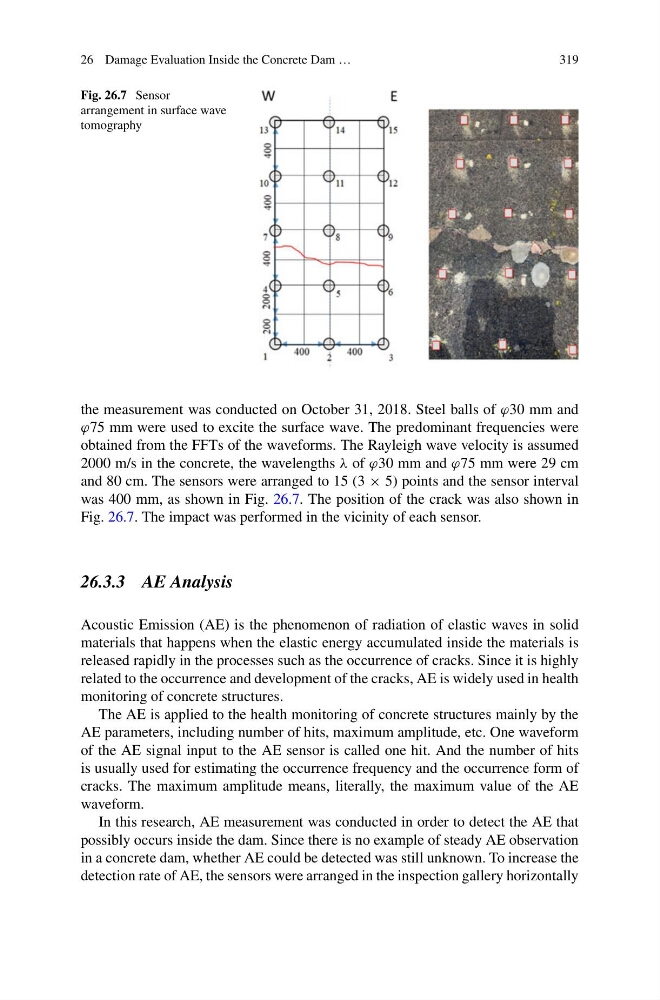
Fig. 26.7 Sensor
arrangement in surface wave
tomography
the measurement was conducted on October 31, 2018. Steel balls of ϕ30 mm and
ϕ75 mm were used to excite the surface wave. The predominant frequencies were
obtained from the FFTs of the waveforms. The Rayleigh wave velocity is assumed
2000 m/s in the concrete, the wavelengths λ of ϕ30 mm and ϕ75 mm were 29 cm
and 80 cm. The sensors were arranged to 15 (3 × 5) points and the sensor interval
was 400 mm, as shown in Fig. 26.7. The position of the crack was also shown in
Fig. 26.7. The impact was performed in the vicinity of each sensor.
26.3.3 AE Analysis
Acoustic Emission (AE) is the phenomenon of radiation of elastic waves in solid
materials that happens when the elastic energy accumulated inside the materials is
released rapidly in the processes such as the occurrence of cracks. Since it is highly
related to the occurrence and development of the cracks, AE is widely used in health
monitoring of concrete structures.
The AE is applied to the health monitoring of concrete structures mainly by the
AE parameters, including number of hits, maximum amplitude, etc. One waveform
of the AE signal input to the AE sensor is called one hit. And the number of hits
is usually used for estimating the occurrence frequency and the occurrence form of
cracks. The maximum amplitude means, literally, the maximum value of the AE
waveform.
In this research, AE measurement was conducted in order to detect the AE that
possibly occurs inside the dam. Since there is no example of steady AE observation
in a concrete dam, whether AE could be detected was still unknown. To increase the
detection rate of AE, the sensors were arranged in the inspection gallery horizontally
319
Fig. 26.7 Sensor
arrangement in surface wave
tomography
the measurement was conducted on October 31, 2018. Steel balls of ϕ30 mm and
ϕ75 mm were used to excite the surface wave. The predominant frequencies were
obtained from the FFTs of the waveforms. The Rayleigh wave velocity is assumed
2000 m/s in the concrete, the wavelengths λ of ϕ30 mm and ϕ75 mm were 29 cm
and 80 cm. The sensors were arranged to 15 (3 × 5) points and the sensor interval
was 400 mm, as shown in Fig. 26.7. The position of the crack was also shown in
Fig. 26.7. The impact was performed in the vicinity of each sensor.
26.3.3 AE Analysis
Acoustic Emission (AE) is the phenomenon of radiation of elastic waves in solid
materials that happens when the elastic energy accumulated inside the materials is
released rapidly in the processes such as the occurrence of cracks. Since it is highly
related to the occurrence and development of the cracks, AE is widely used in health
monitoring of concrete structures.
The AE is applied to the health monitoring of concrete structures mainly by the
AE parameters, including number of hits, maximum amplitude, etc. One waveform
of the AE signal input to the AE sensor is called one hit. And the number of hits
is usually used for estimating the occurrence frequency and the occurrence form of
cracks. The maximum amplitude means, literally, the maximum value of the AE
waveform.
In this research, AE measurement was conducted in order to detect the AE that
possibly occurs inside the dam. Since there is no example of steady AE observation
in a concrete dam, whether AE could be detected was still unknown. To increase the
detection rate of AE, the sensors were arranged in the inspection gallery horizontally