

314
Y. Yang et al.
while avoiding damage toward the concrete structure. And the elastic wave method,
since its characteristics of circumventing and scattering when deterioration such as
crack exists inside the concrete, has received much attention as a promising NDT
method. With the analysis of the parameters of elastic wave, such as velocity and
energy (amplitude), it is possible to evaluate the deterioration of concrete structure
[1, 2]. However, the utilization of elastic wave method on the damage evaluation of
concrete dams still needs in-depth research.
In this research, the characterization of the crack appearing on the surface of
concrete dam by tomography and the feasibility of the automatic continuous monitoring by AE activities have been studied. To investigate the crack appearing on the
surface of the dam, sensors have been arranged and the elastic wave was excited
by steel balls of several diameters both in the inspection gallery and the surface
of the dam body. The elastic wave tomography and surface wave tomography are
applied for detect of crack distribution. AE measurement has been also conducted
in this research. As a result, the length and the depth distribution of the crack was
revealed by elastic wave tomography and surface wave tomography. In addition, it
was confirmed that the sensor arranged in the inspection gallery could measure AE
activities inside the dam, which indicated the possibility of damage monitoring of
the concrete dam by AE analysis.
26.2 Methodology of Tomography
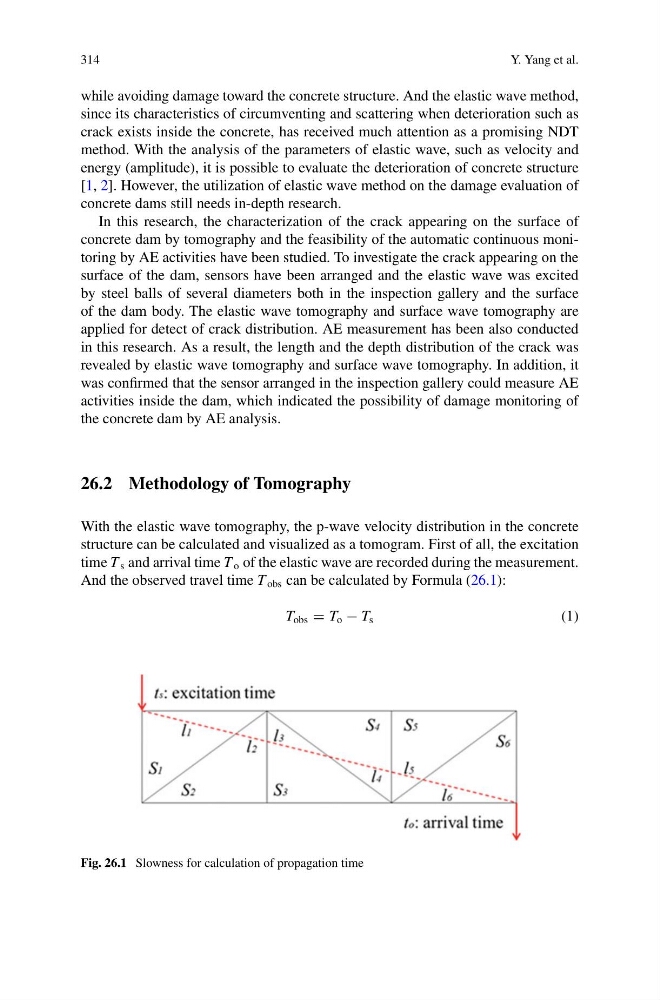
With the elastic wave tomography, the p-wave velocity distribution in the concrete
structure can be calculated and visualized as a tomogram. First of all, the excitation
time T s and arrival time T o of the elastic wave are recorded during the measurement.
And the observed travel time T obs can be calculated by Formula (26.1):
T obs = T o − T s
(1)
Fig. 26.1 Slowness for calculation of propagation time
Y. Yang et al.
while avoiding damage toward the concrete structure. And the elastic wave method,
since its characteristics of circumventing and scattering when deterioration such as
crack exists inside the concrete, has received much attention as a promising NDT
method. With the analysis of the parameters of elastic wave, such as velocity and
energy (amplitude), it is possible to evaluate the deterioration of concrete structure
[1, 2]. However, the utilization of elastic wave method on the damage evaluation of
concrete dams still needs in-depth research.
In this research, the characterization of the crack appearing on the surface of
concrete dam by tomography and the feasibility of the automatic continuous monitoring by AE activities have been studied. To investigate the crack appearing on the
surface of the dam, sensors have been arranged and the elastic wave was excited
by steel balls of several diameters both in the inspection gallery and the surface
of the dam body. The elastic wave tomography and surface wave tomography are
applied for detect of crack distribution. AE measurement has been also conducted
in this research. As a result, the length and the depth distribution of the crack was
revealed by elastic wave tomography and surface wave tomography. In addition, it
was confirmed that the sensor arranged in the inspection gallery could measure AE
activities inside the dam, which indicated the possibility of damage monitoring of
the concrete dam by AE analysis.
26.2 Methodology of Tomography
With the elastic wave tomography, the p-wave velocity distribution in the concrete
structure can be calculated and visualized as a tomogram. First of all, the excitation
time T s and arrival time T o of the elastic wave are recorded during the measurement.
And the observed travel time T obs can be calculated by Formula (26.1):
T obs = T o − T s
(1)
Fig. 26.1 Slowness for calculation of propagation time