

310
Y. Wang et al.
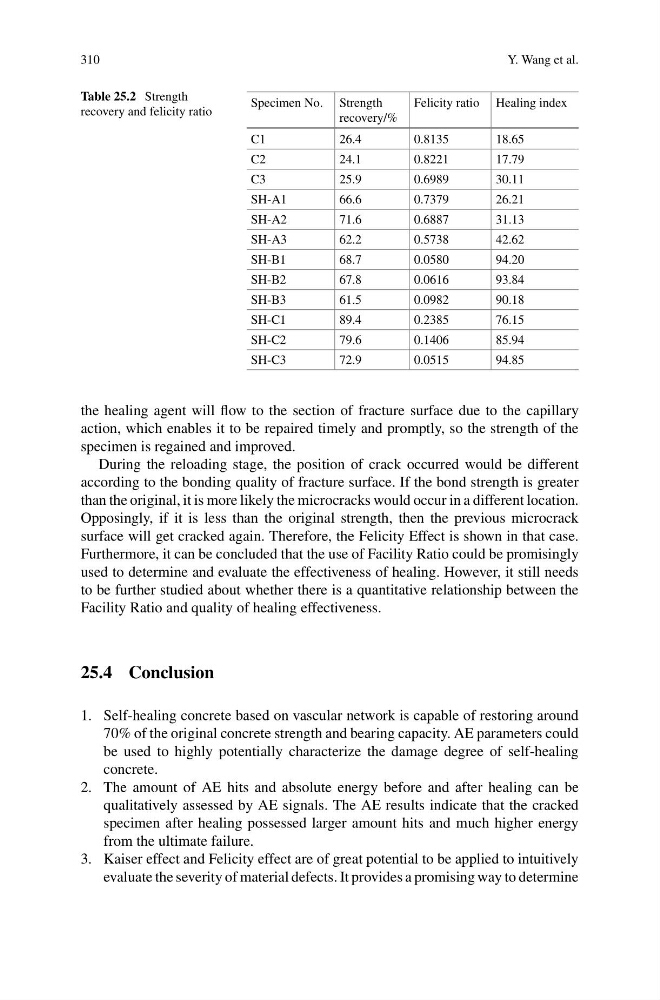
Table 25.2 Strength
recovery and felicity ratio
Specimen No. Strength
recovery/%
Felicity ratio Healing index
C1
26.4
0.8135
18.65
C2
24.1
0.8221
17.79
C3
25.9
0.6989
30.11
SH-A1
66.6
0.7379
26.21
SH-A2
71.6
0.6887
31.13
SH-A3
62.2
0.5738
42.62
SH-B1
68.7
0.0580
94.20
SH-B2
67.8
0.0616
93.84
SH-B3
61.5
0.0982
90.18
SH-C1
89.4
0.2385
76.15
SH-C2
79.6
0.1406
85.94
SH-C3
72.9
0.0515
94.85
the healing agent will flow to the section of fracture surface due to the capillary
action, which enables it to be repaired timely and promptly, so the strength of the
specimen is regained and improved.
During the reloading stage, the position of crack occurred would be different
according to the bonding quality of fracture surface. If the bond strength is greater
than the original, it is more likely the microcracks would occur in a different location.
Opposingly, if it is less than the original strength, then the previous microcrack
surface will get cracked again. Therefore, the Felicity Effect is shown in that case.
Furthermore, it can be concluded that the use of Facility Ratio could be promisingly
used to determine and evaluate the effectiveness of healing. However, it still needs
to be further studied about whether there is a quantitative relationship between the
Facility Ratio and quality of healing effectiveness.
25.4 Conclusion
1. Self-healing concrete based on vascular network is capable of restoring around
70% of the original concrete strength and bearing capacity. AE parameters could
be used to highly potentially characterize the damage degree of self-healing
concrete.
2. The amount of AE hits and absolute energy before and after healing can be
qualitatively assessed by AE signals. The AE results indicate that the cracked
specimen after healing possessed larger amount hits and much higher energy
from the ultimate failure.
3. Kaiser effect and Felicity effect are of great potential to be applied to intuitively
evaluate the severity of material defects. It provides a promising way to determine
Y. Wang et al.
Table 25.2 Strength
recovery and felicity ratio
Specimen No. Strength
recovery/%
Felicity ratio Healing index
C1
26.4
0.8135
18.65
C2
24.1
0.8221
17.79
C3
25.9
0.6989
30.11
SH-A1
66.6
0.7379
26.21
SH-A2
71.6
0.6887
31.13
SH-A3
62.2
0.5738
42.62
SH-B1
68.7
0.0580
94.20
SH-B2
67.8
0.0616
93.84
SH-B3
61.5
0.0982
90.18
SH-C1
89.4
0.2385
76.15
SH-C2
79.6
0.1406
85.94
SH-C3
72.9
0.0515
94.85
the healing agent will flow to the section of fracture surface due to the capillary
action, which enables it to be repaired timely and promptly, so the strength of the
specimen is regained and improved.
During the reloading stage, the position of crack occurred would be different
according to the bonding quality of fracture surface. If the bond strength is greater
than the original, it is more likely the microcracks would occur in a different location.
Opposingly, if it is less than the original strength, then the previous microcrack
surface will get cracked again. Therefore, the Felicity Effect is shown in that case.
Furthermore, it can be concluded that the use of Facility Ratio could be promisingly
used to determine and evaluate the effectiveness of healing. However, it still needs
to be further studied about whether there is a quantitative relationship between the
Facility Ratio and quality of healing effectiveness.
25.4 Conclusion
1. Self-healing concrete based on vascular network is capable of restoring around
70% of the original concrete strength and bearing capacity. AE parameters could
be used to highly potentially characterize the damage degree of self-healing
concrete.
2. The amount of AE hits and absolute energy before and after healing can be
qualitatively assessed by AE signals. The AE results indicate that the cracked
specimen after healing possessed larger amount hits and much higher energy
from the ultimate failure.
3. Kaiser effect and Felicity effect are of great potential to be applied to intuitively
evaluate the severity of material defects. It provides a promising way to determine