

25 Detection and Evaluation of Vascular Network Based …
307
by dotted line, which is consistent with the distribution of AE hit and amplitude as
discussed above.
As can be seen from Fig. 25.6, a different pattern worth noting between the
cumulative absolute energy generated from reloading of control beam and other selfhealing beam tests after the dotted line. The energy released from control specimen
during reloading increases gradually over time as similar as the initial loading stage.
In terms of the self-healing specimens, however, as can be seen from both self-healing
specimens, the most distinguished feature is that the energy generally stays at higher
value during reloading than that of the initial loading after passing the previous
damage level. This can be attributed to the breakage of ultimate failure caused by
either the reopening of healed crack or the formation of new damage because of the
higher bonding strength of the healed area.
Both the self-healing specimens show a similar pattern as there is a burst of energy.
As shown in the Fig. 25.6, the order of magnitude is 106 for the control beam, and
the order of magnitudes are 106, 107 and 108 for (b) 1-h healing beam, (c) 24-h
healing beam, and (d) 3-days healing beam respectively. Based on the result above,
it demonstrate that the self-healing specimens has possessed much higher cumulative
energies than the control specimen, and that is in the order of control beam <1-h selfhealing beam <24-h self-healing beam <3-days self-healing beam, which matched
well with the results of the amounts of AE hits above as well.
On the other hand, it also demonstrates that the AE energy is indeed related to the
healing effect and its corresponding time to some extent. Moreover, the amount of
AE hits for 3-days self-healing beam is about twice than that of control specimen, but
the cumulative energy for 3-days self-healing beam is about 28 times larger than that
of control beam. It shows that the cumulative energy is not only related to the length
of healing time, other factors such as the micropore structures of the material itself,
bonding quality and healing degree, also have significant effect on the cumulative
energy during the reloading stage. For instance, the higher the bonding quality is, or
the less unhealed area left, the more fracture energy could be needed when cracks
and damages occurred.
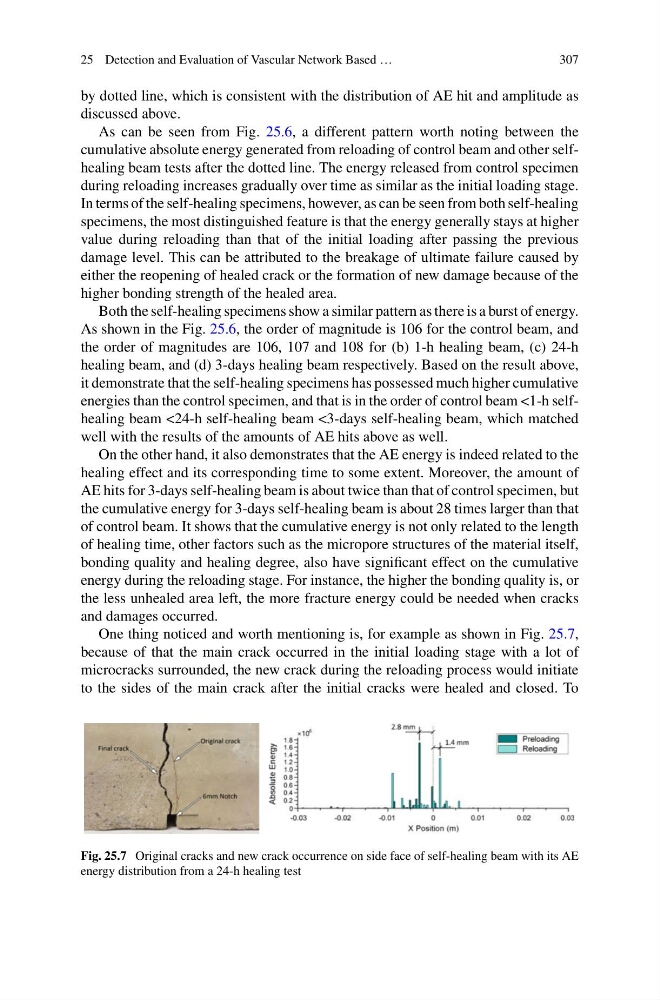
One thing noticed and worth mentioning is, for example as shown in Fig. 25.7,
because of that the main crack occurred in the initial loading stage with a lot of
microcracks surrounded, the new crack during the reloading process would initiate
to the sides of the main crack after the initial cracks were healed and closed. To
Fig. 25.7 Original cracks and new crack occurrence on side face of self-healing beam with its AE
energy distribution from a 24-h healing test
307
by dotted line, which is consistent with the distribution of AE hit and amplitude as
discussed above.
As can be seen from Fig. 25.6, a different pattern worth noting between the
cumulative absolute energy generated from reloading of control beam and other selfhealing beam tests after the dotted line. The energy released from control specimen
during reloading increases gradually over time as similar as the initial loading stage.
In terms of the self-healing specimens, however, as can be seen from both self-healing
specimens, the most distinguished feature is that the energy generally stays at higher
value during reloading than that of the initial loading after passing the previous
damage level. This can be attributed to the breakage of ultimate failure caused by
either the reopening of healed crack or the formation of new damage because of the
higher bonding strength of the healed area.
Both the self-healing specimens show a similar pattern as there is a burst of energy.
As shown in the Fig. 25.6, the order of magnitude is 106 for the control beam, and
the order of magnitudes are 106, 107 and 108 for (b) 1-h healing beam, (c) 24-h
healing beam, and (d) 3-days healing beam respectively. Based on the result above,
it demonstrate that the self-healing specimens has possessed much higher cumulative
energies than the control specimen, and that is in the order of control beam <1-h selfhealing beam <24-h self-healing beam <3-days self-healing beam, which matched
well with the results of the amounts of AE hits above as well.
On the other hand, it also demonstrates that the AE energy is indeed related to the
healing effect and its corresponding time to some extent. Moreover, the amount of
AE hits for 3-days self-healing beam is about twice than that of control specimen, but
the cumulative energy for 3-days self-healing beam is about 28 times larger than that
of control beam. It shows that the cumulative energy is not only related to the length
of healing time, other factors such as the micropore structures of the material itself,
bonding quality and healing degree, also have significant effect on the cumulative
energy during the reloading stage. For instance, the higher the bonding quality is, or
the less unhealed area left, the more fracture energy could be needed when cracks
and damages occurred.
One thing noticed and worth mentioning is, for example as shown in Fig. 25.7,
because of that the main crack occurred in the initial loading stage with a lot of
microcracks surrounded, the new crack during the reloading process would initiate
to the sides of the main crack after the initial cracks were healed and closed. To
Fig. 25.7 Original cracks and new crack occurrence on side face of self-healing beam with its AE
energy distribution from a 24-h healing test