

260
C. Ye et al.
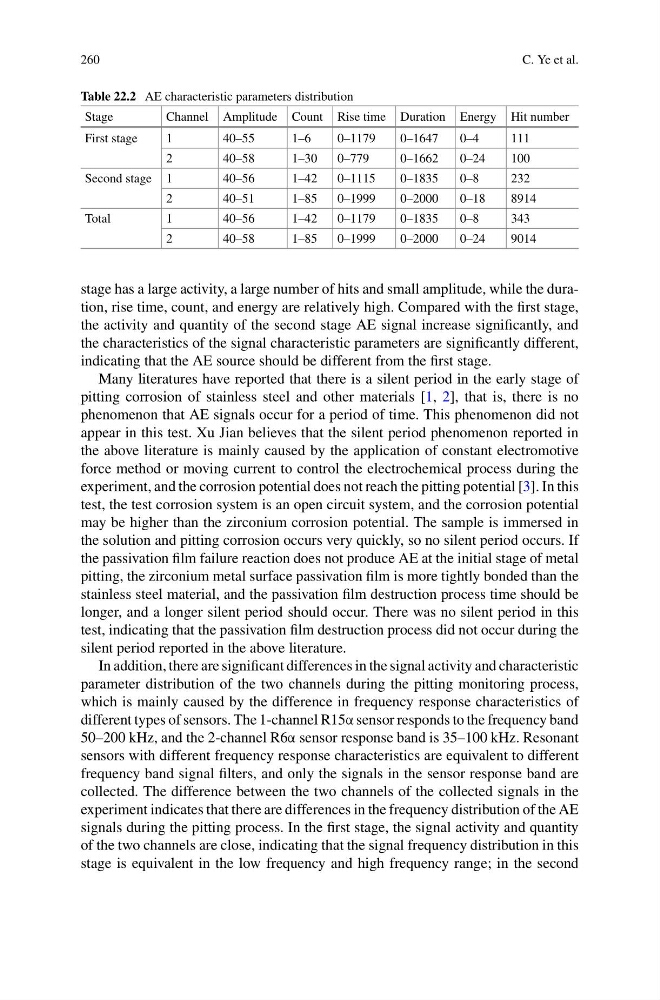
Table 22.2 AE characteristic parameters distribution
Stage
Channel Amplitude Count Rise time Duration Energy Hit number
First stage
1
40–55
1–6
0–1179
0–1647
0–4
111
2
40–58
1–30
0–779
0–1662
0–24
100
Second stage 1
40–56
1–42
0–1115
0–1835
0–8
232
2
40–51
1–85
0–1999
0–2000
0–18
8914
Total
1
40–56
1–42
0–1179
0–1835
0–8
343
2
40–58
1–85
0–1999
0–2000
0–24
9014
stage has a large activity, a large number of hits and small amplitude, while the duration, rise time, count, and energy are relatively high. Compared with the first stage,
the activity and quantity of the second stage AE signal increase significantly, and
the characteristics of the signal characteristic parameters are significantly different,
indicating that the AE source should be different from the first stage.
Many literatures have reported that there is a silent period in the early stage of
pitting corrosion of stainless steel and other materials [1, 2], that is, there is no
phenomenon that AE signals occur for a period of time. This phenomenon did not
appear in this test. Xu Jian believes that the silent period phenomenon reported in
the above literature is mainly caused by the application of constant electromotive
force method or moving current to control the electrochemical process during the
experiment, and the corrosion potential does not reach the pitting potential [3]. In this
test, the test corrosion system is an open circuit system, and the corrosion potential
may be higher than the zirconium corrosion potential. The sample is immersed in
the solution and pitting corrosion occurs very quickly, so no silent period occurs. If
the passivation film failure reaction does not produce AE at the initial stage of metal
pitting, the zirconium metal surface passivation film is more tightly bonded than the
stainless steel material, and the passivation film destruction process time should be
longer, and a longer silent period should occur. There was no silent period in this
test, indicating that the passivation film destruction process did not occur during the
silent period reported in the above literature.
In addition, there are significant differences in the signal activity and characteristic
parameter distribution of the two channels during the pitting monitoring process,
which is mainly caused by the difference in frequency response characteristics of
different types of sensors. The 1-channel R15α sensor responds to the frequency band
50–200 kHz, and the 2-channel R6α sensor response band is 35–100 kHz. Resonant
sensors with different frequency response characteristics are equivalent to different
frequency band signal filters, and only the signals in the sensor response band are
collected. The difference between the two channels of the collected signals in the
experiment indicates that there are differences in the frequency distribution of the AE
signals during the pitting process. In the first stage, the signal activity and quantity
of the two channels are close, indicating that the signal frequency distribution in this
stage is equivalent in the low frequency and high frequency range; in the second
C. Ye et al.
Table 22.2 AE characteristic parameters distribution
Stage
Channel Amplitude Count Rise time Duration Energy Hit number
First stage
1
40–55
1–6
0–1179
0–1647
0–4
111
2
40–58
1–30
0–779
0–1662
0–24
100
Second stage 1
40–56
1–42
0–1115
0–1835
0–8
232
2
40–51
1–85
0–1999
0–2000
0–18
8914
Total
1
40–56
1–42
0–1179
0–1835
0–8
343
2
40–58
1–85
0–1999
0–2000
0–24
9014
stage has a large activity, a large number of hits and small amplitude, while the duration, rise time, count, and energy are relatively high. Compared with the first stage,
the activity and quantity of the second stage AE signal increase significantly, and
the characteristics of the signal characteristic parameters are significantly different,
indicating that the AE source should be different from the first stage.
Many literatures have reported that there is a silent period in the early stage of
pitting corrosion of stainless steel and other materials [1, 2], that is, there is no
phenomenon that AE signals occur for a period of time. This phenomenon did not
appear in this test. Xu Jian believes that the silent period phenomenon reported in
the above literature is mainly caused by the application of constant electromotive
force method or moving current to control the electrochemical process during the
experiment, and the corrosion potential does not reach the pitting potential [3]. In this
test, the test corrosion system is an open circuit system, and the corrosion potential
may be higher than the zirconium corrosion potential. The sample is immersed in
the solution and pitting corrosion occurs very quickly, so no silent period occurs. If
the passivation film failure reaction does not produce AE at the initial stage of metal
pitting, the zirconium metal surface passivation film is more tightly bonded than the
stainless steel material, and the passivation film destruction process time should be
longer, and a longer silent period should occur. There was no silent period in this
test, indicating that the passivation film destruction process did not occur during the
silent period reported in the above literature.
In addition, there are significant differences in the signal activity and characteristic
parameter distribution of the two channels during the pitting monitoring process,
which is mainly caused by the difference in frequency response characteristics of
different types of sensors. The 1-channel R15α sensor responds to the frequency band
50–200 kHz, and the 2-channel R6α sensor response band is 35–100 kHz. Resonant
sensors with different frequency response characteristics are equivalent to different
frequency band signal filters, and only the signals in the sensor response band are
collected. The difference between the two channels of the collected signals in the
experiment indicates that there are differences in the frequency distribution of the AE
signals during the pitting process. In the first stage, the signal activity and quantity
of the two channels are close, indicating that the signal frequency distribution in this
stage is equivalent in the low frequency and high frequency range; in the second