

256
C. Ye et al.
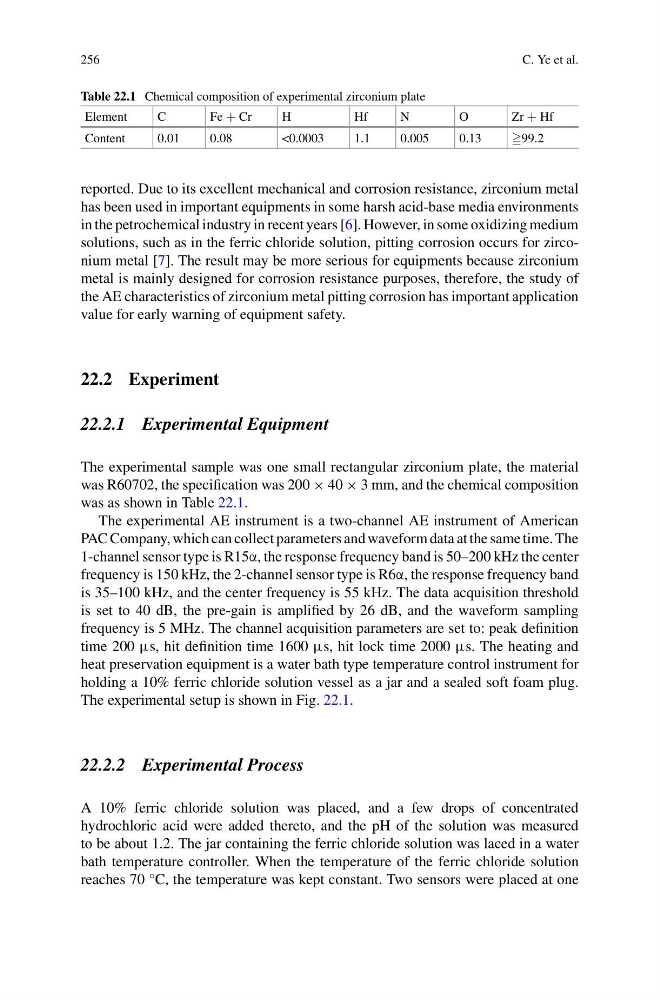
Table 22.1 Chemical composition of experimental zirconium plate
Element
C
Fe + Cr
H
Hf
N
O
Zr + Hf
Content
0.01
0.08
<0.0003
1.1
0.005
0.13
99.2
reported. Due to its excellent mechanical and corrosion resistance, zirconium metal
has been used in important equipments in some harsh acid-base media environments
in the petrochemical industry in recent years [6]. However, in some oxidizing medium
solutions, such as in the ferric chloride solution, pitting corrosion occurs for zirconium metal [7]. The result may be more serious for equipments because zirconium
metal is mainly designed for corrosion resistance purposes, therefore, the study of
the AE characteristics of zirconium metal pitting corrosion has important application
value for early warning of equipment safety.
22.2 Experiment
22.2.1 Experimental Equipment
The experimental sample was one small rectangular zirconium plate, the material
was R60702, the specification was 200 × 40 × 3 mm, and the chemical composition
was as shown in Table 22.1.
The experimental AE instrument is a two-channel AE instrument of American
PAC Company, which can collect parameters and waveform data at the same time. The
1-channel sensor type is R15α, the response frequency band is 50–200 kHz the center
frequency is 150 kHz, the 2-channel sensor type is R6α, the response frequency band
is 35–100 kHz, and the center frequency is 55 kHz. The data acquisition threshold
is set to 40 dB, the pre-gain is amplified by 26 dB, and the waveform sampling
frequency is 5 MHz. The channel acquisition parameters are set to: peak definition
time 200 μs, hit definition time 1600 μs, hit lock time 2000 μs. The heating and
heat preservation equipment is a water bath type temperature control instrument for
holding a 10% ferric chloride solution vessel as a jar and a sealed soft foam plug.
The experimental setup is shown in Fig. 22.1.
22.2.2 Experimental Process
A 10% ferric chloride solution was placed, and a few drops of concentrated
hydrochloric acid were added thereto, and the pH of the solution was measured
to be about 1.2. The jar containing the ferric chloride solution was laced in a water
bath temperature controller. When the temperature of the ferric chloride solution
reaches 70 °C, the temperature was kept constant. Two sensors were placed at one
C. Ye et al.
Table 22.1 Chemical composition of experimental zirconium plate
Element
C
Fe + Cr
H
Hf
N
O
Zr + Hf
Content
0.01
0.08
<0.0003
1.1
0.005
0.13
99.2
reported. Due to its excellent mechanical and corrosion resistance, zirconium metal
has been used in important equipments in some harsh acid-base media environments
in the petrochemical industry in recent years [6]. However, in some oxidizing medium
solutions, such as in the ferric chloride solution, pitting corrosion occurs for zirconium metal [7]. The result may be more serious for equipments because zirconium
metal is mainly designed for corrosion resistance purposes, therefore, the study of
the AE characteristics of zirconium metal pitting corrosion has important application
value for early warning of equipment safety.
22.2 Experiment
22.2.1 Experimental Equipment
The experimental sample was one small rectangular zirconium plate, the material
was R60702, the specification was 200 × 40 × 3 mm, and the chemical composition
was as shown in Table 22.1.
The experimental AE instrument is a two-channel AE instrument of American
PAC Company, which can collect parameters and waveform data at the same time. The
1-channel sensor type is R15α, the response frequency band is 50–200 kHz the center
frequency is 150 kHz, the 2-channel sensor type is R6α, the response frequency band
is 35–100 kHz, and the center frequency is 55 kHz. The data acquisition threshold
is set to 40 dB, the pre-gain is amplified by 26 dB, and the waveform sampling
frequency is 5 MHz. The channel acquisition parameters are set to: peak definition
time 200 μs, hit definition time 1600 μs, hit lock time 2000 μs. The heating and
heat preservation equipment is a water bath type temperature control instrument for
holding a 10% ferric chloride solution vessel as a jar and a sealed soft foam plug.
The experimental setup is shown in Fig. 22.1.
22.2.2 Experimental Process
A 10% ferric chloride solution was placed, and a few drops of concentrated
hydrochloric acid were added thereto, and the pH of the solution was measured
to be about 1.2. The jar containing the ferric chloride solution was laced in a water
bath temperature controller. When the temperature of the ferric chloride solution
reaches 70 °C, the temperature was kept constant. Two sensors were placed at one