

21 High-Temperature Creep Damage Evolution of C/SiC …
251
(a) SEM of long sample
(b) SEM of short sample
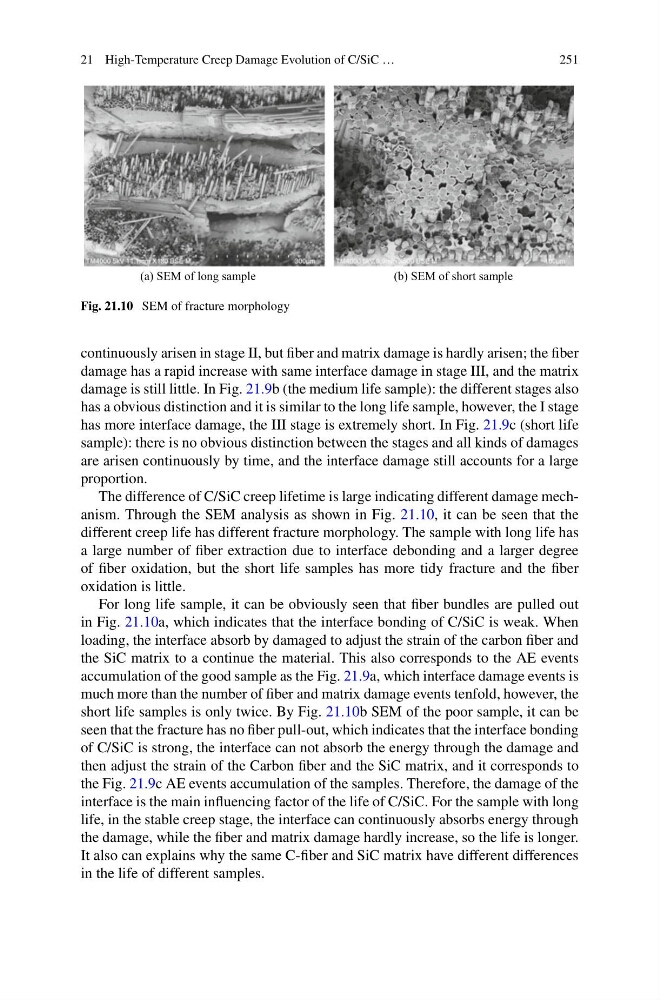
Fig. 21.10 SEM of fracture morphology
continuously arisen in stage II, but fiber and matrix damage is hardly arisen; the fiber
damage has a rapid increase with same interface damage in stage III, and the matrix
damage is still little. In Fig. 21.9b (the medium life sample): the different stages also
has a obvious distinction and it is similar to the long life sample, however, the I stage
has more interface damage, the III stage is extremely short. In Fig. 21.9c (short life
sample): there is no obvious distinction between the stages and all kinds of damages
are arisen continuously by time, and the interface damage still accounts for a large
proportion.
The difference of C/SiC creep lifetime is large indicating different damage mechanism. Through the SEM analysis as shown in Fig. 21.10, it can be seen that the
different creep life has different fracture morphology. The sample with long life has
a large number of fiber extraction due to interface debonding and a larger degree
of fiber oxidation, but the short life samples has more tidy fracture and the fiber
oxidation is little.
For long life sample, it can be obviously seen that fiber bundles are pulled out
in Fig. 21.10a, which indicates that the interface bonding of C/SiC is weak. When
loading, the interface absorb by damaged to adjust the strain of the carbon fiber and
the SiC matrix to a continue the material. This also corresponds to the AE events
accumulation of the good sample as the Fig. 21.9a, which interface damage events is
much more than the number of fiber and matrix damage events tenfold, however, the
short life samples is only twice. By Fig. 21.10b SEM of the poor sample, it can be
seen that the fracture has no fiber pull-out, which indicates that the interface bonding
of C/SiC is strong, the interface can not absorb the energy through the damage and
then adjust the strain of the Carbon fiber and the SiC matrix, and it corresponds to
the Fig. 21.9c AE events accumulation of the samples. Therefore, the damage of the
interface is the main influencing factor of the life of C/SiC. For the sample with long
life, in the stable creep stage, the interface can continuously absorbs energy through
the damage, while the fiber and matrix damage hardly increase, so the life is longer.
It also can explains why the same C-fiber and SiC matrix have different differences
in the life of different samples.
251
(a) SEM of long sample
(b) SEM of short sample
Fig. 21.10 SEM of fracture morphology
continuously arisen in stage II, but fiber and matrix damage is hardly arisen; the fiber
damage has a rapid increase with same interface damage in stage III, and the matrix
damage is still little. In Fig. 21.9b (the medium life sample): the different stages also
has a obvious distinction and it is similar to the long life sample, however, the I stage
has more interface damage, the III stage is extremely short. In Fig. 21.9c (short life
sample): there is no obvious distinction between the stages and all kinds of damages
are arisen continuously by time, and the interface damage still accounts for a large
proportion.
The difference of C/SiC creep lifetime is large indicating different damage mechanism. Through the SEM analysis as shown in Fig. 21.10, it can be seen that the
different creep life has different fracture morphology. The sample with long life has
a large number of fiber extraction due to interface debonding and a larger degree
of fiber oxidation, but the short life samples has more tidy fracture and the fiber
oxidation is little.
For long life sample, it can be obviously seen that fiber bundles are pulled out
in Fig. 21.10a, which indicates that the interface bonding of C/SiC is weak. When
loading, the interface absorb by damaged to adjust the strain of the carbon fiber and
the SiC matrix to a continue the material. This also corresponds to the AE events
accumulation of the good sample as the Fig. 21.9a, which interface damage events is
much more than the number of fiber and matrix damage events tenfold, however, the
short life samples is only twice. By Fig. 21.10b SEM of the poor sample, it can be
seen that the fracture has no fiber pull-out, which indicates that the interface bonding
of C/SiC is strong, the interface can not absorb the energy through the damage and
then adjust the strain of the Carbon fiber and the SiC matrix, and it corresponds to
the Fig. 21.9c AE events accumulation of the samples. Therefore, the damage of the
interface is the main influencing factor of the life of C/SiC. For the sample with long
life, in the stable creep stage, the interface can continuously absorbs energy through
the damage, while the fiber and matrix damage hardly increase, so the life is longer.
It also can explains why the same C-fiber and SiC matrix have different differences
in the life of different samples.