

250
G. Bai et al.
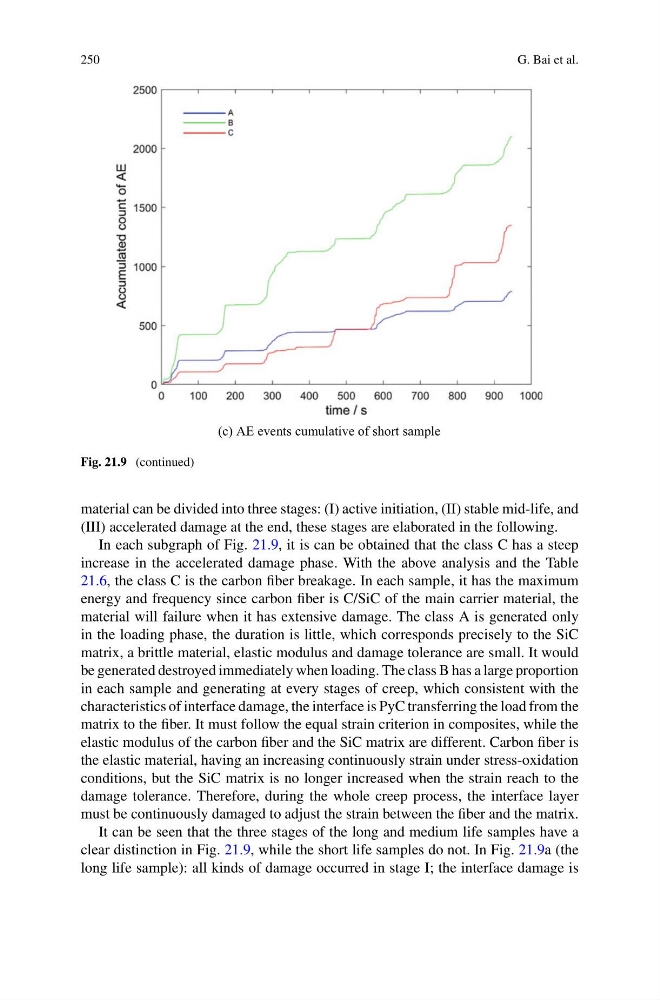
(c) AE events cumulative of short sample
Fig. 21.9 (continued)
material can be divided into three stages: (I) active initiation, (II) stable mid-life, and
(III) accelerated damage at the end, these stages are elaborated in the following.
In each subgraph of Fig. 21.9, it is can be obtained that the class C has a steep
increase in the accelerated damage phase. With the above analysis and the Table
21.6, the class C is the carbon fiber breakage. In each sample, it has the maximum
energy and frequency since carbon fiber is C/SiC of the main carrier material, the
material will failure when it has extensive damage. The class A is generated only
in the loading phase, the duration is little, which corresponds precisely to the SiC
matrix, a brittle material, elastic modulus and damage tolerance are small. It would
be generated destroyed immediately when loading. The class B has a large proportion
in each sample and generating at every stages of creep, which consistent with the
characteristics of interface damage, the interface is PyC transferring the load from the
matrix to the fiber. It must follow the equal strain criterion in composites, while the
elastic modulus of the carbon fiber and the SiC matrix are different. Carbon fiber is
the elastic material, having an increasing continuously strain under stress-oxidation
conditions, but the SiC matrix is no longer increased when the strain reach to the
damage tolerance. Therefore, during the whole creep process, the interface layer
must be continuously damaged to adjust the strain between the fiber and the matrix.
It can be seen that the three stages of the long and medium life samples have a
clear distinction in Fig. 21.9, while the short life samples do not. In Fig. 21.9a (the
long life sample): all kinds of damage occurred in stage I; the interface damage is
G. Bai et al.
(c) AE events cumulative of short sample
Fig. 21.9 (continued)
material can be divided into three stages: (I) active initiation, (II) stable mid-life, and
(III) accelerated damage at the end, these stages are elaborated in the following.
In each subgraph of Fig. 21.9, it is can be obtained that the class C has a steep
increase in the accelerated damage phase. With the above analysis and the Table
21.6, the class C is the carbon fiber breakage. In each sample, it has the maximum
energy and frequency since carbon fiber is C/SiC of the main carrier material, the
material will failure when it has extensive damage. The class A is generated only
in the loading phase, the duration is little, which corresponds precisely to the SiC
matrix, a brittle material, elastic modulus and damage tolerance are small. It would
be generated destroyed immediately when loading. The class B has a large proportion
in each sample and generating at every stages of creep, which consistent with the
characteristics of interface damage, the interface is PyC transferring the load from the
matrix to the fiber. It must follow the equal strain criterion in composites, while the
elastic modulus of the carbon fiber and the SiC matrix are different. Carbon fiber is
the elastic material, having an increasing continuously strain under stress-oxidation
conditions, but the SiC matrix is no longer increased when the strain reach to the
damage tolerance. Therefore, during the whole creep process, the interface layer
must be continuously damaged to adjust the strain between the fiber and the matrix.
It can be seen that the three stages of the long and medium life samples have a
clear distinction in Fig. 21.9, while the short life samples do not. In Fig. 21.9a (the
long life sample): all kinds of damage occurred in stage I; the interface damage is