

240
G. Bai et al.
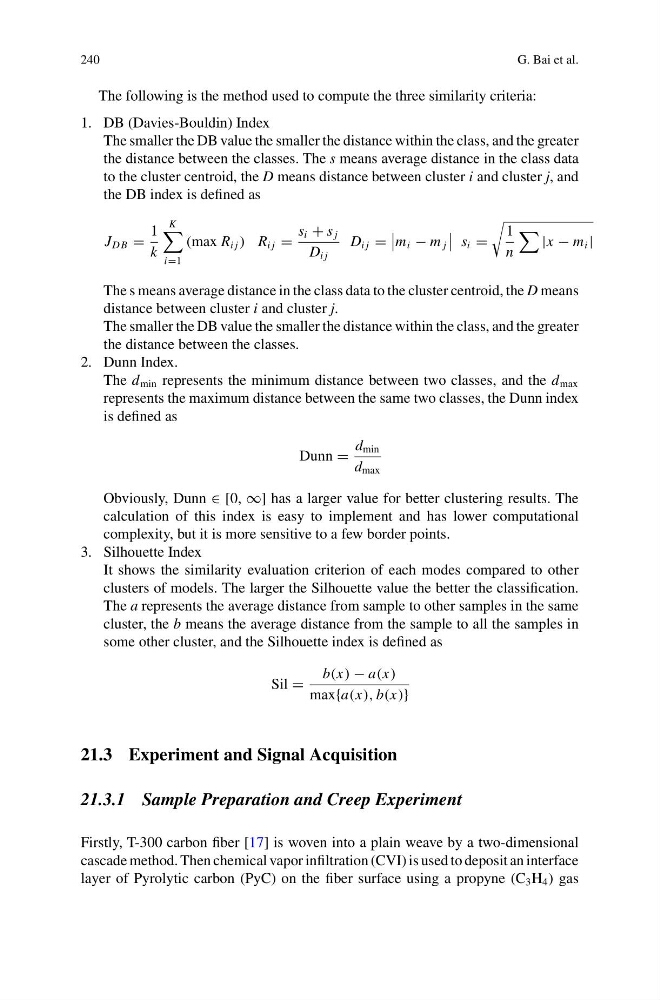
The following is the method used to compute the three similarity criteria:
1. DB (Davies-Bouldin) Index
The smaller the DB value the smaller the distance within the class, and the greater
the distance between the classes. The s means average distance in the class data
to the cluster centroid, the D means distance between cluster i and cluster j, and
the DB index is defined as
J D B =
1
k
K
i=1
(max R i j ) R i j =
s i + s j
D i j
D i j =
m i − m j
s i =
1
n
|x − m i |
The s means average distance in the class data to the cluster centroid, the D means
distance between cluster i and cluster j.
The smaller the DB value the smaller the distance within the class, and the greater
the distance between the classes.
2. Dunn Index.
The d min represents the minimum distance between two classes, and the d max
represents the maximum distance between the same two classes, the Dunn index
is defined as
Dunn =
d min
d max
Obviously, Dunn ∈ [0, ∞] has a larger value for better clustering results. The
calculation of this index is easy to implement and has lower computational
complexity, but it is more sensitive to a few border points.
3. Silhouette Index
It shows the similarity evaluation criterion of each modes compared to other
clusters of models. The larger the Silhouette value the better the classification.
The a represents the average distance from sample to other samples in the same
cluster, the b means the average distance from the sample to all the samples in
some other cluster, and the Silhouette index is defined as
Sil =
b(x) − a(x)
max{a(x), b(x)}
21.3 Experiment and Signal Acquisition
21.3.1 Sample Preparation and Creep Experiment
Firstly, T-300 carbon fiber [17] is woven into a plain weave by a two-dimensional
cascade method. Then chemical vapor infiltration (CVI) is used to deposit an interface
layer of Pyrolytic carbon (PyC) on the fiber surface using a propyne (C 3 H 4 ) gas
G. Bai et al.
The following is the method used to compute the three similarity criteria:
1. DB (Davies-Bouldin) Index
The smaller the DB value the smaller the distance within the class, and the greater
the distance between the classes. The s means average distance in the class data
to the cluster centroid, the D means distance between cluster i and cluster j, and
the DB index is defined as
J D B =
1
k
K
i=1
(max R i j ) R i j =
s i + s j
D i j
D i j =
m i − m j
s i =
1
n
|x − m i |
The s means average distance in the class data to the cluster centroid, the D means
distance between cluster i and cluster j.
The smaller the DB value the smaller the distance within the class, and the greater
the distance between the classes.
2. Dunn Index.
The d min represents the minimum distance between two classes, and the d max
represents the maximum distance between the same two classes, the Dunn index
is defined as
Dunn =
d min
d max
Obviously, Dunn ∈ [0, ∞] has a larger value for better clustering results. The
calculation of this index is easy to implement and has lower computational
complexity, but it is more sensitive to a few border points.
3. Silhouette Index
It shows the similarity evaluation criterion of each modes compared to other
clusters of models. The larger the Silhouette value the better the classification.
The a represents the average distance from sample to other samples in the same
cluster, the b means the average distance from the sample to all the samples in
some other cluster, and the Silhouette index is defined as
Sil =
b(x) − a(x)
max{a(x), b(x)}
21.3 Experiment and Signal Acquisition
21.3.1 Sample Preparation and Creep Experiment
Firstly, T-300 carbon fiber [17] is woven into a plain weave by a two-dimensional
cascade method. Then chemical vapor infiltration (CVI) is used to deposit an interface
layer of Pyrolytic carbon (PyC) on the fiber surface using a propyne (C 3 H 4 ) gas