

224
H. Luo et al.
materials. Therefore, it is very important to find fiber fracture by means of detection
for safety evaluation of these large volume cylinders.
A number of researches have been reported about damage of glass fiber reinforced plastics detected via acoustic emission method. Researches by Fotouhi et al.
[1, 2] showed that the fiber breaking frequency ranges from 350 to 450 kHz in the
test of glass fiber/epoxy resin material. Nevertheless, Studies carried out by Pashmforoush et al. [3] showed that fiber breaking frequency ranges from 350 to 450 kHz
in the test of glass fiber/epoxy resin material. Godin et al. [4] found that the fiber
breaking signal has long duration and high amplitude according to the study of glass
fiber/polyester material. Li et al. [5] carried out tensile test on glass fiber/epoxy ethylene resin material, and obtained that the fiber breaking signal frequency >150 kHz,
and the amplitude was 0–80 dB. Therefore, the conclusions of current studies are
quite different, and it is difficult to give guidance for the detection of cylinders.
20.2 Experiments
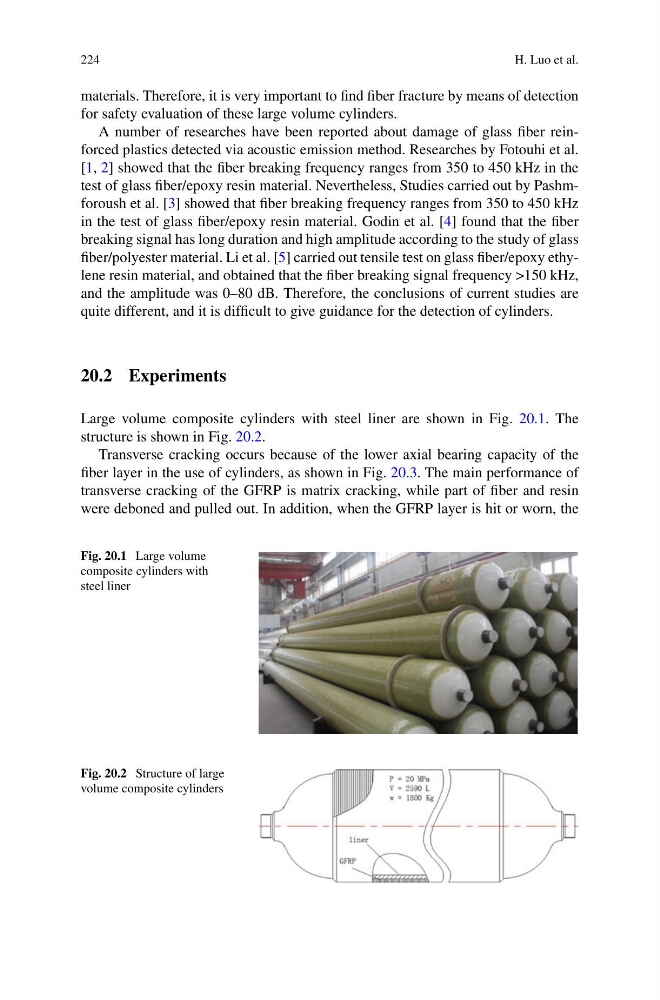
Large volume composite cylinders with steel liner are shown in Fig. 20.1. The
structure is shown in Fig. 20.2.
Transverse cracking occurs because of the lower axial bearing capacity of the
fiber layer in the use of cylinders, as shown in Fig. 20.3. The main performance of
transverse cracking of the GFRP is matrix cracking, while part of fiber and resin
were deboned and pulled out. In addition, when the GFRP layer is hit or worn, the
Fig. 20.1 Large volume
composite cylinders with
steel liner
Fig. 20.2 Structure of large
volume composite cylinders
H. Luo et al.
materials. Therefore, it is very important to find fiber fracture by means of detection
for safety evaluation of these large volume cylinders.
A number of researches have been reported about damage of glass fiber reinforced plastics detected via acoustic emission method. Researches by Fotouhi et al.
[1, 2] showed that the fiber breaking frequency ranges from 350 to 450 kHz in the
test of glass fiber/epoxy resin material. Nevertheless, Studies carried out by Pashmforoush et al. [3] showed that fiber breaking frequency ranges from 350 to 450 kHz
in the test of glass fiber/epoxy resin material. Godin et al. [4] found that the fiber
breaking signal has long duration and high amplitude according to the study of glass
fiber/polyester material. Li et al. [5] carried out tensile test on glass fiber/epoxy ethylene resin material, and obtained that the fiber breaking signal frequency >150 kHz,
and the amplitude was 0–80 dB. Therefore, the conclusions of current studies are
quite different, and it is difficult to give guidance for the detection of cylinders.
20.2 Experiments
Large volume composite cylinders with steel liner are shown in Fig. 20.1. The
structure is shown in Fig. 20.2.
Transverse cracking occurs because of the lower axial bearing capacity of the
fiber layer in the use of cylinders, as shown in Fig. 20.3. The main performance of
transverse cracking of the GFRP is matrix cracking, while part of fiber and resin
were deboned and pulled out. In addition, when the GFRP layer is hit or worn, the
Fig. 20.1 Large volume
composite cylinders with
steel liner
Fig. 20.2 Structure of large
volume composite cylinders