

19 Fatigue Crack Growth of TC4 Titanium Alloy …
219
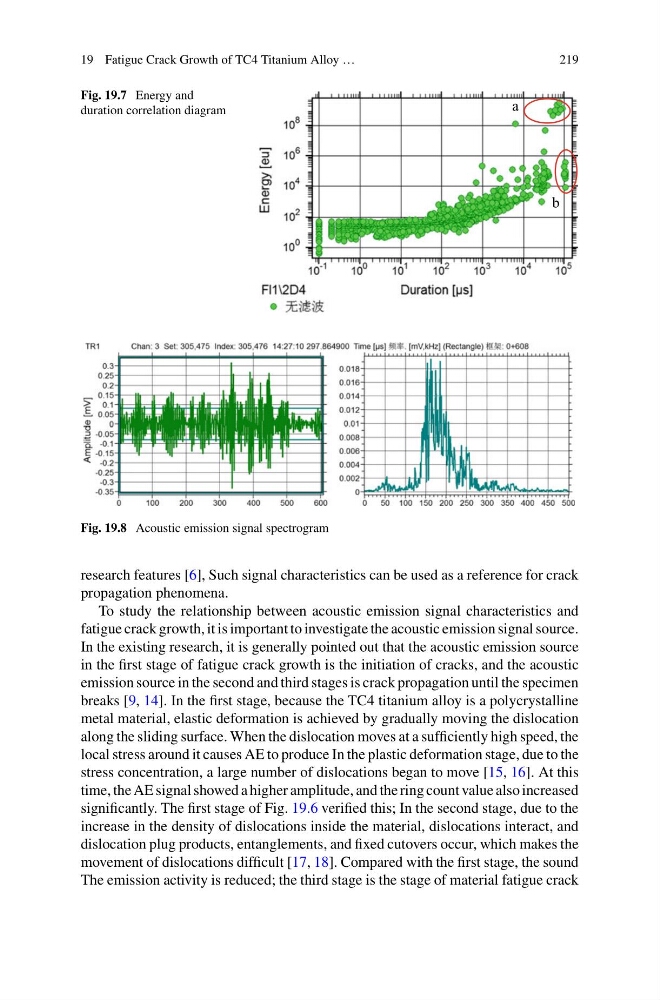
Fig. 19.7 Energy and
duration correlation diagram
a
b
Fig. 19.8 Acoustic emission signal spectrogram
research features [6], Such signal characteristics can be used as a reference for crack
propagation phenomena.
To study the relationship between acoustic emission signal characteristics and
fatigue crack growth, it is important to investigate the acoustic emission signal source.
In the existing research, it is generally pointed out that the acoustic emission source
in the first stage of fatigue crack growth is the initiation of cracks, and the acoustic
emission source in the second and third stages is crack propagation until the specimen
breaks [9, 14]. In the first stage, because the TC4 titanium alloy is a polycrystalline
metal material, elastic deformation is achieved by gradually moving the dislocation
along the sliding surface. When the dislocation moves at a sufficiently high speed, the
local stress around it causes AE to produce In the plastic deformation stage, due to the
stress concentration, a large number of dislocations began to move [15, 16]. At this
time, the AE signal showed a higher amplitude, and the ring count value also increased
significantly. The first stage of Fig. 19.6 verified this; In the second stage, due to the
increase in the density of dislocations inside the material, dislocations interact, and
dislocation plug products, entanglements, and fixed cutovers occur, which makes the
movement of dislocations difficult [17, 18]. Compared with the first stage, the sound
The emission activity is reduced; the third stage is the stage of material fatigue crack
219
Fig. 19.7 Energy and
duration correlation diagram
a
b
Fig. 19.8 Acoustic emission signal spectrogram
research features [6], Such signal characteristics can be used as a reference for crack
propagation phenomena.
To study the relationship between acoustic emission signal characteristics and
fatigue crack growth, it is important to investigate the acoustic emission signal source.
In the existing research, it is generally pointed out that the acoustic emission source
in the first stage of fatigue crack growth is the initiation of cracks, and the acoustic
emission source in the second and third stages is crack propagation until the specimen
breaks [9, 14]. In the first stage, because the TC4 titanium alloy is a polycrystalline
metal material, elastic deformation is achieved by gradually moving the dislocation
along the sliding surface. When the dislocation moves at a sufficiently high speed, the
local stress around it causes AE to produce In the plastic deformation stage, due to the
stress concentration, a large number of dislocations began to move [15, 16]. At this
time, the AE signal showed a higher amplitude, and the ring count value also increased
significantly. The first stage of Fig. 19.6 verified this; In the second stage, due to the
increase in the density of dislocations inside the material, dislocations interact, and
dislocation plug products, entanglements, and fixed cutovers occur, which makes the
movement of dislocations difficult [17, 18]. Compared with the first stage, the sound
The emission activity is reduced; the third stage is the stage of material fatigue crack