

19 Fatigue Crack Growth of TC4 Titanium Alloy …
215
Table 19.1 Chemical composition of TC4 (wt%)
Main element
Alloying element content
Impurity element content
Ti
Al
V
Fe
Si
C
N
H
O
margin
5.5–6.8
3.5–4.5
0.30
0.10
0.10
0.05
0.015
0.015
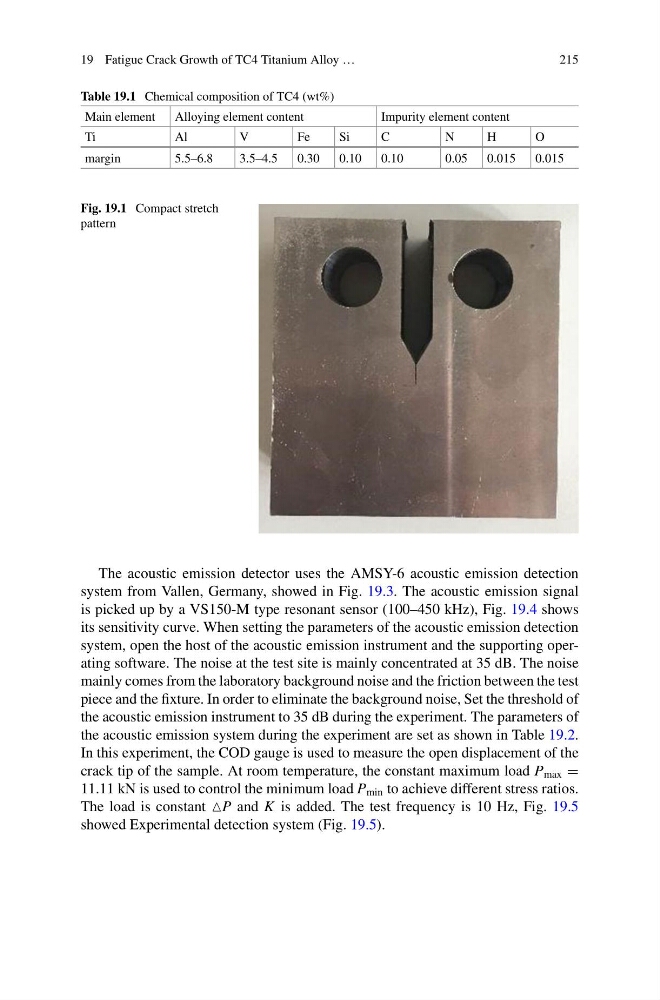
Fig. 19.1 Compact stretch
pattern
The acoustic emission detector uses the AMSY-6 acoustic emission detection
system from Vallen, Germany, showed in Fig. 19.3. The acoustic emission signal
is picked up by a VS150-M type resonant sensor (100–450 kHz), Fig. 19.4 shows
its sensitivity curve. When setting the parameters of the acoustic emission detection
system, open the host of the acoustic emission instrument and the supporting operating software. The noise at the test site is mainly concentrated at 35 dB. The noise
mainly comes from the laboratory background noise and the friction between the test
piece and the fixture. In order to eliminate the background noise, Set the threshold of
the acoustic emission instrument to 35 dB during the experiment. The parameters of
the acoustic emission system during the experiment are set as shown in Table 19.2.
In this experiment, the COD gauge is used to measure the open displacement of the
crack tip of the sample. At room temperature, the constant maximum load P max =
11.11 kN is used to control the minimum load P min to achieve different stress ratios.
The load is constant P and K is added. The test frequency is 10 Hz, Fig. 19.5
showed Experimental detection system (Fig. 19.5).
215
Table 19.1 Chemical composition of TC4 (wt%)
Main element
Alloying element content
Impurity element content
Ti
Al
V
Fe
Si
C
N
H
O
margin
5.5–6.8
3.5–4.5
0.30
0.10
0.10
0.05
0.015
0.015
Fig. 19.1 Compact stretch
pattern
The acoustic emission detector uses the AMSY-6 acoustic emission detection
system from Vallen, Germany, showed in Fig. 19.3. The acoustic emission signal
is picked up by a VS150-M type resonant sensor (100–450 kHz), Fig. 19.4 shows
its sensitivity curve. When setting the parameters of the acoustic emission detection
system, open the host of the acoustic emission instrument and the supporting operating software. The noise at the test site is mainly concentrated at 35 dB. The noise
mainly comes from the laboratory background noise and the friction between the test
piece and the fixture. In order to eliminate the background noise, Set the threshold of
the acoustic emission instrument to 35 dB during the experiment. The parameters of
the acoustic emission system during the experiment are set as shown in Table 19.2.
In this experiment, the COD gauge is used to measure the open displacement of the
crack tip of the sample. At room temperature, the constant maximum load P max =
11.11 kN is used to control the minimum load P min to achieve different stress ratios.
The load is constant P and K is added. The test frequency is 10 Hz, Fig. 19.5
showed Experimental detection system (Fig. 19.5).