

202
W. Zhou et al.
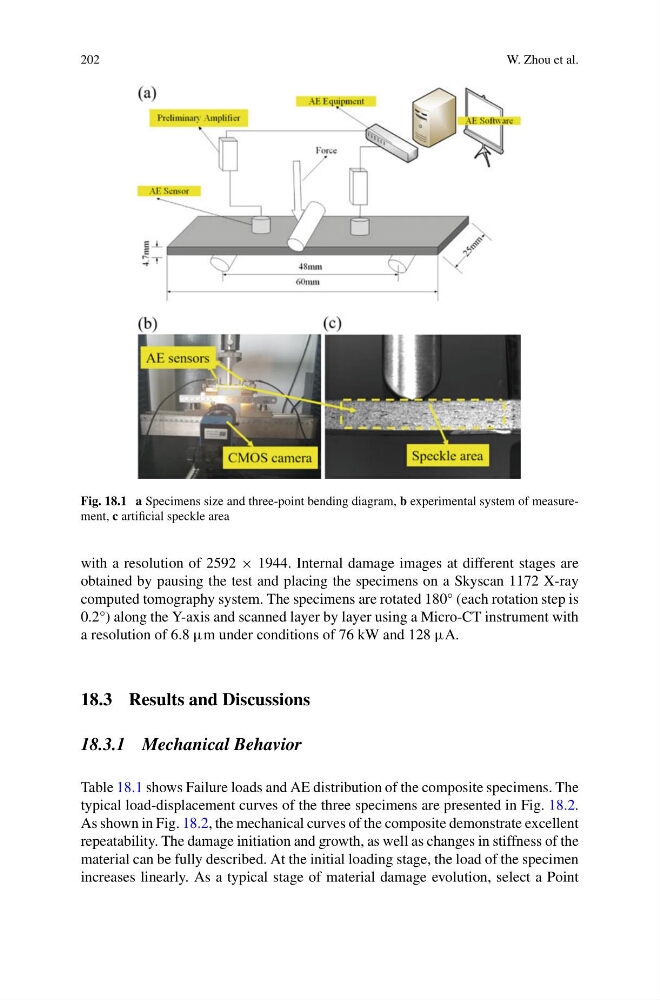
Fig. 18.1 a Specimens size and three-point bending diagram, b experimental system of measurement, c artificial speckle area
with a resolution of 2592 × 1944. Internal damage images at different stages are
obtained by pausing the test and placing the specimens on a Skyscan 1172 X-ray
computed tomography system. The specimens are rotated 180° (each rotation step is
0.2°) along the Y-axis and scanned layer by layer using a Micro-CT instrument with
a resolution of 6.8 µm under conditions of 76 kW and 128 µA.
18.3 Results and Discussions
18.3.1 Mechanical Behavior
Table 18.1 shows Failure loads and AE distribution of the composite specimens. The
typical load-displacement curves of the three specimens are presented in Fig. 18.2.
As shown in Fig. 18.2, the mechanical curves of the composite demonstrate excellent
repeatability. The damage initiation and growth, as well as changes in stiffness of the
material can be fully described. At the initial loading stage, the load of the specimen
increases linearly. As a typical stage of material damage evolution, select a Point
W. Zhou et al.
Fig. 18.1 a Specimens size and three-point bending diagram, b experimental system of measurement, c artificial speckle area
with a resolution of 2592 × 1944. Internal damage images at different stages are
obtained by pausing the test and placing the specimens on a Skyscan 1172 X-ray
computed tomography system. The specimens are rotated 180° (each rotation step is
0.2°) along the Y-axis and scanned layer by layer using a Micro-CT instrument with
a resolution of 6.8 µm under conditions of 76 kW and 128 µA.
18.3 Results and Discussions
18.3.1 Mechanical Behavior
Table 18.1 shows Failure loads and AE distribution of the composite specimens. The
typical load-displacement curves of the three specimens are presented in Fig. 18.2.
As shown in Fig. 18.2, the mechanical curves of the composite demonstrate excellent
repeatability. The damage initiation and growth, as well as changes in stiffness of the
material can be fully described. At the initial loading stage, the load of the specimen
increases linearly. As a typical stage of material damage evolution, select a Point