

9 Burst Analysis for Multi-Level Leakage Detection in Water-Filled Pipeline …
99
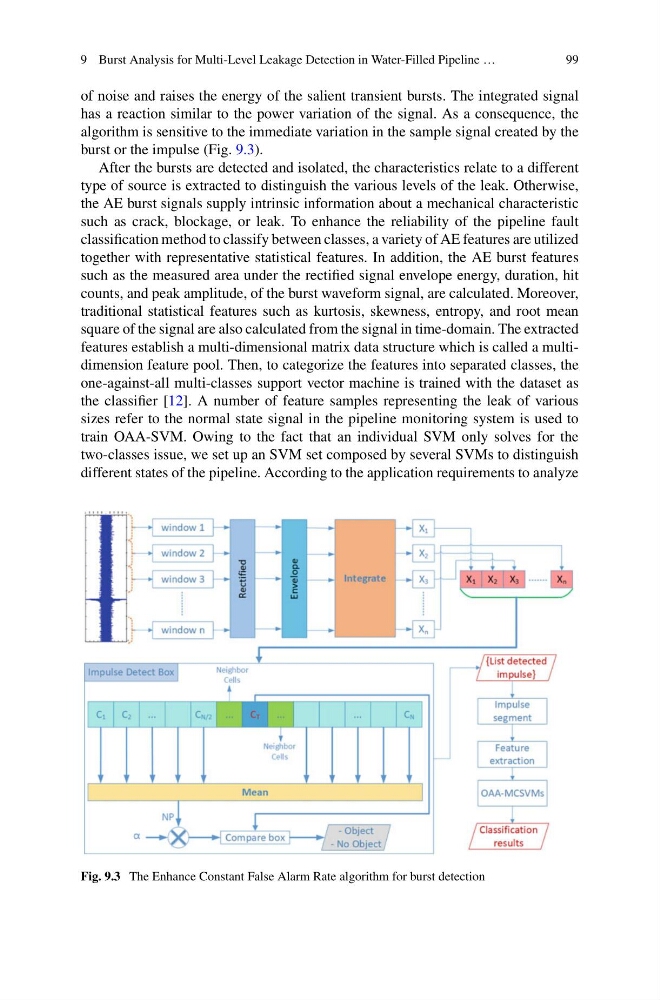
of noise and raises the energy of the salient transient bursts. The integrated signal
has a reaction similar to the power variation of the signal. As a consequence, the
algorithm is sensitive to the immediate variation in the sample signal created by the
burst or the impulse (Fig. 9.3).
After the bursts are detected and isolated, the characteristics relate to a different
type of source is extracted to distinguish the various levels of the leak. Otherwise,
the AE burst signals supply intrinsic information about a mechanical characteristic
such as crack, blockage, or leak. To enhance the reliability of the pipeline fault
classification method to classify between classes, a variety of AE features are utilized
together with representative statistical features. In addition, the AE burst features
such as the measured area under the rectified signal envelope energy, duration, hit
counts, and peak amplitude, of the burst waveform signal, are calculated. Moreover,
traditional statistical features such as kurtosis, skewness, entropy, and root mean
square of the signal are also calculated from the signal in time-domain. The extracted
features establish a multi-dimensional matrix data structure which is called a multidimension feature pool. Then, to categorize the features into separated classes, the
one-against-all multi-classes support vector machine is trained with the dataset as
the classifier [12]. A number of feature samples representing the leak of various
sizes refer to the normal state signal in the pipeline monitoring system is used to
train OAA-SVM. Owing to the fact that an individual SVM only solves for the
two-classes issue, we set up an SVM set composed by several SVMs to distinguish
different states of the pipeline. According to the application requirements to analyze
Fig. 9.3 The Enhance Constant False Alarm Rate algorithm for burst detection
99
of noise and raises the energy of the salient transient bursts. The integrated signal
has a reaction similar to the power variation of the signal. As a consequence, the
algorithm is sensitive to the immediate variation in the sample signal created by the
burst or the impulse (Fig. 9.3).
After the bursts are detected and isolated, the characteristics relate to a different
type of source is extracted to distinguish the various levels of the leak. Otherwise,
the AE burst signals supply intrinsic information about a mechanical characteristic
such as crack, blockage, or leak. To enhance the reliability of the pipeline fault
classification method to classify between classes, a variety of AE features are utilized
together with representative statistical features. In addition, the AE burst features
such as the measured area under the rectified signal envelope energy, duration, hit
counts, and peak amplitude, of the burst waveform signal, are calculated. Moreover,
traditional statistical features such as kurtosis, skewness, entropy, and root mean
square of the signal are also calculated from the signal in time-domain. The extracted
features establish a multi-dimensional matrix data structure which is called a multidimension feature pool. Then, to categorize the features into separated classes, the
one-against-all multi-classes support vector machine is trained with the dataset as
the classifier [12]. A number of feature samples representing the leak of various
sizes refer to the normal state signal in the pipeline monitoring system is used to
train OAA-SVM. Owing to the fact that an individual SVM only solves for the
two-classes issue, we set up an SVM set composed by several SVMs to distinguish
different states of the pipeline. According to the application requirements to analyze
Fig. 9.3 The Enhance Constant False Alarm Rate algorithm for burst detection